Ttimeline of web development details the essential stages from concept to launch, helping you plan effectively. Understanding this roadmap is crucial for businesses seeking efficient website development services, ensuring realistic expectations and successful project completion. This guide breaks down key factors, phased approaches, and strategic timelines for various website types.Understanding the web development timelineA clear web development timeline serves as a project’s essential roadmap. It manages expectations, resources, and ensures successful delivery. This understanding is especially critical when engaging expert website development services. This guide details typical phases, their significance, and who benefits from this knowledge.
Why a clear timeline is crucial for success
A well-defined web development timeline sets clear expectations for all stakeholders. It outlines deliverables and completion dates. This clarity helps prevent scope creep, a common issue that can derail budgets and schedules. Indeed, around 89% of B2B website development projects experience scope changes during development. A structured timeline mitigates this by establishing defined phases and approval points. It also ensures efficient resource allocation and proactive risk management. This leads to smoother execution and a higher chance of achieving project goals on time and within budget.
Defining the “timeline of web development”
The “timeline of web development” estimates the duration and task sequence for building a website. This includes design, development, testing, and launch. It’s a flexible framework, not a rigid schedule. The timeline typically covers distinct phases. These range from initial discovery and planning to design, development, testing, and deployment. Each phase has specific objectives and deliverables. Understanding this sequence helps teams anticipate dependencies and potential bottlenecks.
Who needs to understand this timeline?
Various roles require a clear grasp of the web development timeline. Project managers and web leads use it for resource planning and progress tracking. Product managers align development with business goals and market launch strategies. Heads of Digital and Growth leaders forecast its impact on marketing campaigns and user acquisition. Clients and stakeholders also benefit immensely. The timeline fosters transparency and allows them to anticipate key milestones. It also enables timely feedback. Ultimately, everyone involved in a web project needs to understand the timeline for collaborative success.
Key factors influencing development speed
Several critical elements directly impact how long a web development project takes. Understanding these factors is essential for setting realistic expectations and planning effectively.
Project scope and complexity
The sheer size and intricacy of a project are primary drivers of its timeline. A project with a well-defined, limited scope and straightforward functionality will naturally progress faster than one with extensive features, complex integrations, or advanced custom logic. For instance, building a simple brochure website with a few static pages requires significantly less time than developing a custom enterprise resource planning (ERP) system. Scope creep, where new requirements are added mid-project, is a major threat. According to WebFX data, approximately 89% of business website development projects experience scope changes, directly affecting delivery times.
Website type and purpose
Different types of websites have inherently different development requirements. A small business informational site, often 5-10 pages, might take 2-6 weeks. A marketing website with a content management system (CMS) and 10-25 pages typically requires 6-10 weeks. E-commerce platforms, with their complex product catalogs, payment gateways, and user accounts, can range from 6-12 weeks. Finally, large-scale enterprise platforms or highly integrated custom web applications can demand 3-6 months or more. Data from Zevgeeks and Vezert supports these estimates.
Content readiness and availability
Delays in content creation and provision are a frequent bottleneck. If text, images, videos, and other assets are not ready when needed, development can stall. HubSpot reports that 47% of website delivery delays stem from clients providing content late, not from developer issues. Having content strategy and assets prepared upfront significantly accelerates the process.
Technology stack and platform choice
The chosen technologies profoundly influence development speed. Custom coding from scratch using HTML, CSS, and JavaScript is time-intensive. Conversely, using drag-and-drop builders like Elementor on platforms like WordPress can drastically reduce the time for simpler pages, sometimes to just 1-3 days for a landing page. Elementor’s blog highlights this efficiency. The complexity of integrating specific frameworks, databases, or third-party APIs also adds to the development duration.
Team size, expertise, and methodology
A larger, more experienced team can often complete projects faster, provided they work cohesively. However, team size isn’t the only factor; the specific expertise in required technologies and effective project management are crucial. Methodologies like Agile, with its iterative sprints, can offer flexibility and faster initial delivery of core features compared to a traditional Waterfall approach. AI-assisted teams can also expedite timelines, potentially reducing delivery from 8-12 weeks to 6-9 weeks for standard projects. Vezert notes this AI-driven acceleration.
Client feedback and review cycles
Regular and efficient client feedback is vital. Extended review periods, indecision, or numerous revision rounds can significantly extend the project timeline. Clear communication channels and pre-defined approval processes help mitigate these delays.

The phased approach to web development timelines
A structured, phased approach is crucial for managing web development timelines effectively. This methodology breaks down complex projects into manageable stages, ensuring clarity and control. Each phase builds upon the previous one, moving from initial concept to a live, optimized website.
Stage 1: Discovery and strategy
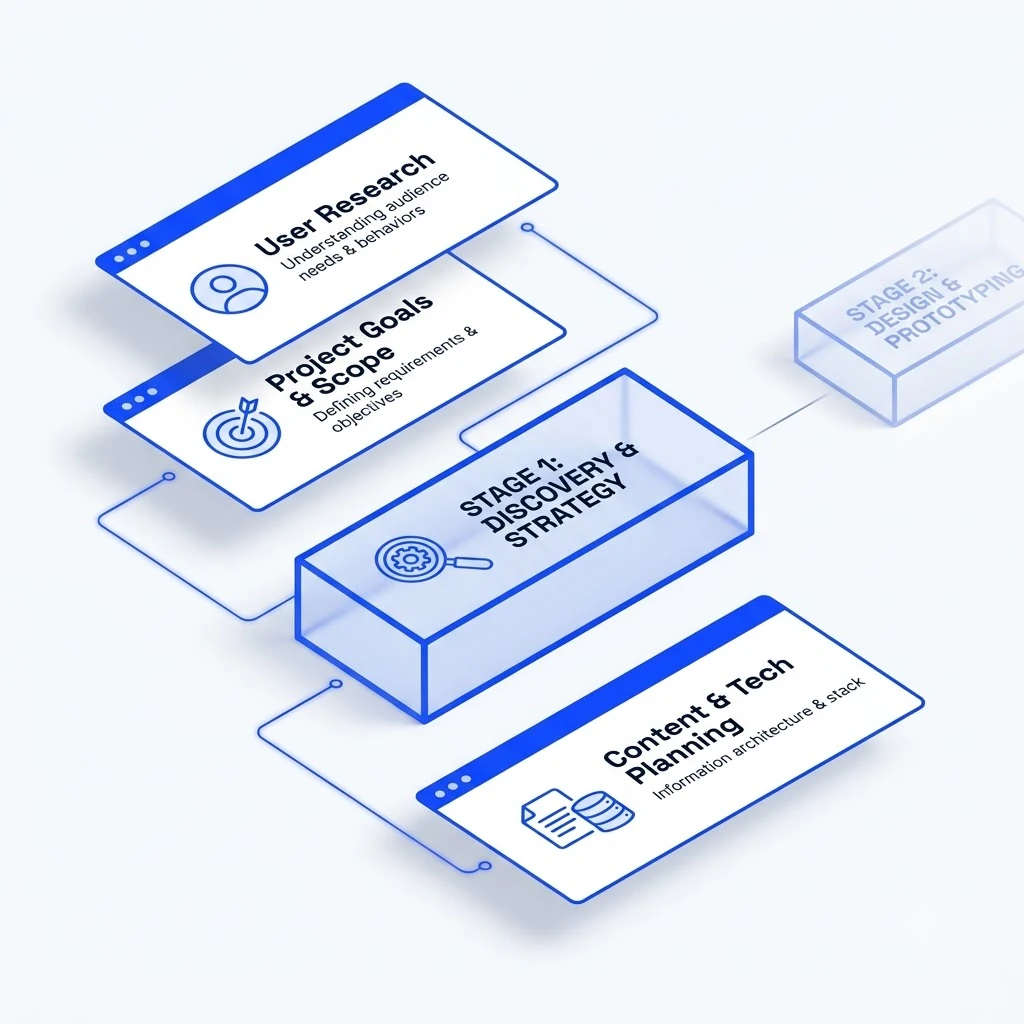
This foundational stage defines the project’s core purpose and direction. It involves deep dives into business goals and target audiences. The outcome is a clear strategic vision that guides all subsequent phases. This phase is critical for aligning stakeholders and establishing a shared understanding of success.
- Define project objectives.
- Identify target audience.
- Conduct market research.
- Establish key performance indicators (KPIs).
Stage 2: Planning and information architecture
With a solid strategy, this stage focuses on the website’s structure and functionality. It involves creating sitemaps and wireframes to map user journeys and content organization. Effective planning prevents scope creep and ensures logical navigation. This phase translates strategic goals into a tangible blueprint.
- Develop a sitemap.
- Create wireframes.
- Define user flows.
- Prioritize features for an MVP.
Stage 3: UI/UX design
Here, the website’s visual identity and user experience take shape. Designers translate wireframes into high-fidelity mockups, focusing on aesthetics and usability. Iterative feedback loops are vital. A well-executed UI/UX design significantly impacts user engagement and conversion rates.
- Design visual mockups for desktop and mobile.
- Develop a style guide.
- Build interactive prototypes.
- Conduct usability testing.
Stage 4: Content creation
Compelling content engages users and achieves business goals. This phase involves writing copy and sourcing visuals. Content must align with SEO strategies and brand voice. High-quality content enhances user experience and improves search engine rankings.
- Write website copy.
- Source or create visuals.
- Optimize content for SEO.
- Ensure brand consistency.
Stage 5: Development and integration
Designs and content become reality through coding. Front-end development handles the user interface. Back-end development manages server-side logic and databases. Integrating third-party services, like CRMs, is also critical. This phase requires close collaboration.
- Code front-end interfaces.
- Develop back-end systems.
- Integrate third-party services.
- Implement content management systems (CMS).
Stage 6: Testing and quality assurance
Rigorous testing ensures a flawless user experience before launch. This phase checks functionality across browsers and devices. It identifies and fixes bugs and verifies performance. Thorough QA minimizes post-launch issues. Website bounce rates increase by 32% if a site takes over 3 seconds to load source: Forbes Advisor.
- Perform cross-browser testing.
- Conduct mobile responsiveness checks.
- Identify and fix bugs.
- Test site speed and performance.
Stage 7: Launch and continuous optimization
The website goes live during the launch phase. This involves deploying code and configuring settings. Post-launch, monitoring performance and gathering feedback continues. This iterative process ensures the website remains effective and relevant.
- Deploy website to live server.
- Monitor performance and analytics.
- Gather user feedback.
- Plan for iterative updates.
Estimated timelines by website type
The duration of a web development project hinges significantly on its complexity and scope. Understanding these variations helps set realistic expectations for project delivery. Different website types require distinct levels of effort, impacting the overall timeline.
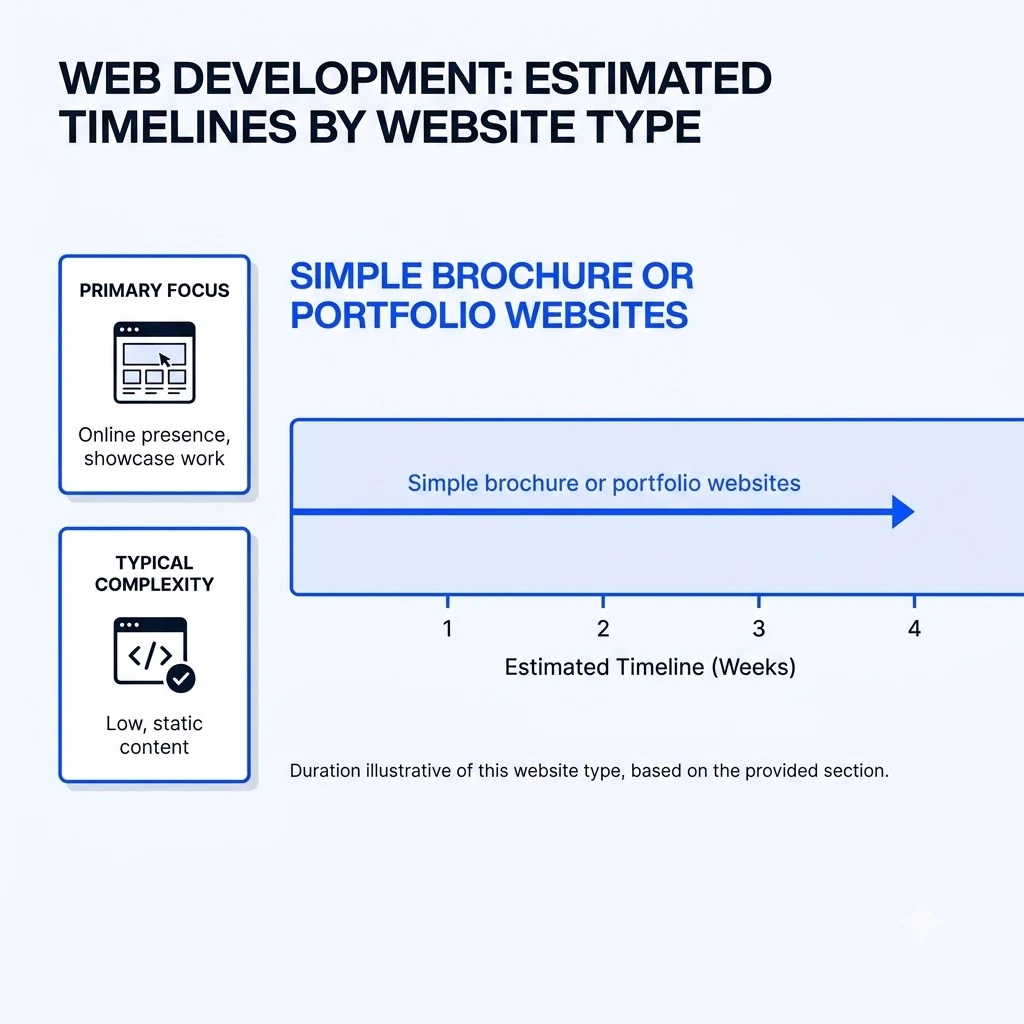
Simple brochure or portfolio websites
For basic brochure or portfolio websites, the timeline is typically the shortest. These sites usually consist of a few static pages, focusing on presenting essential information like company services, contact details, and a brief overview. Development often involves straightforward design implementation and content population.
A simple brochure site with 5-10 pages can realistically be completed within 2 to 6 weeks. This timeframe accounts for initial planning, design mockups, content integration, and basic testing. Projects utilizing drag-and-drop builders like Elementor can even accelerate the creation of simple landing pages or portfolios to just 1 to 3 days.
Small to medium business websites
Small to medium business (SMB) websites generally require more functionality and pages than simple brochure sites. They often include content management systems (CMS) for easier updates, lead generation forms, and potentially basic integrations. These sites aim to establish a stronger online presence and support marketing efforts.
Developing an SMB website with a CMS, typically ranging from 10 to 25 pages, usually takes between 6 to 10 weeks. This period allows for more detailed UI/UX design, custom content creation, CMS setup, and thorough testing to ensure optimal performance and user experience.
E-commerce platforms
E-commerce websites introduce significant complexity due to the need for product catalogs, shopping cart functionality, secure payment gateway integrations, and user account management. The development process involves building robust back-end systems to handle transactions and inventory.
An e-commerce platform build typically requires 6 to 12 weeks. This timeline accommodates the integration of payment processors, shipping solutions, and potentially inventory management systems. More complex e-commerce projects, especially those requiring custom features or extensive product listings, may extend this duration.
Custom web applications and portals
Custom web applications and enterprise portals represent the most complex category. These projects involve unique functionalities, intricate logic, extensive integrations with existing business systems (like CRMs or ERPs), and often require significant back-end development. The scope can range from a Minimum Viable Product (MVP) to a full-scale enterprise solution.
The timeline for developing a custom web application or a large-scale portal can span from 3 to 6 months or even longer. This extended period is necessary for in-depth discovery, complex architecture design, rigorous development, comprehensive testing, and seamless integration with other business software. Projects involving AI-assisted teams can potentially reduce this timeframe, with some estimates suggesting a reduction to 6-9 weeks for standard business websites.
Agile vs. Waterfall: Impact on development timelines
Choosing between Agile and Waterfall methodologies significantly alters a web development project’s timeline. Waterfall follows a linear, sequential approach. Each phase must be completed before the next begins. This can lead to longer overall project durations if issues arise late in the cycle. Agile, conversely, uses iterative cycles called sprints. This allows for flexibility and faster delivery of functional components.
| Feature | Waterfall | Agile |
|---|---|---|
| Approach | Linear, sequential phases (Planning, Design, Development, Testing, Deployment, Maintenance). | Iterative and incremental, with short development cycles (sprints) delivering working software. |
| Flexibility | Low; changes are difficult and costly once a phase is complete. | High; adapts easily to changing requirements and feedback throughout the project. |
| Timeline Impact | Predictable if requirements are stable, but can cause significant delays if scope changes. | Faster initial delivery of features, but overall project end date may be less fixed due to continuous iteration. |
| Risk Management | Risks are identified upfront; late-stage issues can be very disruptive. | Risks are managed incrementally within each sprint, allowing for quicker mitigation. |
| Best For | Projects with clearly defined, stable requirements and minimal expected changes. | Projects with evolving requirements, a need for rapid feedback, and a focus on continuous improvement. |
Waterfall’s rigidity means a project might take 3-6 months for a complex application. This is because all requirements are locked in early. Any deviation discovered during testing, for instance, requires revisiting earlier phases. Agile methodologies, however, often deliver a Minimum Viable Product (MVP) in 6-9 weeks. This is achieved by focusing on core features first. Subsequent sprints then add enhancements. This iterative process allows teams to respond quickly to market feedback. This can accelerate the overall time to market for key functionalities. For instance, a custom web application development schedule using Agile might see a usable core version delivered in 12 weeks, with further features added over the next 8-16 weeks.
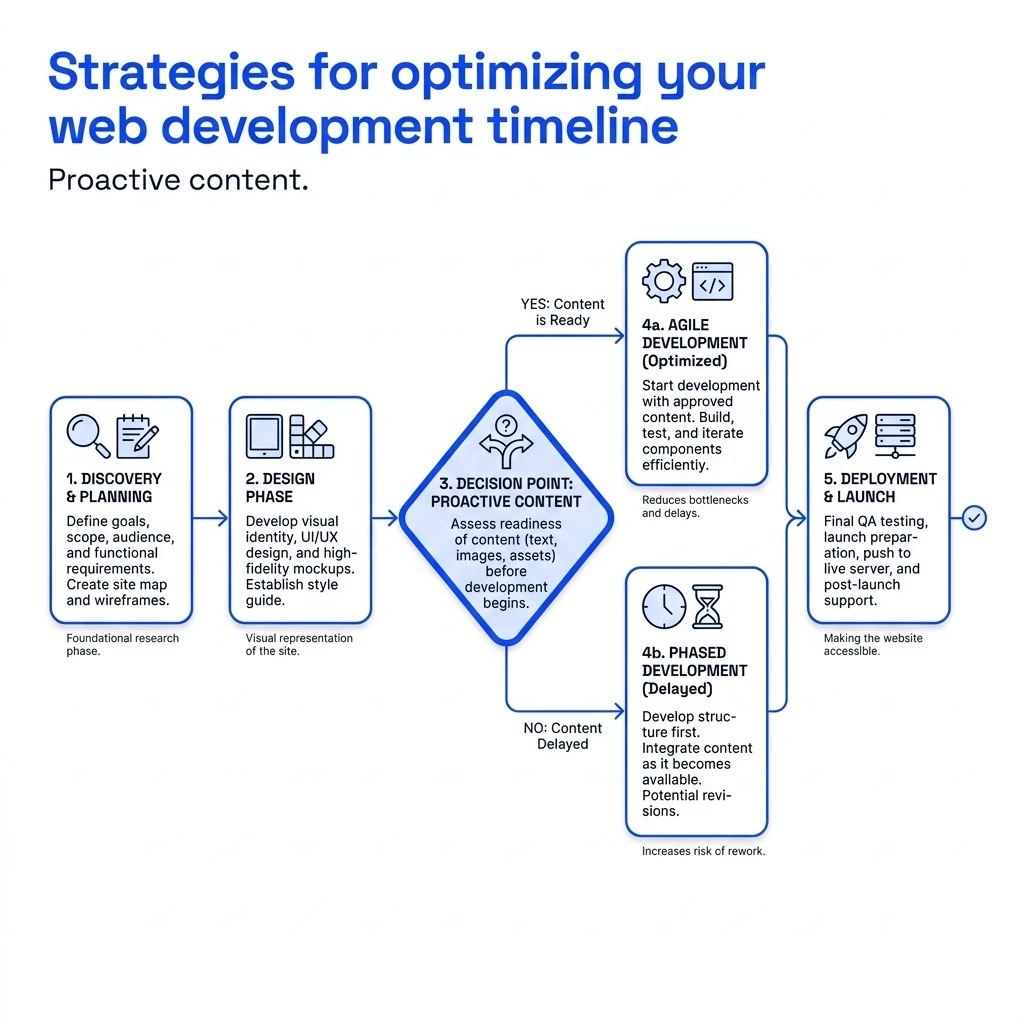
Strategies for optimizing your web development timeline
Optimizing your web development timeline is crucial for efficient project delivery. This involves strategic planning and execution across several key areas. By focusing on these aspects, you can significantly reduce delays and ensure a smoother project flow.
Proactive content preparation
Starting content creation early is vital for staying on schedule. Delays in content delivery are a common cause of project overruns. HubSpot data shows that 47% of website delivery delays stem from clients providing content late. Preparing text, images, and other media in advance prevents bottlenecks. This ensures that developers and designers have the necessary assets when they need them. Our team often sees projects stall because content wasn’t ready.
Streamlined feedback loops and decision-making
Efficient communication and decision-making processes accelerate development. Establish clear channels for feedback and approvals. Define who has the authority to make decisions at each stage. This minimizes back-and-forth communication. It also prevents scope creep from informal requests. Quick decisions keep the project momentum high.
Leveraging modern methodologies and tools
Adopting Agile methodologies can break down projects into manageable sprints. This allows for flexibility and continuous delivery. Tools like project management software and collaboration platforms enhance team efficiency. They also improve transparency. For instance, using AI-assisted tools can shorten development cycles. One report suggests AI-assisted teams can reduce delivery time by 15-20% (Source: vezert.com).
Clear scope definition and management
A well-defined project scope is fundamental. It sets clear expectations for deliverables and features. Scope changes are a major challenge; WebFX statistics indicate that 89% of B2B website projects experience scope changes during development. Implementing a formal change management process helps control these alterations. This ensures that any changes are evaluated for their impact on the timeline and budget.
Preparing for integrations
Integrations with existing systems, such as CRMs or ERPs, add complexity. Plan these integrations early in the discovery phase. Understand the APIs and data structures involved. Thorough preparation for integrations avoids last-minute technical hurdles. This is especially important for custom web applications requiring complex system connections.
How AI is reshaping web development timelines
Artificial intelligence is accelerating web development. It automates tasks and enhances efficiency across various project stages. This shift impacts traditional timelines, offering faster delivery and improved outcomes.
Practical AI applications in development
AI tools streamline coding, debugging, and testing. Developers use AI-powered assistants to generate code snippets and identify errors. This reduces manual effort and speeds up the development process. For instance, AI can analyze code for potential bugs, offering suggestions for correction. This proactive approach minimizes time spent on troubleshooting later. AI also aids in project management by predicting potential delays and optimizing resource allocation.
Limitations and the need for human oversight
Despite AI’s advancements, human expertise remains crucial. AI tools lack the nuanced understanding of complex business logic and creative problem-solving. Over-reliance on AI can lead to generic solutions or missed opportunities for innovation. Human developers are essential for strategic decision-making, client communication, and ensuring the final product aligns with business goals. AI should be viewed as a powerful assistant, not a replacement for human developers.
AI’s impact on specific phases
AI significantly influences the discovery and development phases. In discovery, AI can analyze market trends and user data to inform project scope. During development, AI tools automate repetitive coding tasks. This allows developers to focus on more complex features and integrations. Testing phases also benefit, with AI enabling faster, more comprehensive quality assurance. For example, AI can automate thousands of test cases, identifying issues that might be missed manually. This accelerates the overall project timeline.
Beyond the launch: Post-development timelines
A website’s journey doesn’t end at launch; continuous effort is vital for sustained success. Post-development phases focus on keeping the site secure, performing optimally, and evolving with business needs.
Ongoing maintenance and security
Regular maintenance ensures your website remains secure and functional. This includes routine updates for content management systems (CMS), plugins, and themes. These updates patch vulnerabilities and improve performance. Security audits and malware scans are also critical. Proactive measures prevent data breaches and protect user trust. In our experience, neglecting these updates can lead to significant security risks and costly downtime. For instance, a small business website might require weekly checks, while a complex e-commerce platform needs daily monitoring.
Performance monitoring and iterative improvements
Monitoring website performance is an ongoing task. Key metrics like page load speed, uptime, and error rates must be tracked. Tools like Google Analytics and specialized performance monitoring services provide valuable insights. Analyzing user behavior helps identify areas for improvement. Iterative updates based on this data enhance user experience and conversion rates. For example, if analytics show users drop off on a specific checkout page, the development team can focus on optimizing that particular flow. This continuous improvement cycle ensures the website adapts to user expectations and business goals.
Planning for future feature development
A successful website is a living entity. Planning for future feature development ensures it stays relevant and competitive. This involves gathering user feedback and analyzing market trends. A product roadmap helps prioritize new features and enhancements. This might include adding new integrations, improving existing functionalities, or expanding into new markets. For example, a company might plan to integrate a new CRM system or add a customer loyalty program. These strategic additions keep the website aligned with evolving business objectives and user demands.
Frequently asked questions about web development timelines
Understanding web development timelines can be complex. Here are answers to common questions.
How long does a typical website development project take?
The duration varies significantly based on project scope and complexity. A small business website with 5-10 pages might take 2 to 6 weeks. More integrated sites, like those using a CMS with 10-25 pages, typically require 6 to 10 weeks. E-commerce platforms usually fall within the 6 to 12-week range. For large enterprise-level platforms or custom web applications with complex integrations, the timeline can extend to 3 to 6 months or longer.
What factors influence the web development timeline?
Several key elements impact project speed. The chosen technology stack plays a role; custom coding in HTML, CSS, and JavaScript is more time-consuming than using drag-and-drop builders like Elementor on WordPress, which can speed up landing page creation to just 1-3 days. Project scope, including the number of features and integrations required, is a major driver. The client’s responsiveness in providing content and feedback also significantly affects the schedule. In fact, HubSpot reports that 47% of timeline overruns stem from client-side delays, not technical issues.
How do development methodologies affect the timeline?
Methodologies like Agile and Waterfall have different impacts. Agile development, often using Scrum, breaks projects into shorter sprints, allowing for faster delivery of functional components and greater flexibility. This iterative approach can lead to quicker initial launches and continuous improvement. Waterfall, on the other hand, follows a linear sequence of phases. While it offers clear structure, it can be less adaptable to changes, potentially extending timelines if requirements shift. Teams using AI-assisted tools can see timelines shorten, with some projects moving from 8-12 weeks to 6-9 weeks.
When is performance testing integrated into the timeline?
Performance and speed testing are critical, especially in the later stages before launch. Google data indicates that bounce rates increase by 32% if a website takes over 3 seconds to load. Therefore, dedicated time for optimization and load testing is essential. This phase ensures the site meets user expectations and business goals for speed and responsiveness.
Can scope changes impact the project timeline?
Yes, scope changes are a common challenge. WebFX statistics show that about 89% of B2B website development projects experience scope changes during construction. These changes can directly delay project delivery. Proactive project management and clear communication are vital to managing scope creep effectively.
Conclusion: Building for sustained digital growth
Successfully navigating the web development timeline means building a strong foundation for your digital presence. It’s not just about launching a website; it’s about creating a strategic asset that supports your business objectives. By meticulously planning each phase, integrating key functionalities, and prioritizing user experience and performance, you set the stage for sustained growth. A well-defined timeline ensures each step aligns with your business goals. This transforms a complex process into a predictable roadmap for success.
A website is a living entity, not a static deliverable. Post-launch, continuous monitoring and iterative improvements are crucial for long-term effectiveness. This ongoing commitment ensures your digital platform remains competitive. For instance, a website focused on conversion optimization might incorporate A/B testing frameworks. This proactive approach, driven by data, directly impacts user engagement and revenue.
Embracing iterative development and optimization
The launch is merely the beginning of a website’s lifecycle. Sustained digital growth hinges on iterative development and continuous optimization. This involves actively monitoring key performance indicators (KPIs). Examples include bounce rates, conversion rates, and page load times. If analytics reveal a high bounce rate on a landing page, the team can iterate on its design or content. This responsiveness is key.
- Performance Monitoring: Regularly track site speed and uptime. A slow-loading site deters users. Google data shows bounce rates increase 32% if a site takes over 3 seconds to load.
- User Feedback Integration: Collect and analyze user feedback through surveys or direct input. This qualitative data highlights usability issues.
- SEO Adjustments: Refine SEO strategies based on algorithm updates and performance data.
- Feature Enhancements: Plan future feature rollouts based on market trends and user behavior.
This iterative process ensures your website evolves with your audience and business. It transforms the initial development timeline into a dynamic strategy for ongoing digital success.
Strategic partnerships for long-term success
Complex projects often benefit from strategic partnerships. Collaborating with experienced web development agencies can streamline the entire process. They bring proven methodologies and technical proficiency. This significantly impacts project outcomes. For example, Enosta offers comprehensive web development services. These cover the entire lifecycle, from planning to post-launch optimization. This holistic approach ensures all timeline phases are managed effectively. It reduces risks and maximizes ROI.
Choosing the right partner means finding a team that understands your business objectives. They can translate these into a high-performing digital asset. They help navigate complex integrations and implement cutting-edge technologies. This partnership builds a scalable platform for sustained digital growth.