
What Is AI Transformation? What Changes Beyond AI Tools
September 21, 2026 See more
Web application development transforms raw business ideas into scalable digital products, helping founders streamline operations effectively. This comprehensive guide walks you through the entire lifecycle, modern tech stacks, and cost factors for your next project. Whether you build an inhouse team or partner with expert website development services, this blueprint ensures your product scales securely.
Web application development is the structured process of engineering interactive software solutions that execute inside standard web browsers. These applications connect directly with databases and server logic to process information instantly. Understanding this foundational definition helps teams clarify project requirements when they plan to hire web application developers or evaluate external technical partnerships.
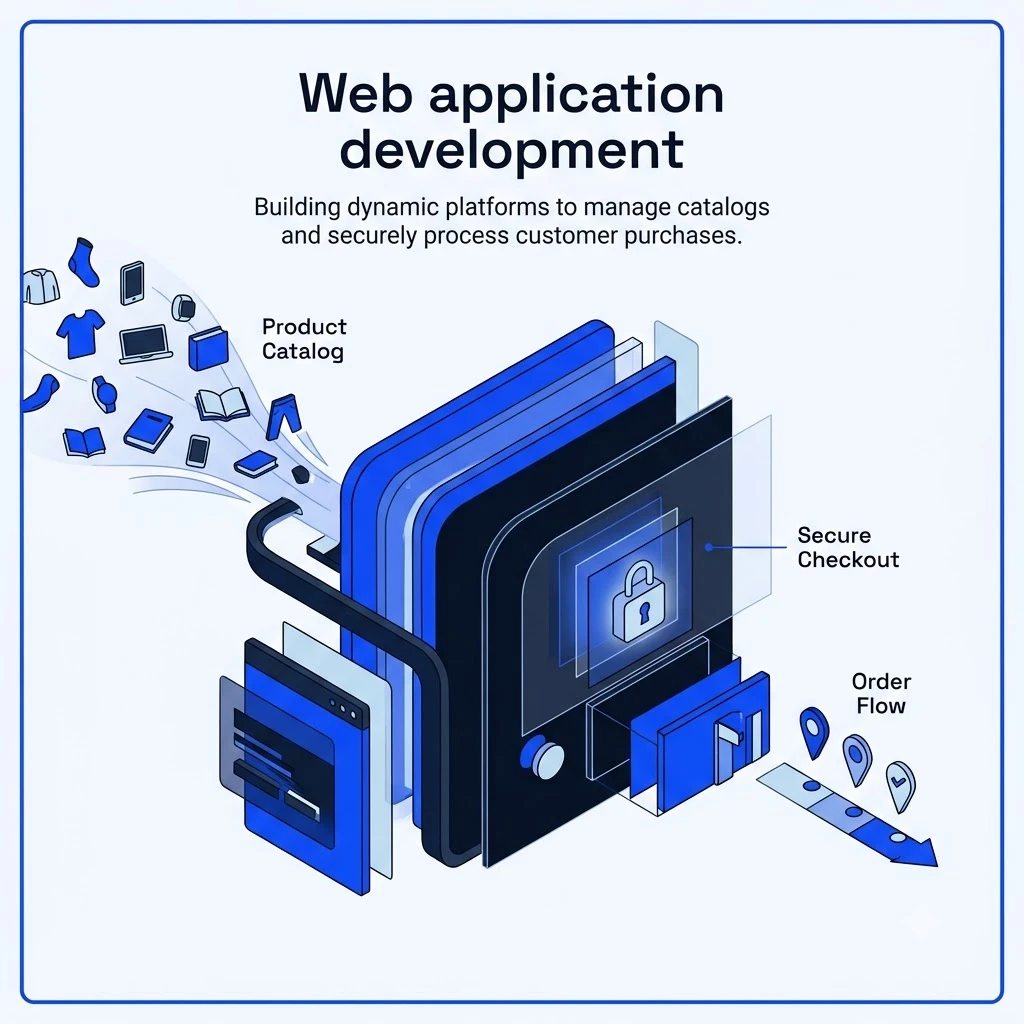
Modern web applications rely on a split client-server architecture. The user browser manages the front-end interface, rendering components and capturing user input locally. The backend server runs remotely to process business logic, handle security rules, and manage database queries. Secure HTTPS protocols and application programming interfaces bridge these two environments seamlessly.
Distinguishing between web applications, websites, and native mobile apps is essential for defining technical scope. Websites act as digital brochures that deliver static information with minimal user interaction. Web applications provide interactive, data-driven utility directly inside browser environments. Native applications require installation from app stores and target specific operating systems.
The global web development market is projected to reach USD 118.6 billion by 2034, indicating significant demand for diverse digital solutions. This macro expansion reflects enterprise and consumer demand for robust digital platforms.
Building a robust web application requires a structured, multi-stage process. This lifecycle ensures clarity, efficiency, and quality from the initial concept to a live product. Each phase builds on the previous one to minimize risks. Understanding these distinct stages helps teams deliver digital solutions that match strategic goals.
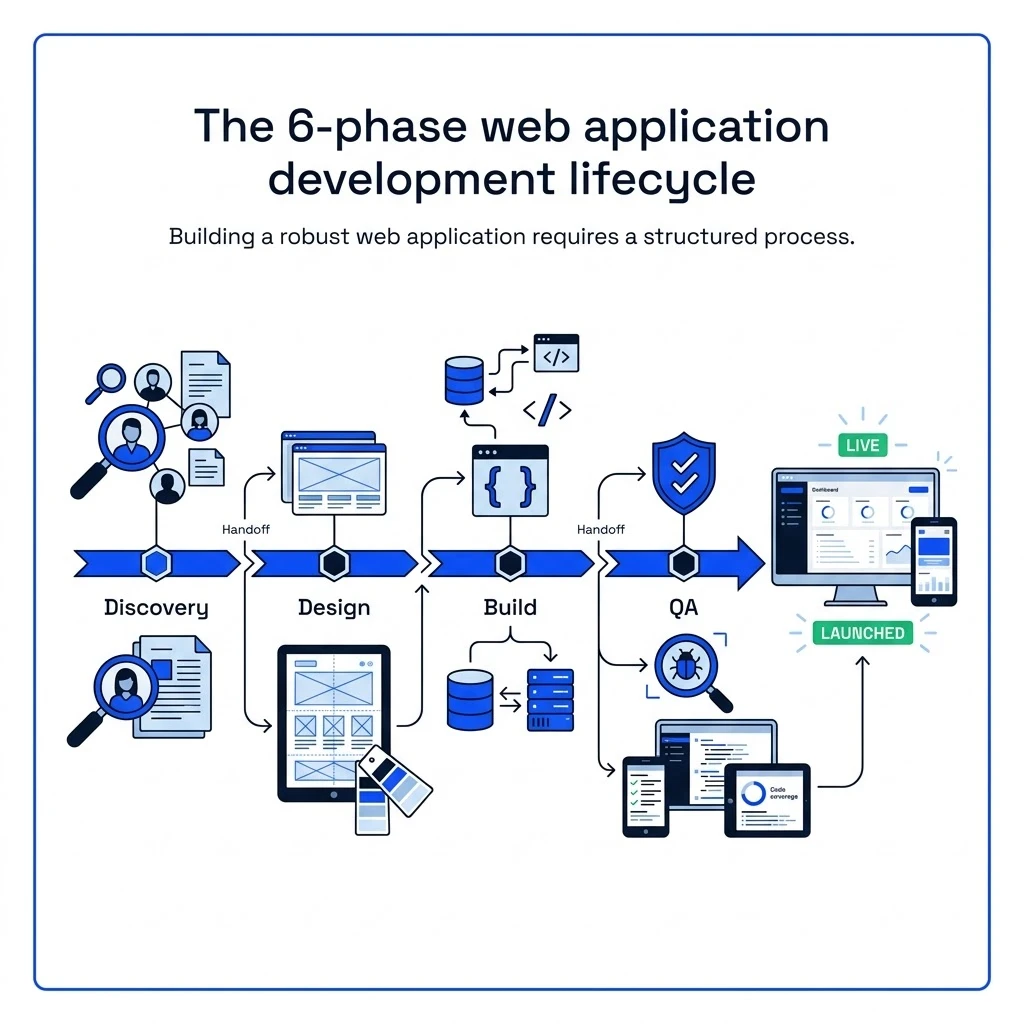
This foundational phase defines the project scope and aligns it with business objectives. It involves deep analysis of the core problem, the target audience, and market competitors. Thorough research validates the core idea and shapes the Minimum Viable Product feature set.
This stage translates user needs and business goals into a visual blueprint. Teams build high-fidelity wireframes and interactive prototypes to map user journeys. The goal is an intuitive user interface that guarantees seamless navigation across devices.
This phase establishes the technical backbone of the web application. Teams select appropriate frameworks, programming languages, and databases to ensure long-term stability. A well-planned architecture supports future user growth and data volume expansion.
This is where engineers write code to bring designs and architecture to life. The custom web application development process is split into distinct layers. Developers follow clean coding standards to ensure future maintainability and speed.
Frontend engineers build the client-side interface that users experience directly. They use HTML, CSS, and modern frameworks to render dynamic components. A responsive user interface adapts smoothly to various screen sizes and mobile devices.
Backend engineers build server-side logic, data processing rules, and system workflows. They use secure languages and frameworks to process incoming requests and manage business rules. This layer controls user permissions and executes core application logic.
Engineers set up data persistence layers to store and retrieve records reliably. They write optimized queries and connect the database securely to backend services. Proper relational database management prevents bottlenecks during peak traffic events.
Rigorous testing eliminates software defects before users encounter them in production. This phase combines automated and manual checks across different system layers. Comprehensive validation ensures the application meets performance benchmarks and security standards.
The final stage pushes the codebase to production cloud hosting environments. Teams configure servers, domain names, and automated release pipelines for smooth updates. Post-launch monitoring keeps the application secure and responsive as user demands evolve.
The global web developer services market is projected to reach USD 118.6 billion by 2034, underscoring the need for disciplined post-launch maintenance.
Choosing the right technology stack is crucial for building robust and scalable web applications. This involves selecting appropriate frontend and backend technologies, databases, and other tools. The modern web development landscape offers a vast array of options, each with its own strengths and weaknesses. Understanding these choices helps ensure your application meets current needs and future growth.
The frontend, or client-side, is what users directly interact with in their browsers. Frameworks and libraries streamline the development of dynamic and responsive user interfaces. React, developed by Meta, is a popular JavaScript library for building user interfaces, known for its component-based architecture and virtual DOM for efficient updates. Angular, a comprehensive framework by Google, offers a complete solution for building complex applications with features like data binding and dependency injection.
Vue.js is another progressive JavaScript framework that is highly adaptable and easy to integrate, often praised for its gentle learning curve. These tools enable developers to create engaging and interactive user experiences efficiently.
The backend, or server-side, handles the application’s logic, data management, and API integrations. Node.js, which allows JavaScript to be run on the server, is a highly popular choice for its speed and efficiency, especially for real-time applications. Python, with its clear syntax and extensive libraries, is widely used for web development through frameworks like Django and Flask. Django offers a full-stack framework with many built-in features, while Flask is a more minimalist microframework, providing greater flexibility.
Ruby on Rails is another robust framework known for its convention-over-configuration approach, speeding up development. Java, with its enterprise-grade capabilities and the Spring framework, remains a strong contender for large-scale, complex applications.

Data storage is a fundamental aspect of any web application. Relational databases, often referred to as SQL databases, store data in structured tables with predefined schemas. PostgreSQL and MySQL are leading examples, offering strong data integrity, complex query capabilities, and ACID compliance. These are excellent choices for applications requiring strict data consistency, like financial systems. NoSQL databases, on the other hand, offer more flexibility and scalability for handling large volumes of unstructured or semi-structured data.
Document databases like MongoDB store data in JSON-like documents, making them ideal for content management systems or user profiles. Key-value stores, column-family stores, and graph databases are other NoSQL types, each suited for specific use cases such as caching, big data analytics, or network relationships. The choice depends heavily on the application’s data structure, scalability needs, and query patterns.
The web application development landscape is constantly evolving. Staying ahead means embracing new technologies and methodologies. Modern businesses leverage these trends to build more engaging, efficient, and scalable applications. These advancements address user expectations for speed, convenience, and intelligent features.
Progressive Web Apps (PWAs) bridge the gap between traditional websites and native mobile applications. They offer an app-like experience directly within a web browser. PWAs load instantly, even with poor network connectivity, and can function offline. Users can add them to their home screens, just like native apps. This accessibility boosts engagement and reach.
PWAs utilize modern web capabilities like service workers for offline functionality and push notifications. This allows for timely user interaction and personalized content delivery. Building a PWA means reaching a broader audience without the friction of app store downloads. Enosta specializes in developing custom web applications, including PWAs, designed for seamless user interaction.
Serverless architecture fundamentally changes how applications are deployed and managed. It allows developers to build and run applications without provisioning or managing servers. Cloud providers automatically handle the infrastructure, scaling resources up or down based on demand. This significantly reduces operational overhead and costs.
With serverless, you only pay for the compute time consumed. This model is ideal for applications with variable traffic patterns or unpredictable loads. It allows teams to focus on writing code and delivering features, rather than managing server maintenance. This agility is crucial for startups and businesses aiming for rapid iteration.
Artificial intelligence is transforming web applications by enabling smarter, more personalized user experiences. AI can power features like chatbots for instant customer support, recommendation engines for tailored content, and predictive analytics for user behavior insights. Integrating AI helps applications understand and respond to user needs more effectively.
Developers are increasingly using AI-assisted coding tools to streamline development and improve productivity. A large majority of software teams now incorporate automated coding assistants into their daily workflows, despite lingering discussions about code validation and maintenance.
Headless CMS and composable architectures decouple content management from presentation layers. A headless CMS provides content through APIs, allowing it to be delivered to any frontend channel. This flexibility enables businesses to create consistent experiences across websites, mobile apps, and other digital touchpoints.
Composable architectures take this further by allowing businesses to assemble applications from best-of-breed microservices and components. This approach enhances agility, enabling faster updates and easier integration of new functionalities. It supports a modular approach to building complex digital products.
Building a successful web application demands more than just functionality. It requires a steadfast commitment to security, optimal performance, and enduring best practices. These elements ensure your application is not only reliable but also resilient and maintainable over time.
Robust web application security is paramount to protect sensitive data and maintain user trust. A common pitfall is treating security as an afterthought. Instead, it must be integrated from the initial design phase through development and deployment.
Key security measures include implementing strong authentication and authorization protocols. This ensures only legitimate users access appropriate data and functionalities. Employing HTTPS encryption across all communication channels is non-negotiable for protecting data in transit. Input validation on both the client and server sides helps prevent common vulnerabilities like SQL injection and cross-site scripting (XSS). Regular security audits and penetration testing can identify and address potential weaknesses before they are exploited.

For instance, a web application development company will prioritize these measures to safeguard client applications.
Optimizing web application performance is crucial for user satisfaction and conversion rates. Slow loading times frustrate users, leading to higher bounce rates and lost opportunities. Performance optimization involves several key areas.
Leveraging browser caching and content delivery networks (CDNs) significantly speeds up content delivery to users worldwide. Efficient code, including minifying JavaScript and CSS, reduces file sizes. Optimizing images through compression and appropriate formatting also plays a vital role. Backend performance relies on efficient database queries and optimized server-side logic. For example, a well-structured database schema can drastically improve data retrieval times. The global web development market is projected to grow, underscoring the importance of delivering high-performing applications Web Development Market Size, Share | CAGR of 9.4%.
Adhering to best practices ensures your web application remains maintainable and scalable as it evolves. Clean, well-documented code is fundamental for long-term health. This allows new developers to understand and modify the codebase efficiently.
Choosing a scalable architecture, such as microservices, allows different components to be scaled independently. This is more cost-effective than scaling an entire monolithic application. Implementing robust logging and monitoring systems helps in quickly identifying and resolving issues. Adopting DevOps practices and continuous integration/continuous delivery (CI/CD) pipelines streamlines the deployment process and reduces errors. This systematic approach is vital for enterprise-grade web application development.
Selecting the right development approach is crucial for project success. This decision impacts cost, timeline, scalability, and overall quality. Common paths include building in-house, outsourcing to a dedicated agency, or leveraging a hybrid model. Each option presents unique advantages and challenges.
Consider your internal team’s expertise, available resources, and long-term strategic goals. An in-house approach offers maximum control but requires significant investment in talent and infrastructure. Outsourcing can provide access to specialized skills and faster time-to-market. A hybrid model blends these benefits, allowing you to manage core functions internally while outsourcing specific tasks.
The cost to develop a web application varies widely. Several key factors influence the final price. These include the complexity of features, the chosen technology stack, and the development team’s location and experience. Simple applications with basic functionalities might cost tens of thousands of dollars. Conversely, complex enterprise-grade applications can run into hundreds of thousands or even millions.
The hourly rates for developers differ significantly by region. For instance, developers in North America might charge between $100-$250 per hour. European developers could range from $70-$150 per hour. Offshore developers in Eastern Europe or Asia might offer rates from $30-$70 per hour. These figures exclude project management, design, and quality assurance costs.
Additional costs arise from third-party integrations, ongoing maintenance, hosting, and potential third-party licenses. Thorough project scoping and clear requirements are essential for accurate cost estimation.
Outsourcing web application development services allows businesses to leverage external expertise. This can be particularly beneficial for companies lacking in-house technical skills or capacity. It enables access to a global talent pool, potentially reducing development costs.
The global enterprise web development outsourcing market was valued at USD 1.40 billion in 2025. It is projected to reach USD 2.80 billion by 2036, growing at a 6.5% CAGR (According to Enterprise Web Development Outsourcing Services Market). Front-end development leads this market, capturing a 34.0% share in 2026. Large enterprises represent 57.0% of application demand in this sector.
When outsourcing, consider factors like communication, cultural alignment, and project management methodologies. A clear contract outlining deliverables, timelines, and intellectual property rights is vital. Choosing a reputable web application development company ensures quality and reliability.
Enterprise-grade web applications demand robust architecture and stringent security. These applications often handle sensitive data and support critical business operations. They require careful planning for scalability, performance, and maintainability.
Key considerations include adopting a microservices architecture for modularity and independent scaling. Implementing comprehensive security measures, such as multi-factor authentication and regular vulnerability assessments, is paramount. A well-defined API-driven strategy decouples frontend and backend systems, enhancing flexibility.
Choosing a reliable cloud hosting provider, like AWS, Azure, or GCP, is also essential. These platforms offer the scalability and managed services needed for enterprise applications. Rigorous testing throughout the development lifecycle ensures the application meets high standards. Our website development services focus on building these high-performance, scalable, and secure web applications.
A website primarily delivers information, much like a digital brochure. In contrast, a web application is an interactive software program. Users can perform actions, manipulate data, and complete tasks within a web app, such as online banking or document editing.
The timeline for custom web application development varies significantly. Factors include complexity, feature set, and chosen technology stack. A simple application might take 3-6 months, while a complex enterprise-grade solution could require 9-18 months or more. Our team at Enosta focuses on efficient development cycles.
Popular front-end frameworks include React, Angular, and Vue.js, enabling dynamic user interfaces. For the back-end, Node.js (JavaScript), Python (with Django or Flask), and Ruby on Rails are widely adopted. These frameworks streamline development and offer robust functionalities.
Post-launch maintenance is crucial for a web application’s longevity. This involves regular monitoring of performance and security. We address bug fixes, implement necessary updates, and provide ongoing support to ensure the application remains secure, functional, and up-to-date with evolving technology.
A typical web application development team includes roles like Project Managers, UI/UX Designers, Front-End Developers, Back-End Developers, Database Administrators, and Quality Assurance Testers. Each role contributes specialized skills to ensure a successful product delivery.
Let’s explore how our expert team can bring your vision to life.
Request Consultation


Error: Contact form not found.
