An AI transformation strategy is a decision document, not a technology wish list. It tells leadership which workflows to fund, defer, or stop, who owns each decision, and what evidence unlocks the next investment. This guide shows operations and transformation leaders how to turn scattered experiments into one executable plan, using a strategy canvas, portfolio screening, an operating model, and a dependency-based roadmap. You will leave with the artifacts sponsors can evaluate and delivery teams can act on.
What an AI transformation strategy must decide
A transformation strategy must decide seven things: the objective, the current constraint, which workflows are selected and deferred, who owns each workflow, what dependencies must be true, what funding assumption is being tested, and what evidence gate triggers the next review. Without these, a strategy is a collection of AI ideas.
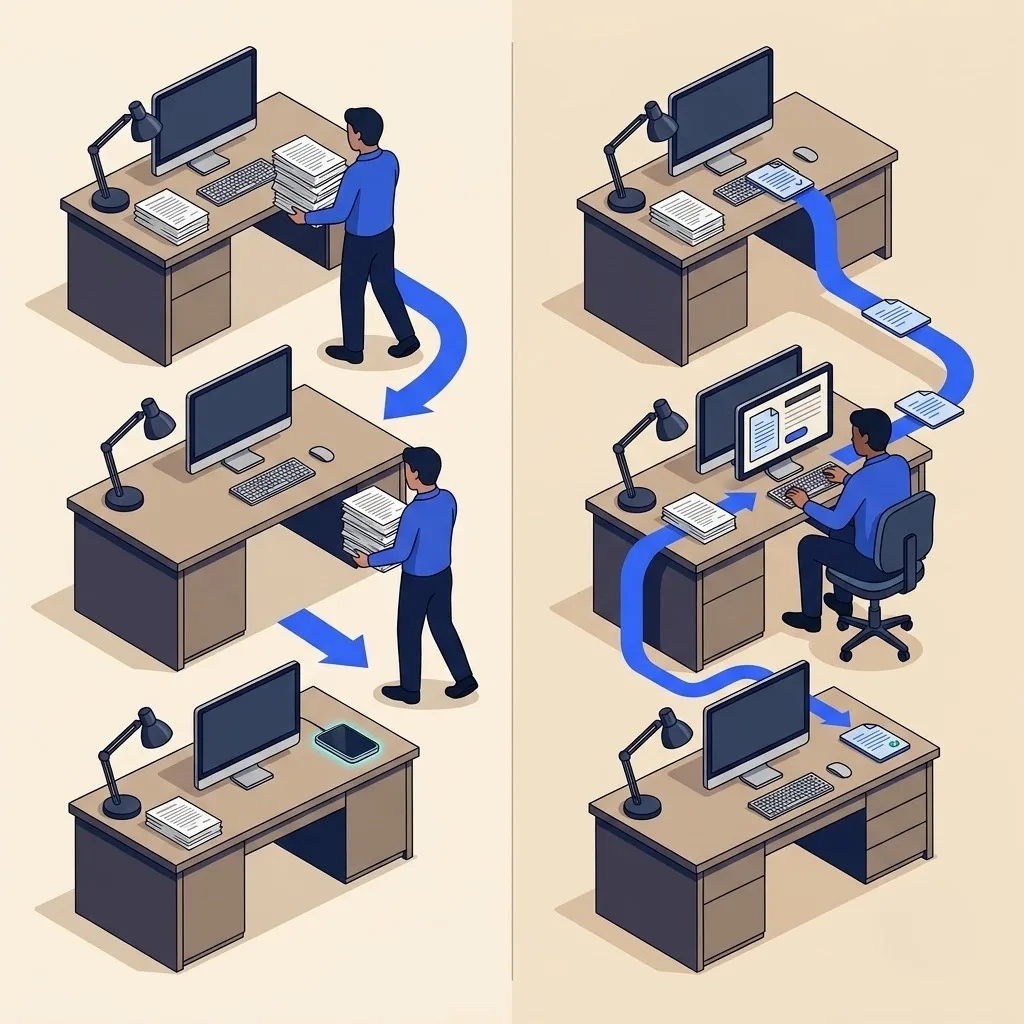
Most stalled programs fail on the same gap. According to Deloitte’s 2026 enterprise AI outlook, 48% of surveyed organizations introduced AI without redesigning the workflows or roles it sits within, and only 12% report redesign at scale with a new operating model behind it. That is a decision gap, not a tooling gap.
Where value actually comes from reinforces the same point. BCG’s AI transformation research estimates that only 10% of transformation value comes from the AI application itself, 20% from underlying data and technology, and roughly 70% from workflow redesign, culture, governance, and human-AI collaboration. The application is the smallest part of the equation.
Strategy vs tool adoption vs implementation roadmap
These three are working distinctions, not a universal taxonomy. A strategy chooses what to change and why. Tool adoption enables individuals to use AI in existing tasks. An implementation roadmap sequences technical delivery.
| Dimension | AI transformation strategy | AI tool adoption | AI implementation roadmap |
|---|---|---|---|
| Purpose | Choose what to change and why | Enable AI use in existing tasks | Sequence technical delivery |
| Primary decision | Fund, defer, or stop a workflow | Which tool, for whom | Build order and dependencies |
| Output | Strategy canvas with evidence gates | Licensed tools and usage norms | Phased delivery plan |
| Owner | Sponsor with process owners | Functional manager | Delivery lead |
| Review trigger | Evidence gate result | Usage and adoption review | Milestone or dependency change |
Growth and customer value also matter. A workflow that shortens response time can lift retention, and a better service-request triage can raise customer satisfaction. This guide concentrates on operational execution because that is where fragmented experiments, ownership gaps, and measurement problems first appear.
Boundaries: no provider rankings, no software tutorial, no exhaustive technology taxonomy, no generic AI history, no standalone legal advice, and no invented case studies. Jurisdiction-specific compliance duties need qualified review. This article also does not duplicate small-business consulting content or generative-AI provider comparisons.
The strategy canvas
The canvas is the smallest complete version of the strategy. It forces nine decisions onto one page, so leadership can review the plan without reading a full document. Fill every field before you request funding.

| Field | What it decides |
|---|---|
| Objective | The measurable business outcome |
| Current constraint | The binding limit on progress |
| Selected workflows | What the strategy funds now |
| Deferred workflows | What is parked with a stated reason |
| Owner | Who is accountable for the workflow outcome |
| Dependencies | What must be true before work starts |
| Funding assumption | The cost or value hypothesis being tested |
| Evidence gate | The threshold for stop, adjust, or scale |
| Review point | When the strategy is next examined |
Each field closes a specific argument. The objective stops the plan from becoming a tool wish list. The current constraint names the one limit that blocks progress, such as fragmented data or missing review capacity. Selected and deferred workflows make the funding boundary explicit, so a parked item has a reason rather than silent neglect.
The owner field names one accountable person, not a committee. Dependencies list what must be true before work starts, like clean data lineage or an approved permissions model. The funding assumption states the cost or value hypothesis being tested, not a promised return. The evidence gate sets the threshold that triggers stop, adjust, or scale. The review point schedules when the strategy is examined again.
A worked example
Consider a hypothetical mid-sized equipment services company. It is not a real client, and no names, dates, or results are attached to it. The company runs a cross-functional service-request workflow that spans sales, dispatch, and field service.
Its canvas would read like this:
- Objective: Reduce request-to-resolution time and rework, not deploy a specific model.
- Current constraint: Request data is fragmented across email, CRM, and field-service logs.
- Selected workflows: Request triage and routing.
- Deferred workflows: Automated resolution suggestions, parked until triage data is reliable.
- Owner: The service operations lead, accountable for resolution time.
- Dependencies: Unified request data and an approved permissions model.
- Funding assumption: A triage pilot costs less than the rework it removes.
- Evidence gate: If triage accuracy or review time misses target, adjust or stop.
- Review point: End of the pilot, before any integration spend.
That single page gives a sponsor something concrete to approve or reject. It also tells the delivery team exactly where to start.
The example then advances through the rest of this guide. Inputs are the fragmented request records. The baseline is today’s request-to-resolution time and rework rate, measured before any tool changes. The action is a triage pilot that routes requests to the right queue. Human review checks a sample of routing decisions and logs corrections. Measurement tracks resolution time, rework, and reviewer time against the baseline. The decision gate then triggers stop, adjust, or scale before integration spend begins.
Readiness assessment without a fake maturity score
Readiness is a set of specific facts about your organization, not a stage on a maturity ladder. Inspect six areas and record what exists, what is missing, and what each missing item changes about your next action. Do not apply a validated maturity score, because no such score tells you which prerequisite is actually blocking progress.

The six inspection areas:
- 01List current AI use by department and workflow, including unofficial tools.
- 02Check who has authority to approve data use for each workflow.
- 03Confirm whether required data exists, is clean, and is legally accessible.
- 04Test whether existing systems can integrate with the planned AI workflow.
- 05Assess whether the team has time and skill to run and review the workflow.
- 06Check whether managers and staff will adopt a changed process.
Run this inspection as a working session with process owners, not as a survey. The output is a short list of confirmed facts and open gaps, not a score.
How a missing prerequisite changes the next action
Each missing prerequisite redirects your next step. Use the mapping below before you commit to any build or purchase.
| Missing prerequisite | What it changes |
|---|---|
| Data rights or permissions | Next action becomes data remediation, not model selection |
| Integration readiness | Sequence starts with a connector or API project |
| Human review capacity | Autonomy level is capped at what reviewers can check |
| Change readiness | Rollout shifts to smaller cohorts with manager-led adoption |
| Named ownership | Funding is blocked until an accountable reviewer exists |
This mapping matters because the gaps are common. According to Deloitte’s 2026 enterprise AI outlook, 48% of surveyed organizations introduced AI without redesigning the workflows or roles it sits within, and only 12% report redesign at scale with a new operating model behind it. Workflow and role gaps are the norm, not the exception.
Autonomy readiness shows a similar pattern. The same Deloitte study found that a combined 69% of respondents sit at the most conservative end of AI autonomy, either with no autonomy or limited to low-risk, reversible actions, while only 12% report AI running end to end with humans auditing outcomes. If your review capacity is thin, your safe autonomy level is low regardless of what the model can technically do.
For calibration, adoption baselines vary widely by market. In the United Kingdom, 39% of businesses use AI while 31% are considering adoption, and larger organizations deploy AI far more than micro-businesses. Canada offers a different reference point: 19.2% of businesses reported using AI in Q2 2026, up from 6.1% in early 2024, according to Statistics Canada. These figures describe adoption, not success, so treat them as context only.
One caveat before you move on. A governance check is not optional here. SAP and Oxford Economics research has pointed to a readiness deficit between AI ambition and the controls, policies, and oversight needed to support it. If your permissions model or review process is unresolved, that gap is your current constraint, and portfolio screening should wait until it is closed.
Prioritizing the portfolio
Screen before scoring. The first gates are authority to act on the workflow and its data, data rights and access conditions, clear ownership with accountable reviewers, and unacceptable risk screening. Only after those pass do you compare value, feasibility, change effort, and reusable foundations.
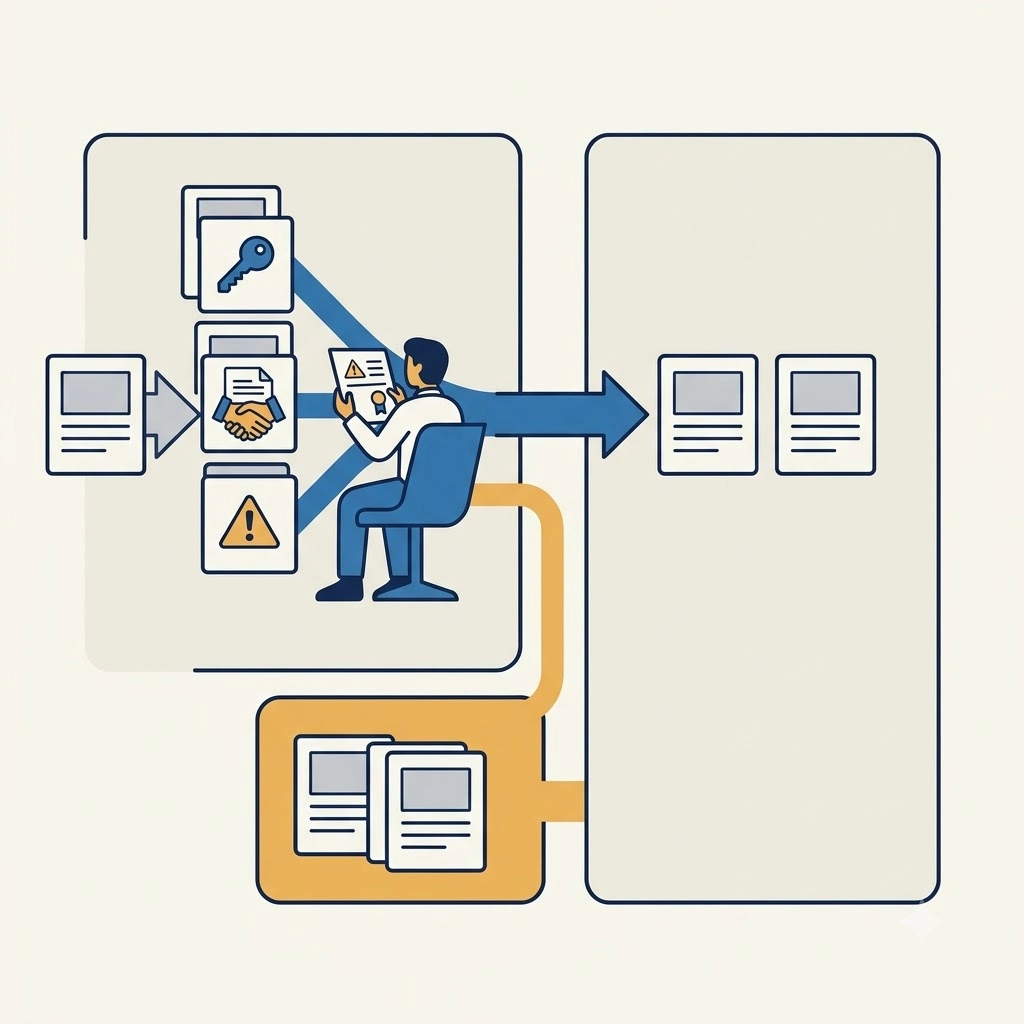
This order matters because a compelling demo can hide a missing prerequisite. A workflow with no named reviewer or no legal data access cannot be funded responsibly, no matter how attractive its projected value looks.
Screening before scoring
Run the gates in sequence. Stop at the first failure and record why. That record becomes the reason a candidate is parked, not a silent omission.
- 01Authority gate: Can this team legally and operationally change this workflow?
- 02Data rights gate: Does the required data exist, and can it be accessed under approved conditions?
- 03Ownership gate: Is there a named accountable reviewer for the outcome?
- 04Risk gate: Does this workflow create unacceptable harm if the AI is wrong?
- 05Value comparison: What measurable outcome improves, and by how much?
- 06Feasibility and change effort: What integration, training, and process change is required?
- 07Reusable foundations: Does this work create data, permissions, or integration assets others can reuse?
Gates one through four are eligibility checks. They produce a yes or no. Only candidates that pass all four move into the scoring comparison below.
The table below ranks four eligible candidates. It is illustrative, not a validated scorecard. Read each column as a judgment your panel records, not as a number to sum.
| Candidate workflow | Authority | Data rights | Owner | Risk level | Value | Feasibility | Reusable foundation | Decision |
|---|---|---|---|---|---|---|---|---|
| Service-request triage | Yes | Approved | Named | Low, reversible routing | Cycle-time reduction | High, existing data | Request data and permissions | Fund pilot |
| Invoice exception handling | Yes | Partial, finance data | Named | Medium, financial impact | Cost containment | Medium, ERP coupling | Shared classification rules | Fund after data rights close |
| Sales proposal drafting | Yes | Approved | Named | Low | Faster response | High | Template library | Fund |
| Predictive maintenance scheduling | Partial, shared with facilities | Not approved | Unclear | High, safety-adjacent | Downtime reduction | Low, sensor gaps | Sensor pipeline | Defer |
Do not turn this table into a weighted total. Adding a benefit score to a risk score and maximizing the sum is a common error. Risk and cost run in the opposite direction from value. Treat risk, cost, and effort as gates or reversed scores, never as points that offset weak data rights.
When to automate, buy, integrate, build, or defer
Once a workflow passes the gates, the next decision is delivery mode. Each option fits a different condition. Choosing the wrong one wastes the most time.
- Non-AI automation: Choose this when rules are stable and the workflow needs no judgment. It is cheaper, more predictable, and easier to audit than a model.
- Buy: Choose this when a proven product fits the workflow and your data model. Buying trades uniqueness for speed.
- Integrate: Choose this when an existing platform already holds the workflow. Extend what you run rather than adding another system.
- Build: Choose this when the workflow encodes unique knowledge or needs deep system coupling. Build only after the gates pass, because it is the slowest path.
- Defer: Choose this when prerequisites are missing. A formal park or kill decision is a disciplined success, not a failure.
Set exit criteria before work begins. Define the maximum acceptable human-review time, a cost-per-outcome ceiling, or a minimum quality threshold. When a pilot misses those criteria, stop or adjust it rather than extending it indefinitely.
This connects to where value actually comes from. BCG’s AI transformation research estimates that only 10% of transformation value comes from the AI application itself. Data and technology contribute 20%, while workflow redesign, culture, governance, and human-AI collaboration drive roughly 70%. A portfolio that funds applications while starving redesign is funding the smallest slice.
The same research distinguishes deploying AI into existing work from reshaping workflows around it. Deploy tends to unlock modest productivity gains. Reshape unlocks substantially more. That gap is why redesign belongs in the funding decision, not in a later change-management phase.
The hypothetical service-request triage passes every gate, so it earns a pilot. The predictive maintenance candidate fails on data rights and ownership, so it is deferred with a stated reason. That contrast is the point of screening first. It protects the portfolio from confident-sounding requests that have no foundation.
The operating model and ownership
Five responsibilities must be separated before any AI workflow goes live: sponsor, process owner, delivery and data, risk, and finance. Each one needs a named person and a defined decision right. When these blur together, approvals stall and no one can say who accepted the risk.

| Role | Owns | Approves | Hands off to |
|---|---|---|---|
| Sponsor | The business outcome and continued funding | Evidence gate results and scope changes | Process owner at operating handoff |
| Process owner | The workflow design, adoption, and daily performance | Process changes and reviewer assignments | Delivery and data for build requests |
| Delivery and data | Build, integration, data access, and monitoring | Technical readiness and test results | Process owner at operating handoff |
| Risk | Risk classification, controls, and review standards | Autonomy level and human oversight rules | Sponsor when risk exceeds tolerance |
| Finance | Funding assumption, full cost, and benefit tracking | Spend against the approved assumption | Sponsor at each review point |
The split only works when the same person does not hold two conflicting rights. A delivery lead who also approves risk controls will approve their own work. Keep approval and delivery separate even in a small team.
Approval, handoff, and human review capacity
Approval is the moment a sponsor accepts an evidence gate result. Handoff is the moment delivery passes a working workflow to the process owner. Both need a written record, or the plan quietly reverts to whoever is loudest.
Human review capacity is the number of qualified people available to check AI outputs. Autonomy must not exceed that capacity. Deloitte’s 2026 outlook found that a combined 69% of respondents sit at the most conservative autonomy levels, while only 12% report end-to-end AI with humans auditing outcomes. That spread reflects review capacity, not model limits.
Role-based practice turns this into behavior. Managers need to support the changed process, and reviewers need a feedback loop that logs corrections. Workforce capability is uneven: Google UK and Public First research found that 15% of the UK workforce qualify as AI Trailblazers with substantial time savings, while 85% sit at earlier stages. Treat proficiency as knowledge capture, not a one-off training event.
Central, distributed, or hybrid
No single model fits every organization. The right choice depends on how much you value risk control, reuse, and domain proximity. A new center of excellence is one option, not a default.
| Model | Favors | Trade-off |
|---|---|---|
| Central | Risk control and reuse | Slower delivery, weaker domain proximity |
| Distributed | Local speed and market fit | Tool duplication, inconsistent governance |
| Hybrid | Shared foundations with local execution | Needs clear boundaries or the center micromanages |
Central works when risk control outweighs speed and reuse matters more than domain proximity. Regulated industries often land here. Distributed works when business units face different markets or regulatory zones and need local speed. Hybrid works when a central team provides shared infrastructure and guardrails while domain teams build and run local use cases.
Risk classification is a design input, not legal advice. The EU AI Act (Regulation 2024/1689) classifies AI systems by risk and requires documented governance and oversight for high-risk systems. Jurisdiction-specific duties need qualified review. For the hypothetical service-request example, triage routing is low risk and reversible, so a hybrid split fits: central teams own the permissions model, and the service operations lead owns the workflow.
Building a roadmap leadership will trust
A trustworthy roadmap shows what happens next, who owns it, what must be true first, and what decision the evidence will unlock. Calendar dates are planning assumptions, not proof of readiness. Integration, testing, rollout, training, and ongoing operating cost belong in the plan, not in a later budget request.
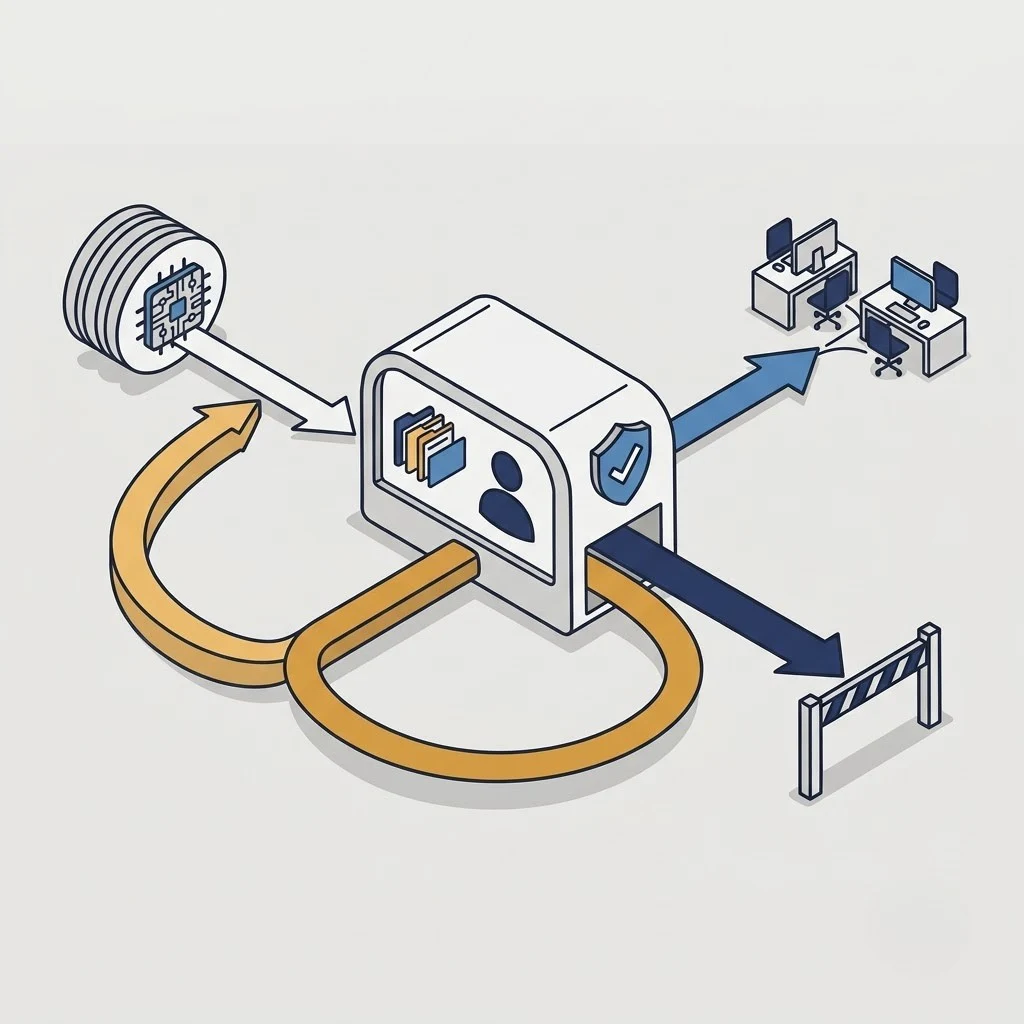
The roadmap below sequences the surviving initiatives from the portfolio screen. Each phase lists a deliverable, an accountable owner, a dependency, and a decision gate. The gate names the explicit stop, adjust, or scale outcome.
| Phase | Deliverable | Accountable owner | Dependency | Decision gate |
|---|---|---|---|---|
| 1. Foundation | Data access map, baseline measurement, permissions model | Delivery and data | Data rights closed for service-request records | Stop if data access cannot be approved; adjust scope to a narrower record set |
| 2. Pilot | Single-agent triage with human review and error logging | Process owner | Phase 1 baseline and review capacity confirmed | Stop if rework exceeds threshold; adjust autonomy level; scale only if quality holds |
| 3. Integration | Connector to the field-service system, testing, rollback plan | Delivery and data | Phase 2 pilot passes its quality gate | Stop if integration destabilizes the system of record; adjust to a read-only link |
| 4. Rollout | Two service teams trained, operating cost tracked, handover pack | Sponsor | Phase 3 integration signed off | Scale to more teams if adoption and rework data hold; adjust training if adoption lags |
Phase 1 covers data access and baseline measurement. Phase 2 runs a single-agent triage pilot with human review. Phase 3 integrates with the field-service system. Phase 4 rolls out to two service teams and makes a scale decision based on adoption and rework data.
This is the same hypothetical service-request workflow introduced earlier, not a client project. It advances here to show how dependencies chain. You cannot start the pilot before the baseline exists, because you would have nothing to measure against.
Two planning assumptions shape the sequence. Agentic capability is moving fast: IDC predicts that by 2026, 40% of G2000 job roles will involve working with AI agents. That is a reason to keep the architecture modular, not a reason to skip the foundation phase. Budget expectations are also rising. US enterprises above $1 billion in revenue planned an average of $202 million in AI spending over a 12-month period, according to the Zinnov analysis. Planned spend is not realized value, so tie each phase to its own evidence gate.
Use a 90-day review cadence with two to three named KPIs, named owners, and a one-sentence hypothesis per phase. Add explicit rollback and error budgets before any write-access goes live. Treat the cadence as a planning assumption, not proof that transformation finishes on schedule.
Measuring value honestly
Measure seven components: baseline, outcome, quality, adoption in actual work, full cost, measurement window, and accountable reviewer. Each one answers a different question. Skipping any of them lets activity masquerade as results.
Capacity released is not automatically cash saved. If a team saves ten hours a week but nobody changes headcount, scope, or service levels, the balance sheet does not move. Count released capacity as a benefit only when you can name where it goes.
| Component | What it measures | Example for service-request workflow | Who reviews |
|---|---|---|---|
| Baseline | The pre-AI performance level | Median request resolution time and rework rate for the prior quarter | Process owner |
| Outcome | The business result the strategy targets | Reduction in end-to-end resolution time | Sponsor |
| Quality | Whether output still meets the standard | Error rate and rework count on AI-assisted triage | Risk |
| Adoption in actual work | Whether people use it in the real workflow, not a demo | Share of requests routed through the AI path | Process owner |
| Full cost | Integration, testing, rollout, training, and ongoing operations | Build, connector, training hours, and monthly run cost | Finance |
| Measurement window | The period before judging the result | One full quarter after rollout, not the pilot week | Sponsor |
| Accountable reviewer | The named person who signs off on the number | Service operations lead | Sponsor |
The full-cost row is where most ROI claims break. BCG’s AI transformation research estimates that only 10% of transformation value comes from the AI application itself, while roughly 70% comes from workflow redesign, culture, governance, and human-AI collaboration. If your cost model only counts the application, you are pricing the smallest slice and ignoring the largest.
Adoption deserves its own line because a working tool is not a used tool. Deloitte’s 2026 outlook found that 48% of surveyed organizations introduced AI without redesigning the workflows or roles it sits within. A pilot can pass every technical test and still fail here. Measure usage inside the real workflow, not logins or prompt counts.
Two accounting rules keep the numbers honest. First, do not double count. If the same saved hour appears under both “cycle time” and “labor cost,” you have counted it twice. Second, do not claim causation you cannot support. If resolution time dropped during a seasonal lull, the AI may not be the reason.
When to revise the strategy
Revise the strategy when one of four triggers fires. Each trigger changes a specific canvas field and has a named reviewer.
- Failed evidence gate: The pilot misses its quality or cost threshold. Change the autonomy level or scope, and let the sponsor decide whether to stop.
- Changed dependency: A data source, integration, or vendor assumption shifts. Change the dependency field and the phase that relied on it. The delivery and data lead reviews.
- Adoption shortfall: Usage in actual work stays below target after the measurement window. Change the training and change plan, not the model. The process owner reviews.
- New risk finding: A control gap or regulatory concern appears. Change the risk classification and autonomy rules. Risk reviews and escalates to the sponsor.
Treat revision as a scheduled decision, not a failure. A strategy that never changes is usually one nobody is testing against evidence.
Deciding on outside support
External support earns its place only when it removes a specific blocker. It is not a default first step. The right question is not “should we hire help?” but “which blocker is stopping us, and what closes it?”

Three blocker types lead to different next actions.
| Blocker | What it looks like | Appropriate next step | When support is premature |
|---|---|---|---|
| Unresolved readiness | Data rights, permissions, integration, or review capacity are not in place | A short, scoped readiness assessment that names the missing prerequisite | When the missing item is a decision only your sponsor can make |
| Missing execution plan | The objective and workflows are clear, but no phased plan, owner map, or evidence gate exists | Planning help to build the canvas, roadmap, and decision gates | When leadership has not yet agreed on the objective |
| Missing delivery capacity | The plan is sound, but your team cannot build, integrate, or run it at the required pace | Implementation support for build, integration, and rollout | When the plan is still a hypothesis and nothing has passed a gate |
The order matters. Readiness comes before planning, and planning comes before delivery. Hiring implementation support while data rights are unresolved buys speed you cannot use.
A simple rule keeps spending honest. If your team can close the blocker with an internal decision, do that first. If the blocker is a capability or capacity gap you cannot close in the required window, external support is reasonable.
For the hypothetical service-request workflow, the blocker was never the model. It was data access and review capacity. That points to a scoped assessment, not a large build. The same logic applies to your portfolio: match the support to the blocker, not to the ambition.
Frequently asked questions
What should an AI transformation strategy actually decide?
It should decide the objective, the current constraint, which workflows to fund now, which to defer, who owns each outcome, what must be true before work starts, the funding assumption, the evidence gate, and the next review point. If a decision is missing, the plan is incomplete.
How do I diagnose our starting point without a fake maturity score?
Inspect six areas: current AI use, permissions, data access, integration readiness, team capacity, and change readiness. Record what exists, what is missing, and what each missing item changes. The output is a next action, not a score.
How do I prioritize the AI portfolio fairly?
Screen before you score. Confirm authority, data rights, clear ownership, and acceptable risk first. Only candidates that pass those gates move to value, feasibility, change effort, and reusable foundations. A high score on a workflow you cannot legally change is meaningless.
Who should own what in the operating model?
Separate five responsibilities: sponsor, process owner, delivery and data, risk, and finance. Give each a named person and a defined decision right. Keep approval and delivery separate, so nobody approves their own work.
How do I build a roadmap leadership will trust?
Show what happens next, who owns it, what must be true first, and what decision the evidence unlocks. Treat calendar dates as planning assumptions. Include integration, testing, rollout, training, and ongoing operating cost in the plan.
How do I measure value without overclaiming?
Measure baseline, outcome, quality, adoption in actual work, full cost, measurement window, and accountable reviewer. Count released capacity as a benefit only when you can name where it goes. Avoid double counting and unsupported causal claims.
When should we revise the strategy?
Revise when an evidence gate fails, a dependency changes, adoption falls short, or a new risk finding appears. Each trigger changes a specific canvas field and has a named reviewer. Treat revision as a scheduled decision, not a failure.
When is outside support genuinely useful?
Only when it removes a specific blocker you cannot close internally in the required window. Match the support to the blocker: readiness, execution planning, or delivery capacity. If an internal decision closes the gap, do that first.
When should I not fund an AI initiative?
Do not fund it when authority or data rights are missing, no accountable reviewer exists, the risk is unacceptable, the workflow is not worth redesigning, or a cheaper non-AI fix solves the problem. Parking it with a stated reason is a disciplined decision, not a failure.