AI consulting helps small businesses turn one repetitive, costly workflow into a measurable automation win without wasting budget on tools they do not need. This guide explains what credible consulting actually includes, when it is worth the investment, and how to choose a focused first project your team can own. It compares doing it yourself, commissioning an assessment, and engaging implementation support, then covers cost drivers, risk controls, and the questions that reveal a good partner. Use it to move from scattered AI experiments to a scoped workflow with a baseline, a success metric, and a clear stop-or-scale decision.
What AI consulting means for a small business
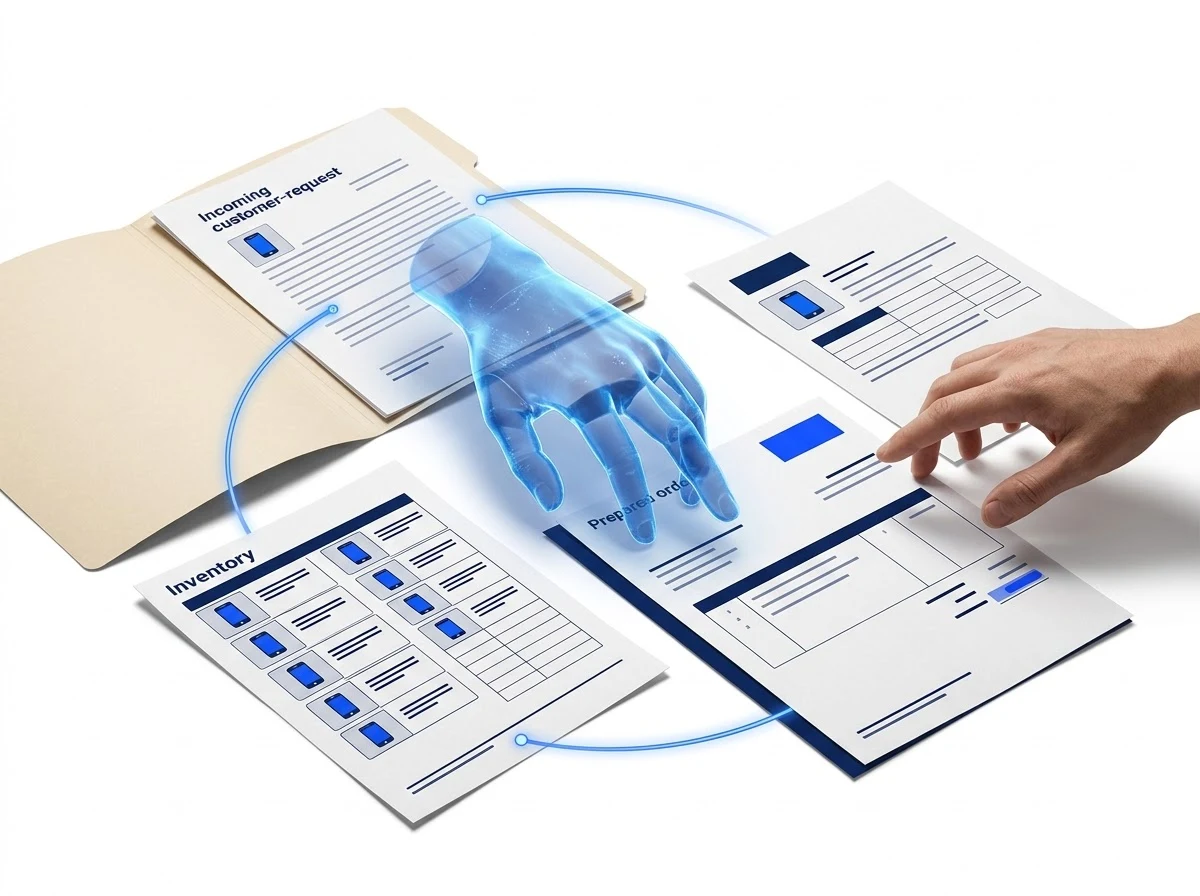
AI consulting is workflow-led advisory plus implementation support. It starts with a named business problem, not a tool catalogue. A credible consultant maps how work actually happens, identifies the bottleneck, and only then proposes a solution. That solution may be a simple automation, a purchased product, or no AI at all.
The distinction matters because many small-business leaders have already tried generic AI tools without a clear result. They open a chatbot, draft a few emails, and then wonder what changed. Consulting changes the sequence: first understand the process, then define the outcome, then choose the technology.
Workflow-led advisory, not tool resale
A vendor-led engagement starts with a product and looks for a place to fit it. A workflow-led engagement starts with the process and may recommend no AI at all. That is the core difference between buying software and buying consulting.
The table below shows how the two approaches differ in practice.
| Dimension | Tool resale approach | Workflow-led consulting approach |
|---|---|---|
| Starting point | A product or platform | A named business problem |
| First question | Where can we fit this tool? | Which step consumes the most time? |
| Recommendation logic | Find a use case for the product | Match the solution to the process |
| Possible outcome | Tool is deployed | AI, simple automation, or no AI at all |
| Success measure | Tool adoption or licences | Time saved, error reduction, or cost avoided |
| Team ownership after exit | Often depends on vendor | Transferred through training and handover |
Credible AI consulting for a small business covers four things:
- Workflow audit: Mapping a specific operation to find the manual step consuming the most time.
- Quick-win automation: Implementing one targeted fix, such as a draft generator or a data extraction step.
- Practical roadmap: Designing a lightweight plan the existing team can run without a dedicated IT department.
- Staff training and handover: Making sure employees can operate and maintain the tool after the consultant leaves.
An illustrative example helps here. Imagine a small retail team spends hours answering common refund requests. A tool-first approach might say: “Deploy a customer support chatbot.” A workflow-led approach would say: “Draft replies for common refund requests using approved policy documents, with a human staff member reviewing every draft before it goes out.” The second version is narrower, safer, and easier to measure. It treats the refund process, not the software, as the unit of work.
What a credible engagement includes
A credible engagement moves through a clear sequence. The full detail appears later in this guide, but the shape matters at the start.
The typical stages are discovery, process mapping, prioritization, pilot or prototype, measurement, rollout, training, monitoring, and handover. Each stage produces something tangible: a documented workflow, a scored shortlist, a working prototype, a measured result, or an owned operating guide. If a partner cannot describe these stages and their outputs, that is a warning sign.
The key test is simple: does the consultant leave you with a working process your team understands and owns? If the answer is no, you may have bought a product demonstration rather than consulting.
When AI consulting is useful
AI consulting is most useful when you have a specific operational bottleneck, no in-house technical owner, and a need for a business case before spending. It helps you move from vague interest to a scoped, reviewable project. Without those three conditions, consulting often produces advice that does not change daily operations.
Readiness signals that point to a good first project
You are ready to get value from AI consulting when the following conditions exist. One missing item is not always fatal, but most should be present.
| Readiness signal | What it looks like in practice | Why it matters |
|---|---|---|
| Named business problem | You can point to the exact workflow step that consumes time or creates errors | Scopes the project to a real bottleneck |
| Clear process owner | One person can explain the rules and approve changes | Keeps decisions moving without committee delays |
| Baseline metric | You know current time, cost, or error rate | Gives you a number to compare against later |
| Defined success measure | The team agrees what better looks like | Prevents vague “AI worked” claims |
| Usable data with permissions | Inputs exist in an accessible format and are legally usable | Avoids stalled pilots and compliance surprises |
| Human review capacity | Someone has time to check outputs before they go live | Protects customers and reduces risk |
| Stop-or-scale gate | Conditions for continuing, changing, or ending are set before the pilot | Prevents endless experiments with no decision |
These signals act as a pre-flight checklist, not a scorecard. They tell you whether the ground is stable enough for a first project. The table order moves from problem definition to decision authority, then to measurement, data, review, and finally a way to stop or expand. That sequence mirrors how a scoped pilot should be designed: start with the problem, end with the exit condition.
The gap between tool use and real integration helps explain why advisory support is often needed. According to the Goldman Sachs 10,000 Small Businesses survey, only 14% of US small businesses have fully integrated AI into core operations, even though 76% report using AI tools. Many teams are experimenting, but few have turned that into an owned workflow with a measured result.
Non-readiness signals that suggest waiting
Some businesses should delay consulting. The warning signs below usually mean a consultant cannot yet produce a useful outcome.
- Undefined problem: You want to “use AI” but cannot name the process or the bottleneck.
- No data or unavailable data: The required inputs are missing, locked, siloed, or legally unclear. This includes data you cannot export from a vendor system or access without violating a contract.
- No process owner: Nobody can explain the current rules or approve a change.
- No review capacity: The team is too busy to check outputs before they go live.
- Unclear success metric: You cannot say what better looks like after the project.
Hiring a consultant before these conditions exist usually produces a generic roadmap that does not change operations. A partner can help you clarify some of these items, but the core process knowledge must come from your team.
The expertise barrier reinforces when outside help makes sense. The same Goldman Sachs survey found that 73% of small business owners cite lack of technical expertise and training as a primary barrier to implementing AI effectively. That barrier matters most when the readiness signals above are already present. In that case, a focused consultant can help you turn a clear workflow into a bounded, measurable first project.
How to choose your first AI workflow
Choose a recurring, time-consuming task with low risk and a clear before-and-after baseline. Do not start with a tool. The goal is one workflow your team can measure, review, and either stop or scale.

Start with a workflow, not a tool
The wrong question is “How can we use ChatGPT?” The right question is “What keeps the team busy or stuck?” That framing shift changes the entire project.
A tool-first search produces a catalogue of possibilities. A workflow-first search produces a shortlist of real bottlenecks. You already know which steps consume the most time. You may not know which of those steps is safe to automate.
Use the intern test before choosing anything. If you would not trust a capable intern with clear written rules to do the task unsupervised, do not trust AI without human review. This heuristic separates human-reviewed automation from fully autonomous AI.
A good first workflow always sits in the first category. AI drafts, extracts, or summarizes. A person checks the output before it reaches a customer, vendor, or public channel.
Score candidate workflows against six criteria
Use a two-stage decision aid. This is an illustrative framework, not a validated scorecard. It does not prove ROI. It helps you compare candidates consistently.
Stage one is an eligibility screen. Defer any candidate whose potential harm cannot be contained by human review. Also defer any candidate whose required changes exceed current team capacity. These two factors are gates, not scores.
Stage two applies only to candidates that pass the gate. Score four benefit criteria on an anchored 1 to 5 scale, where 1 is weak and 5 is strong. The maximum benefit total is 20.
The first table answers one question: which candidate offers more measurable benefit? It shows the four benefit criteria and the total for each workflow that already passed the eligibility screen.
| Criterion | What it measures | Refund email drafts | Inventory report summaries |
|---|---|---|---|
| Business value | Time saved, cost avoided, or errors prevented | 5 | 3 |
| Frequency | How often the task recurs | 5 | 2 |
| Rule clarity | A written policy or standard exists | 4 | 4 |
| Data access | Inputs are available and legally usable | 3 | 4 |
| Benefit total | Maximum 20 | 17 | 13 |
The second table answers a different question: did each candidate clear the two eligibility gates before scoring? It is read before the benefit table in practice, even though both appear together here for comparison.
| Eligibility gate | Refund email drafts | Inventory report summaries |
|---|---|---|
| Risk contained by human review? | Yes | Yes |
| Change effort within current capacity? | Yes | No, needs new data export step |
Define each criterion before scoring. Business value means time saved, cost avoided, or errors prevented. Frequency means how often the task recurs. Rule clarity means a written policy or standard exists. Data access means inputs are available and legally usable.
Rank only within this illustrative comparison. Do not add risk or change effort raw scores to the benefit total. A candidate with high business value still fails if risk cannot be contained.
In the table, refund email drafts score 17 of 20. Inventory report summaries score 13 but fail the change-effort gate. The simple scoring approach does not pick the winner alone. The eligibility screen removes the second candidate first.
One illustrative example of choosing a workflow
Imagine a small retail team handling refund requests. The baseline assumption is 40 refund requests per week at 25 minutes each. That equals 1,000 minutes, or 16 hours 40 minutes per week.
The proposed workflow is narrow. AI drafts replies for common refund requests using approved policy documents. A human staff member reviews every draft before it goes out.
This passes the eligibility gate. Potential harm is contained because no draft reaches a customer unreviewed. Change effort is modest because the team already follows a policy.
The benefit score is 17 of 20. High frequency, clear rules, accessible data, and meaningful time impact make it a strong first pilot. The score supports selection. It does not prove the pilot will succeed.
Stop here at selection. The same example continues into the engagement sequence in the next section.
DIY, focused assessment, or implementation support
The right path depends on four things: your readiness, your risk tolerance, your capacity to own the result, and the deliverable you actually need. No single option is universally better. A technically confident team with a low-risk workflow may move faster alone. A leader facing unclear data permissions or compliance concerns may need a short assessment first.
A comparison table for the three paths
This table is a decision aid, not a ranking. Use it to see which path matches your current situation.
| Criterion | DIY | Focused assessment | Implementation support |
|---|---|---|---|
| Readiness required | Clear process, usable data, in-house technical skill, review capacity | Named problem, baseline, process owner, unresolved risk or prioritization questions | Scoped workflow, defined success metric, approval to change the process |
| Risk level | Highest if skills or review gates are missing | Low; no production change occurs | Moderate; contained by pilot scope and human review |
| Ownership after engagement | Already internal | You own the roadmap and scorecard, not a built workflow | Transferred through training, documentation, and handover |
| Expected deliverable | A working test or small automation | Prioritized roadmap, readiness scorecard, risk notes | Working pilot or production workflow with operating guide |
| Typical fit | Low-risk, standalone task with confident technical owner | Multiple candidate workflows or unresolved governance questions | Clear bottleneck, missing implementation capacity, or integration needs |
Read the table by column, not by row. A business can score high on readiness for DIY but still lack the review capacity to run it safely. That combination points toward implementation support, not a solo build.
What each path delivers and where it breaks down
Each path has a distinct output and a distinct failure mode.
DIY can mean lower upfront spend and faster setup. It suits a technically confident team testing a low-risk, standalone workflow. But DIY is not automatically the cheapest option. Include staff time, review effort, integration work, and ongoing maintenance in the total cost. The path breaks down when skills, data access, or review capacity are missing. In that case, outside support can cost less in real terms than a stalled internal experiment.
Focused assessment delivers a prioritized roadmap and a readiness scorecard. It stops before implementation. That is a feature, not a weakness. It gives you evidence before you commit to a larger spend. The limit is clear: you receive a plan, not a working workflow. If your team already knows the exact process and metric, an assessment may add less value than a small pilot.
Implementation support delivers a working pilot or production workflow. It includes training and handover so your team can run the result. The cost and change effort are higher. The benefit is stronger ownership transfer and a measured outcome rather than a recommendation. This path breaks down when the workflow is still undefined or the success metric is unclear. Implementation cannot fix a missing business problem.
What a credible engagement should deliver
A credible engagement moves from a bounded test to an owned, monitored workflow. Discovery should stay proportionate to your uncertainty, scope, and risk. A short discovery phase is not automatically shallow. A long one is not automatically thorough. What matters is whether each stage produces a tangible output, names an owner, and sets a condition for moving forward.
The engagement sequence in numbered steps
Use the same illustrative refund workflow from the selection section. The agreed baseline is 40 refund requests per week at 25 minutes each, or 1,000 minutes weekly. These are planning assumptions, not promised savings.
- 01Discovery. Output: a documented problem statement, constraints, and data permissions. Owner: the business process owner. Move forward when the workflow, its inputs, and its legal constraints are clear enough to map.
- 02Process mapping. Output: a visual map of the current refund-handling steps, including where policy applies and where exceptions occur. Owner: the consultant drafts it, the process owner confirms it. Move forward when both sides agree the map reflects reality.
- 03Prioritization. Output: a shortlist of candidate automation points with the refund draft step selected as the pilot. Owner: the business leader approves the choice. Move forward when the selected step passes the risk and change-effort gates from the earlier framework.
- 04Pilot or prototype. Output: a working draft generator that uses approved policy and order data. A staff member reviews every draft before sending. Owner: the consultant builds it, the process owner tests it. Move forward only after review gates work and exception escalation is defined.
- 05Measurement. Output: a comparison against the 1,000-minute baseline using drafting time, error count, and review burden. Owner: the process owner collects the numbers. Move forward when the business decides to stop, adjust, or scale based on thresholds agreed before the pilot began.
- 06Rollout. Output: the workflow goes live for the agreed scope, not the whole team at once. Owner: the process owner manages the rollout. Move forward when the first group uses the workflow without unresolved operational issues.
- 07Training. Output: documented operating steps and hands-on practice for staff. Owner: the consultant trains, the process owner confirms competence. Move forward when staff can run the workflow without the consultant present.
- 08Monitoring. Output: a named monitoring owner, review cadence, and escalation path for errors or drift. Owner: an internal person, not the consultant. Move forward when monitoring runs for an agreed period without unresolved gaps.
- 09Handover. Output: a handover pack with configuration, permissions, operating steps, exception handling, monitoring ownership, and a rollback procedure. Owner: the business accepts the pack. Move forward when the team can operate and recover the workflow independently.
A pilot is not production. A pilot is a bounded test with a baseline and a stop-or-scale gate. Production adds training, monitoring, and handover. Treating a pilot as a finished project is a common failure mode.
Risk controls you should expect
Even a small workflow needs controls. Ask how the engagement will handle each item below.
- Data protection: Which data can the workflow use, and where is it stored or processed?
- Permissions: Who can access the tool, inputs, and outputs?
- IP terms: Who owns custom work, prompts, and configuration after the project ends?
- Accuracy checks: How are errors detected before output reaches a customer?
- Human approval gates: Which steps always require a person to approve the result?
- Audit trails: What record shows who reviewed what and when?
- Model dependency limits: What happens if the underlying model changes, fails, or becomes unavailable?
- Monitoring: Who watches performance after handover, and how often?
The NIST AI Risk Management Framework and SBA guidance are useful general references for structuring these controls. They are not legal advice. Data protection, privacy, and IP obligations vary by jurisdiction and contract, so confirm the specific requirements that apply to your business before starting.
Cost and timeline drivers
There is no universal price for AI consulting. The shape of the workflow and the state of your data drive most cost differences.
What actually changes the price
Five drivers explain most project cost gaps. They matter more than the consultant’s brand or the recommended tool.
- Workflow complexity: A single drafting step costs less than a workflow with multiple decision branches, exceptions, and approval layers.
- Data readiness: Clean, accessible inputs reduce preparation time. Missing, siloed, or legally unclear data adds discovery and remediation work.
- Integration depth: A standalone workflow costs less than one that must connect to your CRM, billing system, or other software.
- Review burden: More human checks, reviewers, and approval rules increase operating cost and implementation effort.
- Rollout scope: One team pilot costs less than a company-wide deployment with training across multiple locations.
These drivers also explain why scoping matters before signing. According to a techUK and YouGov survey, high costs and uncertain ROI are cited as primary adoption barriers by 22% and 25% of smaller UK businesses respectively. A bounded first workflow directly addresses both concerns. It keeps cost controlled and gives you a measured result before spending more. No credible consultant should promise guaranteed ROI. A disciplined scope and a clear baseline make the return measurable, not certain.
Illustrative market ranges, not universal prices
The table below shows publisher-reported ranges, not verified market benchmarks. Treat them as planning references. Your actual quote depends on the five drivers above.
| Engagement type | Publisher-reported range | Billing basis | Scope caveat |
|---|---|---|---|
| Advisory | $100-$300 per hour | Hourly | Strategy, process mapping, or technical guidance without full implementation. |
| Fixed-scope quick-win project | $2,500-$10,000 | Fixed project fee | One bounded workflow such as a single drafting or summarization step. |
| Fractional retainer | $1,500-$8,000 per month | Monthly retainer | Ongoing advisory, optimization, or light implementation support. |
| Clutch average | $200-$500 per hour | Hourly | Reported via Founders Workshop; directional only until the primary Clutch data is verified. |
The first three ranges come from Iternal Technologies as an advisory pricing guide. The Clutch figures appear through a secondary source, so treat that row as directional only. Confirm the primary Clutch data before relying on it for a budget decision. A publisher pricing guide is not a market-wide benchmark, and none of these numbers are verified facts. Use them to compare engagement shapes, not to predict your final invoice.
What determines the delivery timeline
Elapsed time is not the same as engineering effort. Many projects wait longer for access or approvals than for actual build work.
- Approved scope and data access must come before build. Without them, the team cannot start.
- Integration and representative tests must pass before a pilot. A workflow that works in a demo may fail on real data.
- Enough real cases and reviewer availability must exist before a stop-or-scale decision. A pilot with five examples proves little.
- Training, monitoring, and acceptance must finish before handover. These steps often take longer than leaders expect.
Some activities can overlap. Training can begin while monitoring runs. Data cleanup can proceed alongside process mapping. But scope approval, integration, and pilot results block the next stage. Ask any partner for milestone-based estimates and the assumptions behind them. A credible quote names dependencies, not just a number of weeks. Do not accept a fixed duration without seeing which activities run in parallel and which gate the next phase.
Questions to ask an AI consulting partner
The right questions reveal whether a partner plans to leave you with a working, owned workflow or a dependency. A credible consultant welcomes these questions. A tool reseller usually avoids them.
Deliverables, ownership, and data handling
Ask these questions before you sign anything. They expose whether the engagement is built around your workflow or the consultant’s preferred stack.
- What is the smallest viable project you recommend? A credible partner narrows the scope. If every answer leads to a larger platform purchase, treat that as a warning sign.
- How will you measure success for that project? Ask for the specific baseline, target metric, and measurement window. The answer should match the workflow you discussed, not a generic productivity claim.
- What will I own at the end? You should leave with documentation, configuration, operating steps, and the ability to run the workflow without the consultant. Ask for the specific handover pack, not a verbal promise.
- How will my data be handled, stored, and protected? Get concrete answers about processing location, retention, access controls, and whether your data trains a shared model. Vague reassurances are not enough.
- Who owns any custom work or IP? Clarify prompts, integrations, configuration files, and any custom code. Ownership should transfer to you where the work is built for your business.
- Can you share references from similar small businesses? Ask for one or two contacts who completed a comparable engagement. Listen for how the reference describes handover, not just the initial result.
These questions do not require technical depth. They require written answers in the proposal or contract.
Review gates, training, and handover
A working pilot means little if your team cannot review outputs or run the system after the consultant leaves.
- Where are the human review gates? Every customer-facing or financially significant output needs a named person who approves it. Ask which steps are automated and which always require a human.
- What training will my team receive? Training should include hands-on practice with real examples, not a recorded walkthrough. Confirm who trains, how long, and how competence is verified.
- How will monitoring and maintenance work after you leave? Ask who watches for errors, how often, and what happens when the underlying model changes or fails. The consultant should not be the permanent monitoring owner.
- What happens if the pilot does not meet the success metric? The answer should include a stop-or-adjust decision, not a push toward a larger rollout. A credible partner defines failure conditions before the pilot starts.
- What does self-management look like in week one after handover? Ask for a concrete runbook: who logs in, what they check daily, and how to pause the workflow. If routine tasks require the consultant on call, ownership has not really transferred.
Listen for specific, documented answers. If a partner cannot describe review gates, training, or handover in plain language, the engagement will likely end with you dependent on their availability.
A low-risk first step
A focused governance assessment can clarify readiness before you commit to implementation. It is not the right move for every reader. The smallest sensible action depends on which blocker is actually stopping you.
Choose the next step for your current blocker
Match your next step to the problem in front of you, not to a generic AI roadmap.
- The process is still unclear. Document one workflow and its current baseline internally. Name the owner, the inputs, the output, and the time it takes today. Do not hire anyone until this exists.
- The workflow is clear, low-risk, and the team has skills and capacity. Propose a bounded DIY test. Pick a starter category such as content drafting, summarization, or reformatting data. Keep a human review gate on every output.
- Data permissions, risk, or ownership remain unresolved. A focused governance assessment may help. This is the case where outside structure reduces the chance of a stalled or unsafe pilot.
- Scope and acceptance conditions are ready, but implementation capacity is missing. Discuss implementation support directly. Do not pay for another planning document you do not need.
The order above is deliberate: it separates readiness blockers from execution gaps. The first two rows are internal actions you can take without external spend. The third row is the only one where an assessment is the natural next step. The fourth row assumes readiness already exists, so paying for discovery would add cost without adding clarity. These are decision gates, not a ranking of value. A business in the fourth row is not more advanced than one in the first; it simply faces a different constraint.
If you do pursue an assessment, bring five things: one workflow description, its baseline, a sample of approved inputs, a named owner, and the constraints or decision you need help making. That preparation keeps the engagement focused and prevents a generic discovery exercise.
A governance assessment is not a legal audit. It does not replace jurisdiction-specific compliance advice on privacy, IP, or sector regulation. Treat it as a structured way to surface risks and decision gates before you spend more.
Frequently asked questions
What is AI consulting for a small business?
AI consulting is workflow-led advisory plus hands-on implementation support. It starts with a named business problem, not a tool catalogue. A credible consultant helps you map a repetitive process, choose one measurable automation target, run a bounded pilot, and transfer ownership to your team. The goal is a working, monitored workflow you can operate independently.
When should a small business use AI consulting?
Use it when you have a specific operational bottleneck, no in-house technical owner, and a need for evidence before spending. You also need a process owner, a baseline metric, usable data, and review capacity. If the problem is undefined or nobody can review outputs, wait. Consulting cannot fix a missing business problem.
How do I choose the first AI use case?
Choose a recurring, time-consuming task with low risk and a clear before-and-after baseline. Score candidates against business value, frequency, rule clarity, data access, risk, and change effort. First remove candidates whose harm cannot be contained by review or whose change effort exceeds capacity. Then compare the rest. Start with a workflow, not a tool.
How much does AI consulting cost?
There is no universal price. Publisher-reported ranges include $100 to $300 per hour for advisory work, $2,500 to $10,000 for a fixed-scope quick-win project, and $1,500 to $8,000 per month for a fractional retainer. These are planning references, not verified benchmarks. Your quote depends on workflow complexity, data readiness, integration depth, review burden, and rollout scope.
How long does a first AI project take?
Elapsed time depends on scope approval, data access, integration, reviewer availability, and training. Many projects wait longer for access or approvals than for build work. A bounded pilot can move faster than a full rollout, but training, monitoring, and acceptance must finish before handover. Ask for milestone-based estimates and the assumptions behind them.
Should I do it myself, buy an assessment, or hire implementation support?
It depends on your readiness, risk tolerance, ownership capacity, and the deliverable you need. DIY suits a technically confident team testing a low-risk, standalone workflow. A focused assessment delivers a roadmap but no working system. Implementation support delivers a working pilot with training and handover. Choose the path that matches your current blocker.
What questions should I ask an AI consulting partner?
Ask about the smallest viable project, how success will be measured, and what you will own at the end. Clarify data handling, storage, and IP terms. Ask where human review gates sit, what training your team will receive, and how monitoring works after the consultant leaves. Also ask what happens if the pilot misses its success metric. Written answers should appear in the proposal or contract.
What is a low-risk first step?
Document one workflow and its current baseline internally. Name the owner, inputs, output, and time required. If the workflow is clear, low-risk, and your team has capacity, propose a bounded DIY test. If data permissions, risk, or ownership remain unresolved, a focused governance assessment can clarify readiness before you commit to implementation. Do not pay for planning you do not need.