
What Is AI Transformation? What Changes Beyond AI Tools
September 21, 2026 See more
B2B SaaS marketing strategies combine demand generation, product-led growth, and account-based tactics to acquire and retain enterprise software users. Effective campaigns align distribution channels with your business model, reduce churn rates, and focus on long-term annual recurring revenue over short-term traffic. Brands often scale their campaigns faster by partnering with an outsourcing marketing service to handle specialized acquisition tasks. This guide details foundational frameworks, enterprise target tactics, and metric optimization methods for sustainable software growth.
B2B SaaS marketing centers on acquiring and retaining business customers for software delivered on a subscription basis. Unlike one-time product sales, SaaS marketing focuses on the entire customer lifecycle and relies heavily on structured subscription models. This requires a shift from transactional sales to continuous value delivery across every stage of the user journey.
Effective B2B SaaS marketing relies on three foundational pillars:
Key metrics like Customer Acquisition Cost and Lifetime Value are vital for evaluating financial health. Blended customer acquisition costs average around $273, splitting into roughly $205 for organic channels and $341 for paid acquisition, according to the Prospeo B2B SaaS CAC Benchmark Report. Marketing efforts directly influence lifetime value by fostering customer loyalty and reducing churn. Net Revenue Retention is also critical, measuring revenue growth from existing customers through upgrades and expansions.

This focus on the customer lifecycle and recurring revenue distinguishes B2B SaaS marketing from traditional software sales. Strategies must align with subscription economics to ensure customers derive ongoing value. For businesses seeking specialized capabilities, exploring outsourcing marketing service can accelerate pipeline creation and demand generation.
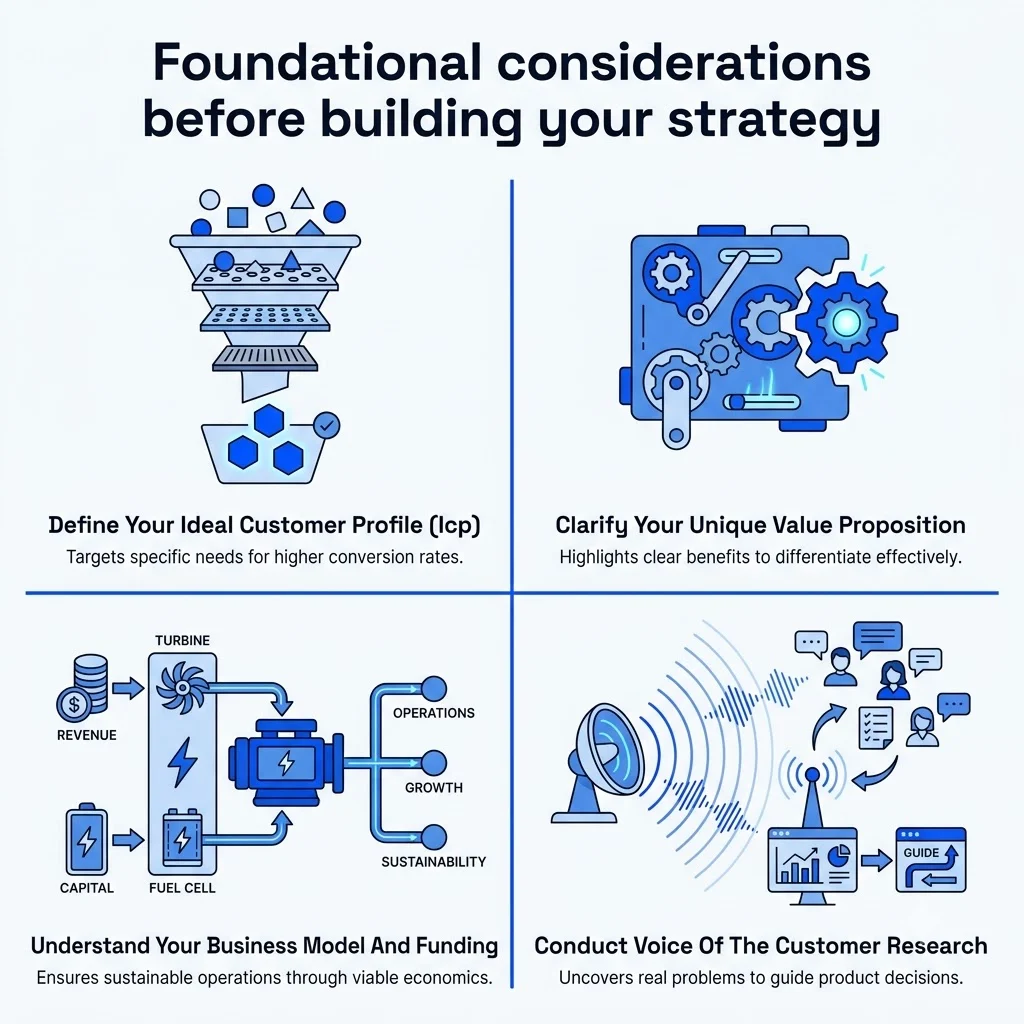
Before implementing specific B2B SaaS marketing tactics, establishing a strong strategic foundation is essential. This involves understanding your core business, your ideal customer, and what makes your solution unique. These prerequisites ensure your marketing efforts are targeted and efficient.
Clearly defining your Ideal Customer Profile (ICP) is paramount for successful B2B SaaS marketing. This process requires deep research into your target audience’s specific pain points, unmet needs, and their typical buyer journey. Understanding their challenges allows you to tailor your messaging and product positioning effectively. For instance, a SaaS company selling project management software might identify its ICP as mid-sized construction firms struggling with project delays and budget overruns. This detailed understanding guides all subsequent marketing activities.
Articulating a compelling unique value proposition (UVP) is critical to stand out in a crowded market. Your UVP should clearly communicate what makes your SaaS solution distinct and why it is the best choice for your ICP. It needs to resonate with their specific problems and highlight the tangible benefits your product offers. For example, a cybersecurity SaaS might emphasize its AI-driven threat detection capabilities that offer real-time protection against emerging threats, a benefit competitors may not match. This clarity helps potential customers quickly grasp your offering’s relevance.
Your business model and funding status significantly influence your marketing strategy and growth velocity. Bootstrapped companies often focus on cost-effective, organic growth channels, prioritizing fast return on investment and sustainable customer acquisition. Venture-backed companies, conversely, may have the capital to invest more heavily in paid acquisition and aggressive market scaling.
| SaaS Business Model | Primary Acquisition Motion | Ideal Funding Context | Strategic Focus |
|---|---|---|---|
| Freemium | Self-serve product-led growth | Venture-backed or high-volume | High user acquisition, low touch, fast feedback loops |
| Limited Trial | Hybrid product and sales-led | Bootstrapped or moderate funding | Value demonstration within restricted trial window |
| Enterprise Demo | High-touch sales-led motion | Well-funded or profitable | Account-based marketing, long sales cycles, high ACV |
Gathering direct feedback through Voice of the Customer (VoC) research provides invaluable insights for your messaging and positioning. This includes surveying current users, analyzing support tickets, and conducting user interviews with potential buyers. VoC data helps refine your content strategy, inform product development, and identify overlooked marketing opportunities. According to Omnibound primary research, approximately 71% of B2B software decision-makers rely on AI chatbots for research at some stage of their purchasing journey. This shift makes gathering accurate customer feedback more urgent than ever to ensure your brand messaging appears in AI-driven recommendation sources.
Driving sustainable growth for a B2B SaaS business requires a multifaceted approach. This involves building organic visibility, optimizing conversion pathways, fostering user engagement, and leveraging personal brands. Effective strategies combine educational content with targeted outreach and community building, protecting recurring revenue and lifetime value over time.
Creating valuable, educational content is fundamental for attracting and engaging your ideal customer profile. This content should directly address core pain points and challenges. Formats like in-depth blog posts, comprehensive whitepapers, compelling case studies, and informative webinars serve as powerful lead magnets. Ensuring this content is optimized for search engines is crucial.
This practice helps your brand appear when potential customers are actively researching solutions. For instance, improving your visibility through structured search and content systems can attract qualified traffic while keeping customer acquisition cost manageable. This organic approach builds trust and establishes your company as a thought leader.
Your website’s homepage acts as the initial gateway for many potential customers. It must immediately communicate your unique value proposition and clearly guide visitors toward desired actions. Applying principles from classic copywriting frameworks can significantly enhance conversion rates. This involves understanding and addressing psychological triggers within your target audience, as shown in the evaluation framework below.
| Framework Element | Focus Area | SaaS Application | Conversion Impact |
|---|---|---|---|
| Desire | Core pain points | Highlight workflow bottlenecks | Increases initial page engagement |
| Role | Target buyer persona | Address CMO and growth lead needs | Directs traffic to relevant solutions |
| Belief | Product credibility | Showcase peer reviews and metrics | Reduces friction during trial signup |
A well-optimized homepage converts visitors into qualified leads by making it easy for them to understand what you offer and how to take the next step.
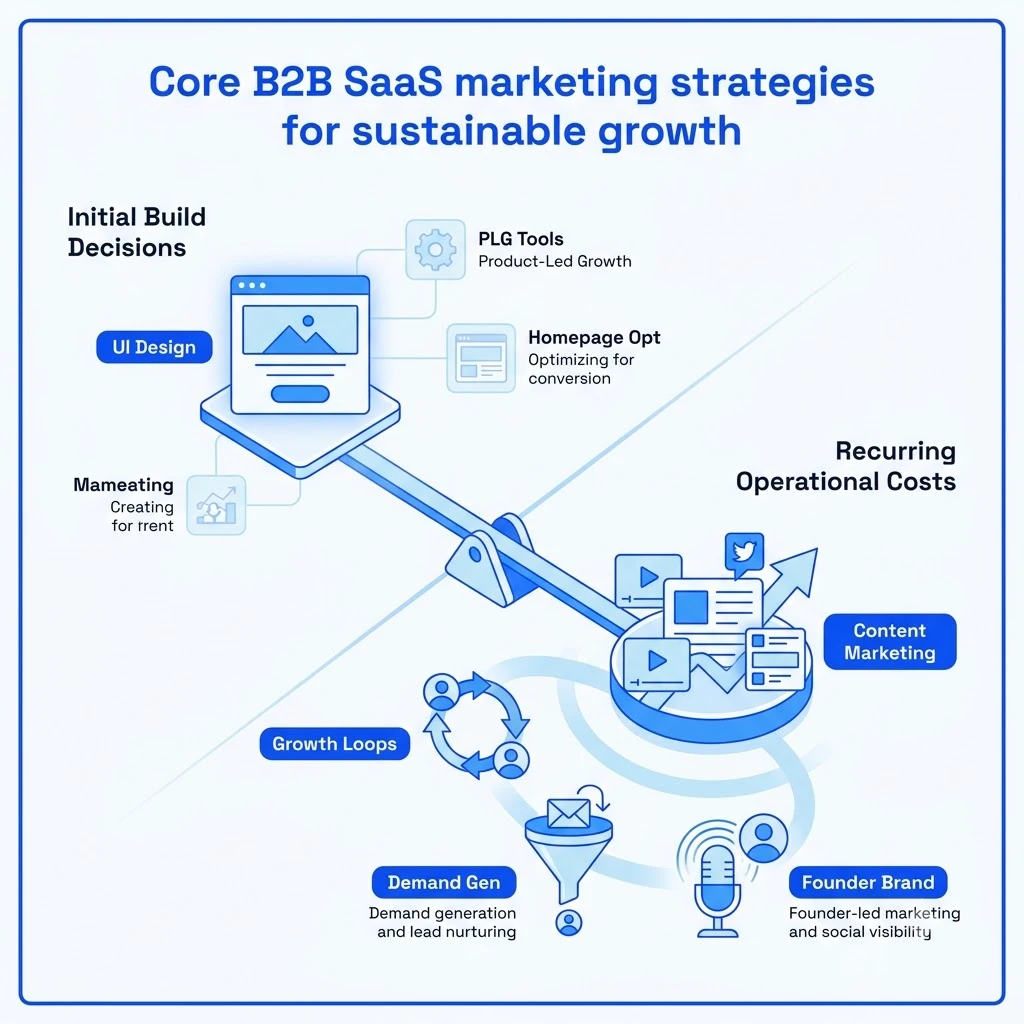
Growth loops are powerful mechanisms that create self-reinforcing cycles of user acquisition and engagement. They turn user actions into growth for the product, directly improving retention rate and net revenue retention. Complementing this, community marketing cultivates a loyal user base that advocates for your brand.
Building a thriving community through dedicated forums, newsletter execution, affiliate programs, micro-influencers, or exclusive Slack channels provides invaluable feedback. These strategies move beyond transactional marketing to build lasting customer relationships in subscription models.
Product-Led Growth is a strategic approach where the product itself drives customer acquisition, conversion, and expansion. Offering free trials, freemium versions, or ungated micro-tools significantly lowers the barrier to entry. This allows potential users to experience the product value proposition firsthand. A successful PLG strategy ensures users quickly achieve time-to-value, which naturally leads to adoption and upgrades. This model is particularly effective for SaaS products with intuitive user interfaces.
The personal brands of founders and executives can be a significant asset in software as a service marketing. Leveraging platforms like LinkedIn to share unique insights and industry perspectives amplifies organic reach. This approach fosters a deeper emotional connection and builds trust in today’s landscape where buyers seek authenticity. Furthermore, executing targeted Product Hunt launches alongside executive visibility can generate substantially more pipeline creation than corporate brand pages alone.
Effective demand generation focuses on attracting potential customers by highlighting their problems and offering solutions. Robust lead nurturing then guides these prospects through the marketing and sales funnel, converting marketing qualified leads into sales qualified leads. This involves a strategic mix of digital marketing solutions and personalized communication. The goal is to move prospects from initial awareness to consideration and ultimately to a purchasing decision.
The global SaaS market reached roughly $408 billion in 2025 and is projected to hit about $465 billion in 2026, underscoring the need for efficient demand generation strategies. Account-based marketing strategies for saas are linked to a 171% increase in average contract value and approximately 200% more marketing-sourced revenue.
Account-Based Marketing (ABM) offers a strategic approach for B2B SaaS companies targeting high-value accounts. It shifts focus from broad outreach to personalized engagement with specific, identified accounts. This method requires close alignment between marketing, sales, and customer success teams. Such collaboration ensures a unified message and a cohesive experience for potential buyers.
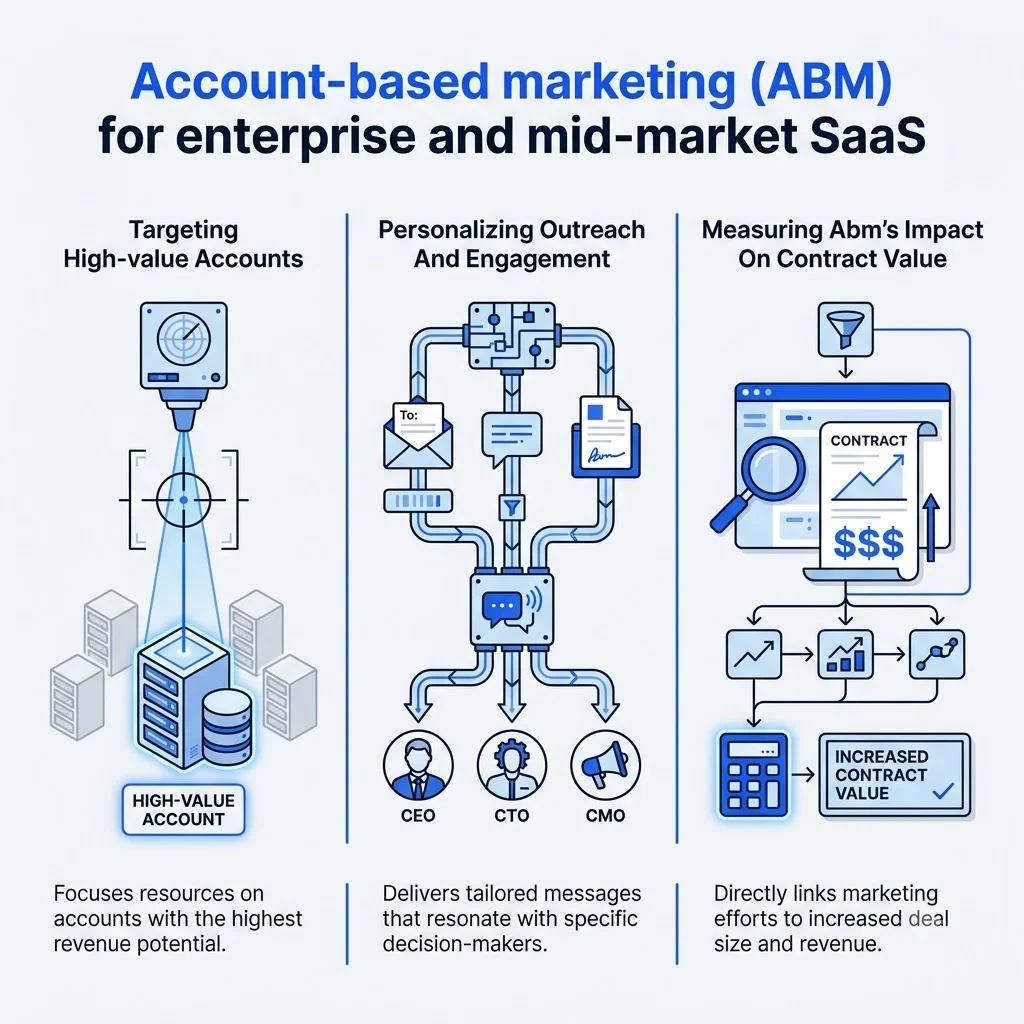
ABM prioritizes quality over quantity in lead generation. Instead of casting a wide net, marketing and sales efforts concentrate on a select group of ideal customer profiles. This allows for deep personalization in every interaction. Buying committees within these target accounts receive tailored content and communications. This bespoke approach resonates more effectively with their specific needs and challenges. This strategy is particularly effective for SaaS products with higher average contract values (ACV) or complex sales cycles.
Achieving ABM success hinges on seamless collaboration. Marketing teams must work hand-in-hand with sales and customer success departments. This alignment ensures consistent messaging across all touchpoints. For example, a marketing campaign might identify key pain points for a target account.
Sales can then leverage this insight for a more relevant conversation. Customer success can proactively address potential concerns during onboarding. This unified front builds trust and accelerates the buying journey.
The revenue benefits of implementing an account-based marketing strategy are substantial. Account-based marketing is linked to a 171% increase in average contract value and approximately 200% more marketing-sourced revenue. These figures are based on G2 research reports for enterprise and mid-market SaaS deals. This demonstrates ABM’s power in driving significant growth for SaaS businesses. For instance, a company might use ABM to target 50 high-potential accounts. Success here means not just closing those deals, but also increasing their value and fostering long-term relationships. This contrasts with broad campaigns that might yield more leads but at a lower overall value.
The search landscape is rapidly evolving, shifting how B2B buyers discover software solutions. AI-driven search engines and generative AI tools are fundamentally changing information retrieval across global markets. This shift necessitates a strategic adaptation for B2B SaaS marketers to maintain visibility and customer engagement.
Zero-click searches have become the dominant search behavior, with Stratabeat analysis noting they now surpass 60% of all searches. This trend means business buyers frequently find their answers directly within search engine results pages. Google’s AI Overviews appear on approximately 13% of all U.S. desktop queries, causing organic click-through rates to drop by an average of 61% according to Stratabeat data. This reality proves that traditional SEO metrics alone no longer guarantee website traffic or top-of-funnel capture.
To navigate this changing environment, traditional search engine optimization must evolve into answer engine optimization. The focus shifts from merely ranking high to providing clear, authoritative answers that AI models can easily parse. Creating expert-led content mapped directly to buyer pain points ensures your brand appears where decision-makers research software solutions. This content must feature concise definitions and structured data that generative algorithms can reference.
Generative AI models like ChatGPT, Google Gemini, and Copilot pull information from diverse web domains beyond standard search rankings. Data from Stratabeat research shows that fewer than 10% of the sources cited in these AI tools rank in the top 10 Google organic results for the same query. This gap highlights the importance of securing visibility on trusted review sites and industry forums. Building authority across multiple platforms ensures your software product is referenced when AI systems answer buyer queries.
AI chatbots are now foundational tools for enterprise software evaluation and vendor discovery. According to Omnibound research, approximately 71% of B2B software decision-makers rely on AI chatbots for research at some stage of their purchasing journey. However, only 48% of B2B SaaS companies currently track answer engine optimization citation performance. Marketers must close this tracking gap to understand how buyers evaluate alternative solutions within conversational search interfaces.
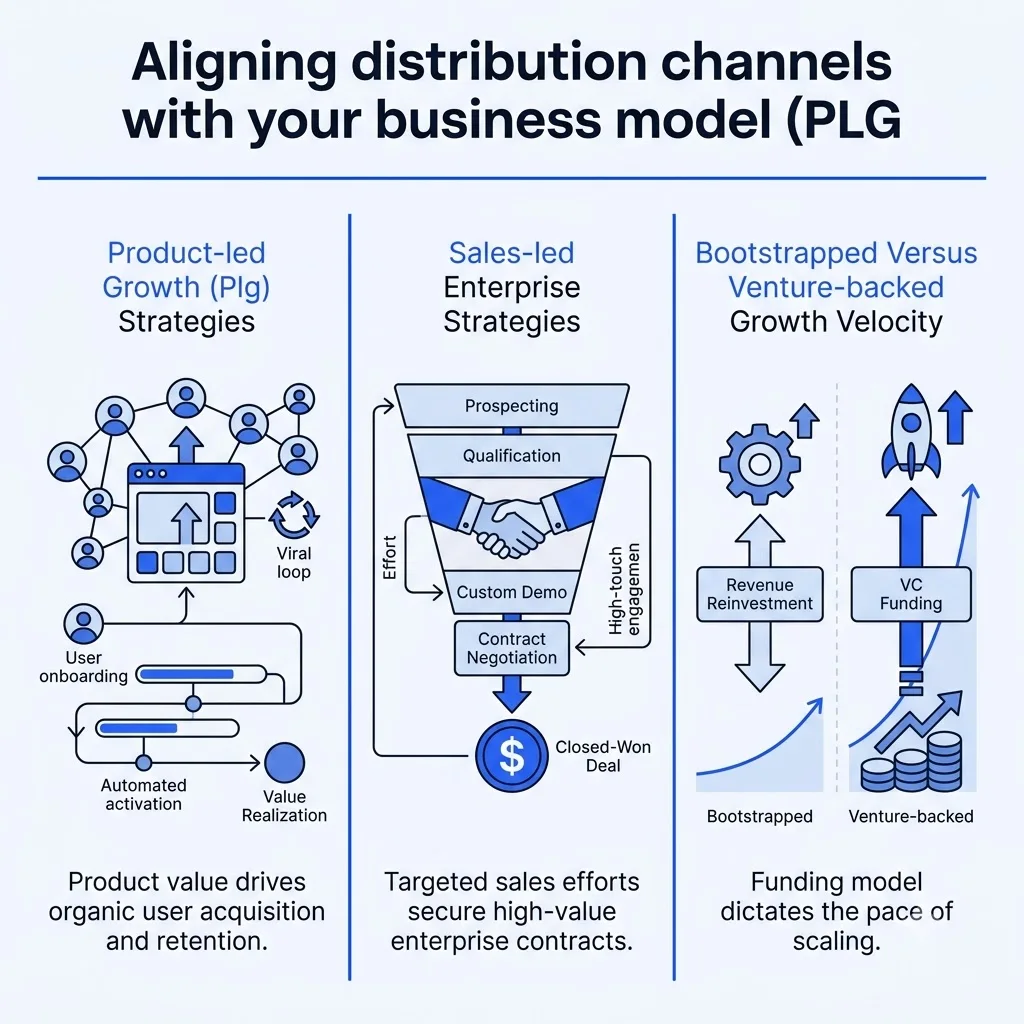
Choosing the right marketing channels hinges on your SaaS business model. Product-led growth (PLG) and sales-led strategies require distinct approaches to customer acquisition and engagement. Understanding these differences is crucial for effective resource allocation and achieving growth targets.
Product-led growth prioritizes the product itself as the main engine for acquiring and retaining customers. This model thrives on self-service capabilities and a seamless user experience. Marketing efforts focus on driving users to experience the product’s value firsthand. This often involves offering free trials, freemium tiers, or interactive demos. The goal is to let the product’s inherent value convert users into paying customers.
In a PLG model, channels like content marketing, SEO, and social media are used to attract users to the product. Self-service loops depend on viral sharing, collaborative features, and frictionless onboarding flows. The product then guides users through conversion without requiring human sales intervention. Customer success is embedded within the product experience itself. This approach can lead to faster growth cycles and lower customer acquisition costs for SMB markets.
Sales-led models are ideal for complex, high-value SaaS solutions targeting enterprise clients. Here, direct sales teams are central to the go-to-market motion. Marketing’s primary role is to generate a consistent flow of qualified leads for the sales team. This involves creating targeted campaigns that resonate with specific buyer personas and their pain points.
Channels such as account-based marketing, targeted LinkedIn advertising, and industry events become paramount. Marketing content often includes in-depth case studies, whitepapers, and webinars that educate prospects and build credibility. The sales team then engages these leads, nurturing them through a longer, more involved sales cycle. According to the Optifai Sales Ops Benchmark, the median CAC payback period for enterprise deals can reach 18, 24 months, highlighting the heavy investment required in sales enablement.
The financial backing of a SaaS company significantly influences its channel strategy and growth pace. Bootstrapped companies often prioritize profitability and sustainable growth. They may favor cost-effective channels with a clear ROI, such as organic SEO and content marketing. Their focus is on maximizing capital efficiency, aiming for a shorter CAC payback period.
Conversely, venture-backed companies often pursue rapid scaling and market share acquisition. They might invest heavily in paid acquisition channels and aggressive growth hacking tactics. Channel sequencing typically starts with organic discovery before layering on paid acquisition once product-market fit is proven. According to a SaaS Capital survey, the median private B2B SaaS company grew 25% in 2024, a benchmark that is heavily influenced by funding status and growth ambition.
Effective B2B SaaS marketing hinges on demonstrating tangible business impact, not just vanity metrics like website traffic. This section delves into the critical metrics, pipeline quality, and attribution models that truly gauge marketing performance and drive revenue growth. Understanding these elements allows for informed decision-making and optimal resource allocation.
To accurately assess marketing effectiveness, focus on core SaaS metrics. These include Customer Acquisition Cost (CAC), Lifetime Value (LTV), Net Revenue Retention (NRR), and churn rate. These figures offer a comprehensive view of your business financial health and the efficiency of your marketing efforts. High LTV relative to CAC indicates a sustainable growth model. NRR shows your ability to grow revenue from existing customers, while churn rate highlights potential issues with product value or customer success.
Analyzing conversion rates at each stage of the sales funnel is crucial for identifying bottlenecks and evaluating pipeline quality. First Page Sage research indicates that B2B SaaS sales funnels typically show distinct stage-to-stage conversion rates across the buying journey:
The B2B SaaS buyer journey is often complex, involving multiple interactions across various channels before a purchase decision is made. This complexity makes attributing conversions accurately a significant challenge for growth teams. Understanding which marketing touchpoints contribute most effectively to revenue is vital for calculating marketing ROI. Common attribution models, such as first-touch, last-touch, and linear, each offer different perspectives but often oversimplify the buyer path. Exploring sophisticated models like time-decay or position-based attribution provides a clearer picture of marketing impact.
Assessing how long it takes to recoup customer acquisition costs is a key indicator of capital efficiency. The median CAC payback period for private B2B SaaS companies reaches 15 months, according to the Optifai Sales Ops Benchmark. This period varies significantly by deal tier depending on sales complexity:
This metric highlights the importance of customer retention and increasing LTV to improve overall financial performance. A shorter payback period generally signifies a healthier business model and stronger capital efficiency.
Avoiding common mistakes is as important as implementing effective strategies. This section highlights frequent errors that can hinder growth for B2B SaaS companies.

Focusing solely on metrics like website traffic or social media likes can be misleading. These vanity metrics do not directly correlate with revenue or customer acquisition. True success lies in tracking metrics that impact the bottom line. For instance, while non-brand Google Ads can drive traffic, they come at a higher cost. Non-brand search ads carry an average cost-per-click of $13.75 and generate leads at roughly $207 each. In contrast, brand search ads are more cost-effective, with a $3.12 CPC and $34 per lead.
Marketing without a clear understanding of your target audience leads to wasted resources and ineffective messaging. An undefined ICP means your campaigns lack focus. This can result in low-quality leads and a higher customer acquisition cost (CAC). Our team often sees companies struggle when they try to appeal to everyone. This broad approach dilutes their message and fails to resonate with high-value prospects.
Acquiring new customers is expensive; retaining existing ones is crucial for sustainable growth. High churn rates can negate acquisition efforts. Focusing solely on new customer acquisition overlooks the significant value of existing customers. Our experience shows that investing in customer success and retention programs yields a much higher return. A fragmented brand experience across different channels can confuse prospects and erode trust, contributing to churn.
A fragmented brand experience across different channels confuses prospects and erodes trust. Your messaging should be consistent whether a prospect encounters your brand on social media, your website, or in an email. Inconsistent branding weakens your market position and makes it harder to build lasting relationships. This lack of cohesion can also impact your ability to scale effectively.
While paid ads can drive quick results, a balanced strategy incorporating organic channels is essential for long-term, sustainable growth. Relying too heavily on paid acquisition can lead to unsustainable costs. For example, paid channels are generally more expensive than organic ones. A robust marketing plan needs a mix of demand generation tactics. This ensures a steady flow of leads without constant ad spend.
This section addresses common questions B2B SaaS marketers may have about launching and budgeting.
Starting your go-to-market and launch promotion three to six months in advance is essential. This lead time helps build sustainable early momentum for your software product. Engaging peer communities like Superpath or Demand Curve during this window also refines your messaging before the public rollout.
For early-stage teams, focusing on core metrics like user activation, conversion rates from trial to paid, and early retention is key. As the company grows, metrics like customer acquisition cost and lifetime value become more critical. Understanding customer acquisition cost payback benchmarks, which average 15 months for private B2B SaaS companies, informs overall capital efficiency and budgeting.
Budget allocation depends on your business model, funding stage, and product motion. Early-stage companies often invest heavily in organic search, content, and founder-led community channels. Later-stage firms typically allocate larger portions to paid acquisition. A common benchmark for early-stage startups is allocating 20% to 40% of annual recurring revenue to marketing. Paid channels require careful monitoring since non-brand search ads can carry higher lead costs than organic efforts.
Partner with our team to scale pipeline acquisition and lower customer acquisition costs.
Schedule Consultation


Error: Contact form not found.
