
What Is AI Transformation? What Changes Beyond AI Tools
September 21, 2026 See more
App development timeline planning dictates how quickly founders launch software and control budgets. Our team maps every phase from discovery to deployment to help product managers balance velocity, mobile app development services, and technical scope. Master these scheduling strategies to avoid costly delays and ship your minimum viable product on schedule.
A typical mobile app development timeline spans between 3 to 9 months, or roughly 20 to 40 weeks. This comprehensive period covers the entire journey from initial concept and planning through design, development, rigorous testing, and final deployment. Several key elements influence this duration, including the complexity of features, the chosen platform strategy (native iOS, Android, or cross-platform), and the size and expertise of your development team. Establishing a clear roadmap early on is essential for efficient resource allocation and avoiding costly delays. We can help you navigate this process with our expert mobile app development services.
The duration of app development is not a fixed number; it is a variable influenced by project scope and technical requirements. Stakeholders must understand how different project tiers compare across development duration, resource requirements, and architectural scope.
| Complexity Level | Estimated Duration | Primary Focus | Typical Architecture |
|---|---|---|---|
| Simple App | 2 to 3 months | Basic utilities and MVPs | Single-purpose, light backend, minimal integrations |
| Medium App | 3 to 5 months | Core business platforms | User authentication, payments, standard APIs |
| Large Product | 5 to 8 months | Feature-rich software | Multiple roles, custom logic, third-party services |
| Complex App | 8 to 12 months | Advanced ecosystems | AI and machine learning, real-time sync, compliance |
| Enterprise System | 12+ months | Corporate-wide deployment | Heavy legacy integration, strict audits, custom scale |
Understanding these benchmarks helps stakeholders align their expectations with the realities of software engineering. Simple utilities require significantly less coordination than enterprise platforms with strict regulatory demands.
The core coding and development phase itself typically consumes 40% to 60% of the total application delivery timeline. This significant portion highlights the intensive nature of building robust software. Factors like technical debt, backend architecture complexity, and the efficiency of cross-platform frameworks can further influence this development sprint. Careful planning of this central phase is paramount for staying on schedule.
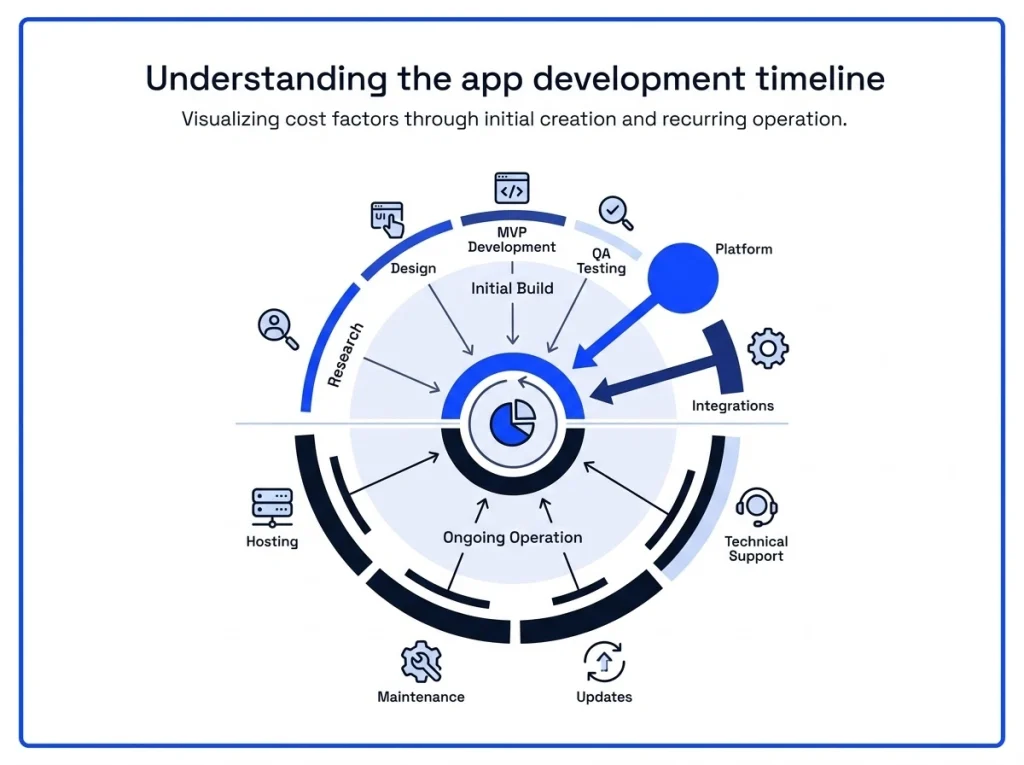
Successful app development follows a structured lifecycle. Each phase contributes distinct value and requires specific expertise. Understanding these stages helps in forecasting and managing project momentum.
| Development Phase | Typical Duration | Primary Focus and Key Activities |
|---|---|---|
| Discovery and strategy | 2 to 4 weeks | Defining core purpose, audience mapping, and technical feasibility. |
| UI/UX design | 2 to 6 weeks | Wireframing, interactive prototyping, and visual branding. |
| Core development | 3 to 6 months | Coding backend infrastructure and frontend screens. |
| Testing and QA | 3 to 6 weeks | Functional audits, performance testing, and bug remediation. |
| Deployment and launch | 1 to 2 weeks | Store submissions, metadata prep, and server go-live. |
| Post-launch maintenance | Continuous | OS updates, security patches, and feature expansion. |
This foundational stage involves defining the app’s core purpose, target audience, and monetization strategy. Market research, competitive analysis, and technical feasibility studies are conducted. Clear requirements and a well-defined product roadmap are crucial outputs. This phase typically takes 2 to 3 weeks, though complex projects may extend this to 4 weeks. Early planning reduces mid-development pivots, as highlighted by SellersCommerce CRM adoption statistics.
Design translates concepts into a user-friendly and visually appealing product. This phase includes wireframing, creating interactive prototypes, and developing high-fidelity mockups. User experience (UX) mapping ensures intuitive navigation, while user interface (UI) design focuses on aesthetics and branding. This stage typically spans 2 to 6 weeks, depending on the app’s complexity and the need for extensive user testing.

This is the most time-intensive phase, involving the actual coding of the application. It includes setting up the development environment, frontend development (user interface implementation), backend development (server-side logic, databases, APIs), and integrating third-party services. The core coding phase consumes 40% to 60% of the total delivery timeline. For medium complexity apps, this can range from 3 to 6 months.
Building a robust backend involves designing server architecture, database schemas, and creating secure APIs. This phase is critical for data integrity, user authentication, and enabling communication between the frontend and server. Compliance requirements and data security standards significantly influence its duration.
Frontend development brings the UI/UX designs to life, focusing on creating responsive and interactive user interfaces. Developers implement screen layouts, animations, and integrate APIs to ensure seamless functionality across various devices. Performance optimization and cross-browser compatibility are key considerations.
Rigorous testing ensures the app is stable, secure, and performs as expected. This includes functional testing, performance testing, security audits, and usability testing. Automated testing can significantly speed up this process. This phase typically takes 3 to 6 weeks. Resolving critical bugs here prevents negative user experiences and app store rejections.
This phase involves packaging the application for submission to the Apple App Store and Google Play Store. It includes preparing store listings, metadata, and adhering to platform guidelines. Apple processes 90% of App Store submissions within 24 hours, meaning the final review adds days rather than months. This stage usually takes 1 to 2 weeks, excluding potential review delays or rejections.
App development doesn’t end at launch. Ongoing maintenance is crucial for patching security vulnerabilities, ensuring OS compatibility, and introducing new features based on user feedback and market trends. This phase is continuous and typically requires a budget of about 20 percent of the initial development cost annually.
The time required to build an app directly correlates with its complexity. Projects range from simple utility tools to intricate enterprise systems, each demanding a unique development duration. Understanding these tiers helps set realistic expectations for your project schedule.
Simple applications often serve a single purpose. Think of basic utility tools or apps with minimal backend needs. These projects typically require 2 to 4 months for completion. They usually feature a straightforward user interface with a limited number of screens. Functionality remains uncomplicated, making them quicker to design, develop, and test. For instance, a basic calculator app or a simple note-taking tool would fall into this category.
Medium complexity apps offer more robust features. These might include user account creation, push notifications, and integration with third-party services like payment gateways. Developing such applications generally takes between 4 to 8 months. Examples include fitness tracking apps that sync with wearables or basic e-commerce platforms allowing product browsing and purchases. These projects involve more intricate logic and data management.
Complex applications push the boundaries with advanced functionalities. This can include real-time data processing, artificial intelligence or machine learning capabilities, and Internet of Things (IoT) integration. Apps requiring strict regulatory compliance, such as those in healthcare (HIPAA), also fall into this category. These projects can span 8 to 18 months or even longer. Enterprise-level platforms, which often integrate with existing systems like ERP or CRM, frequently exceed 12 months due to extensive customization and rigorous testing requirements.
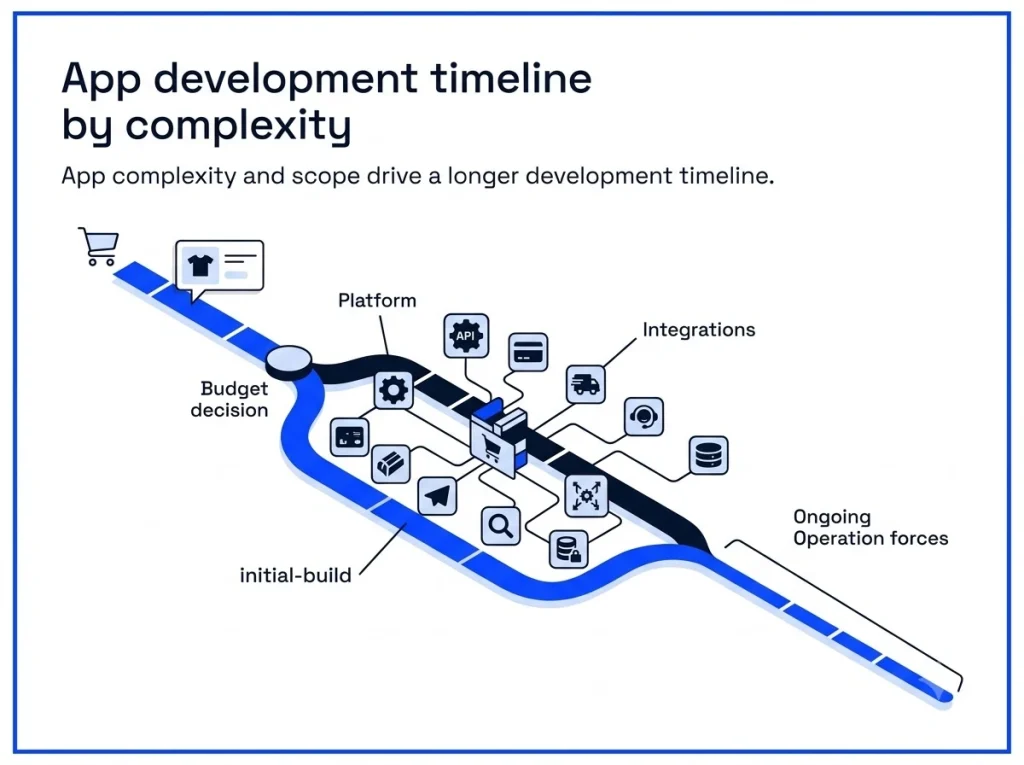
The choice of development platform significantly affects the overall timeline and resource allocation. This decision impacts how quickly you can build, deploy, and maintain your application across different operating systems. Understanding these differences is crucial for accurate project planning.
Building separate native apps for iOS and Android effectively doubles the development effort. This is due to distinct codebases, unique programming languages, and separate testing cycles for each platform. For instance, an app requiring deep integration with Apple’s HealthKit would need specific development for iOS. Similarly, leveraging Android’s Material Design system requires tailored implementation for Android.
Cross-platform frameworks like React Native or Flutter offer a compelling alternative. They allow developers to write code once and deploy it on both iOS and Android. This approach significantly reduces development time and costs. A single codebase streamlines updates and maintenance. For example, a feature implemented in Flutter is immediately available on both operating systems.
However, cross-platform development is not without its considerations. While these frameworks offer near-native performance, complex native integrations or access to the very latest platform-specific features might still require custom, native code modules. This can add complexity and extend the timeline for specific functionalities. Our team at Enosta often finds that for applications prioritizing cutting-edge native features or maximum performance, native development remains the preferred path. Conversely, for rapid market entry or when budget is a primary concern, cross-platform solutions provide a highly efficient route to reaching a wider audience.
| Aspect | Native iOS Development | Native Android Development | Cross-Platform Development (React Native, Flutter) |
|---|---|---|---|
| Timeline (Medium Complexity) | 10, 16 weeks | 10, 16 weeks | 30, 40% faster than native |
| Codebase | Single (Swift/Objective-C) | Single (Kotlin/Java) | Single, shared across platforms |
| Performance | Optimized for iOS hardware and OS | Optimized for Android hardware and OS | Near-native performance, potential minor compromises |
| Platform Features | Full access to iOS-specific features (Face ID, HealthKit) | Full access to Android-specific features (Material Design) | Access via native modules; may require custom implementation |
| Development Cost | Higher for multi-platform | Higher for multi-platform | Generally lower for multi-platform |
| Maintenance | Separate updates for each platform | Separate updates for each platform | Single codebase update |
| Best For | Maximizing native performance and user experience on iOS | Maximizing native performance and user experience on Android | Rapid multi-platform deployment, budget constraints |
Beyond complexity and platform choice, several other factors can impact how long an app takes to build. These elements often introduce unforeseen challenges or require meticulous planning.
While some factors are inherent to project scope, several strategies can help speed up the app development process without compromising quality. Our team at Enosta often sees clients eager to launch faster. We focus on efficient workflows to meet ambitious deadlines.
Focus on building a Minimum Viable Product (MVP) with core functionalities first. This allows for a quicker launch, faster market feedback, and iterative improvements based on real user data. An MVP app development timeline can be significantly shorter than a full-featured release. For example, defining and prioritizing essential features for an MVP can shave weeks off the initial planning phase.
Using frameworks like React Native or Flutter can cut development time by 30-40% compared to building native apps separately for iOS and Android. This means a single codebase can serve both platforms, reducing engineering effort and accelerating deployment cycles. This approach is ideal for reaching a wider audience quickly.
Continuous Integration and Continuous Deployment (CI/CD) pipelines automate code integration and release processes. This enables faster and more reliable deployments of new features and bug fixes. Teams can integrate code changes frequently, catching issues early and streamlining the path to production.
Pre-built cloud solutions and third-party APIs for common features, such as authentication, data storage, and payment processing, reduce custom development effort. Leveraging these services allows your development team to focus on the unique, value-adding aspects of your application. This saves significant backend development time.
Clear communication channels and prompt stakeholder decisions prevent delays and ensure the development team remains aligned. Regular stand-up meetings and transparent progress tracking are crucial. When decisions are made quickly, the development process moves forward without unnecessary roadblocks.
An MVP app development timeline typically ranges from 2 to 4 months. This focuses on essential features to validate market demand quickly.
Yes, a simple app or an MVP with core features can realistically be built within 3 months. This requires efficient planning and a focused development team.
The core development phase, encompassing both frontend and backend coding, typically consumes the most time. It often lasts 3 to 6 months for medium-complexity apps.
Cross-platform development can reduce the overall timeline by 30-40%. This is achieved by using a single codebase for both iOS and Android apps.
The testing and quality assurance phase usually requires 3 to 6 weeks. This duration depends on the app’s complexity and the thoroughness of testing protocols.
Understand your project’s specific needs and get a custom estimate
Get Estimate

Error: Contact form not found.
