
What Is AI Transformation? What Changes Beyond AI Tools
September 21, 2026 See more
Creating a landing page involves aligning your core value proposition, layout, and conversion elements to turn casual traffic into qualified leads. Marketers and business owners need this workflow to run targeted digital marketing campaigns, reduce bounce rates, and maximize return on ad spend. This guide walks you through selecting the right tools, designing mobile responsive layouts, and launching targeted campaigns, backed by expert insights from our website development services. You will learn how to structure compelling call to action buttons, configure CRM integration, and run A/B testing for sustainable growth.
A landing page is a standalone digital asset built with one clear objective in mind. It removes secondary navigation links and external menus to keep visitor attention entirely on a targeted offer.
| Page Type | Primary Purpose | Navigation Structure | Typical Median Conversion Rate |
|---|---|---|---|
| General Website | Broad exploration and brand discovery | Multi-level menus, footers, and sidebars | 2.35% |
| Dedicated Landing Page | Single conversion goal or lead capture | Zero external links or menus | 4.02% |
Dedicated landing pages convert at a median rate of 4.02% across all industries, according to the Digital Applied Benchmark Report. This performance is nearly double the median observed for general website pages, highlighting their tactical value. For businesses looking to enhance their digital presence, exploring website development services can ensure your foundational web infrastructure supports these targeted campaigns.
To understand single-goal architecture, think of a restaurant analogy. A general website operates like a large restaurant with a diverse menu, offering endless choices. A landing page functions like a specialized sandwich shop delivering one highly refined product. This focused approach ensures visitors are guided toward a single desired outcome without cognitive overload.
Different campaigns require specific landing page architectures to guide user behavior effectively. Selecting the correct type aligns the page mechanics with your ultimate business goals.
| Landing Page Type | Primary Objective | Best Use Case | Core Focus |
|---|---|---|---|
| Lead generation pages | Capture visitor contact details | Building sales pipelines | Short forms and valuable lead magnets |
| Clickthrough pages | Warm up visitors for checkout | E-commerce promotions | Detailed product benefits and clear paths to cart |
| Software free trials | Encourage software sign-ups | SaaS product adoption | Quick onboarding and low-friction access |
| Ebook downloads | Deliver gated educational content | Content marketing funnels | Highlighting resource value and email capture |
| Webinar registrations | Capture live session attendees | Event and community building | Speaker credibility and key takeaways |
The choice of landing page type directly influences its structure and content. For instance, a dedicated lead generation page focuses on a single form to capture visitor details, often in exchange for a valuable lead magnet. In contrast, a clickthrough page aims to persuade users to take a specific action, like adding an item to their cart, by presenting a compelling offer before directing them to a separate sales page.
Each type serves a distinct purpose within a broader digital marketing campaign. A webinar registration page, for example, needs to clearly articulate the value of attending the session and provide an easy sign-up process. Similarly, an ebook download page must entice visitors with the promise of valuable information, making the download form the central focus. While video content can boost conversion rates by as much as 86% on landing pages, according to Unbounce insights, its effectiveness depends on how well it supports the page’s primary objective.
Creating a high-converting landing page requires a strategic combination of elements designed to capture attention and drive action. Each component plays a vital role in guiding the visitor through the conversion funnel.
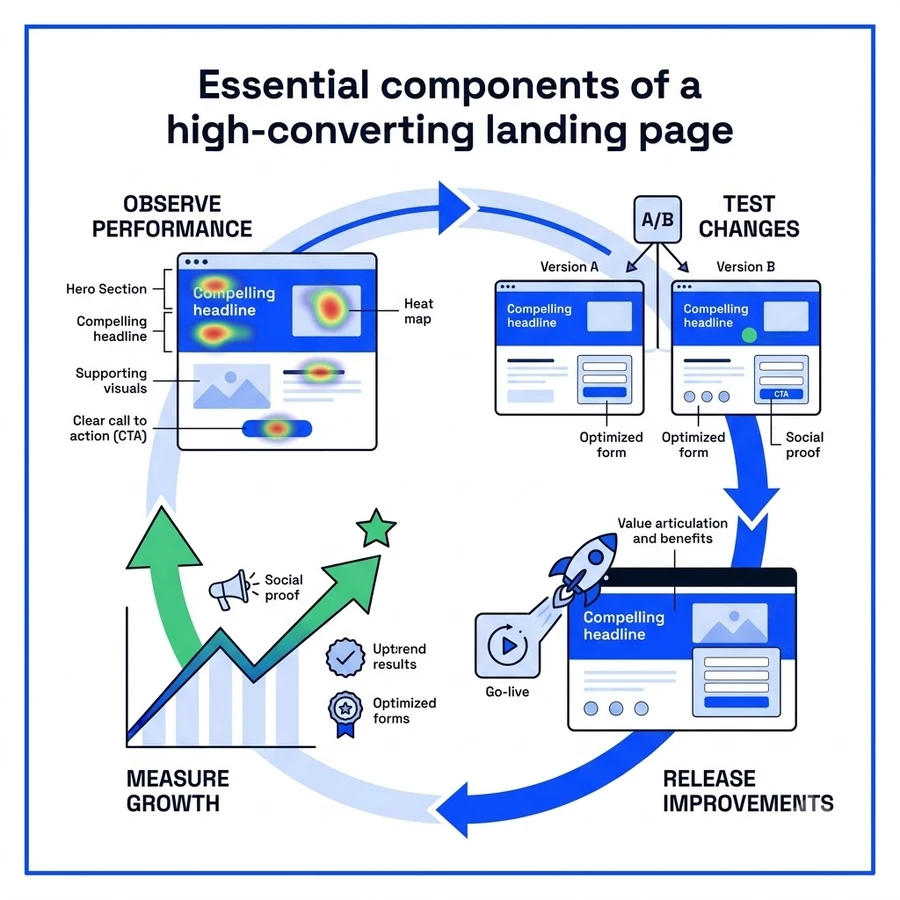
The hero section, visible above the fold, is critical for making an immediate impact. It must clearly communicate your value proposition and entice visitors to learn more. This is especially true given the average consumer screen duration on a single digital interface has decreased to just 47 seconds, requiring landing pages to instantly communicate value.
Beyond features, focus on the tangible benefits your offer provides. Answer the visitor’s implicit question: “So what?” through a dedicated solutions section. Explain how your product or service solves their problems or improves their lives. Differentiate clearly between features (what it is) and benefits (what it does for them). This approach ensures visitors understand the true value proposition.
Leverage social proof to build trust and reduce visitor hesitation. This can include customer testimonials with real names and photos, client logos from recognizable brands, review scores, and trust badges. Authentic social proof significantly enhances credibility, assuring visitors that others have found value in your offering.
Keep forms concise to minimize user friction by managing field count optimization carefully. Forms with three fields typically achieve a higher conversion rate of 10.1%, whereas forms with nine fields experience a steep drop to 3.6%. Include clear labels, privacy notices, and explicit GDPR compliance requirements to build trust and encourage completion.
Follow these structured steps to create a landing page that aligns with your marketing objectives.
Before building, clearly define the specific and measurable goal for your landing page. Determine if your target is lead generation, product sales, webinar registration, or ebook downloads. This objective will guide all subsequent design and content decisions.
Select a user-friendly platform that suits your technical skills, budget, and project scale.
Consider AI-generated creation tools, noting that 25% of startups in a recent Y Combinator batch used 95% AI-generated code, according to an App Builder guide. Traditional development ranges from $5,000 to $50,000+, while platform subscriptions and AI alternatives start much lower.
Choose a template designed for your specific goal, such as lead generation or product sales. Look for clean layouts that minimize distractions and clearly highlight your core offer.
Write clear, benefit-driven copy that resonates with your target audience using a direct tone and empathy. Answer headline discovery questions by addressing the core pain point immediately. Maintain exact message match between your traffic source ad copy and the landing page headline. Use short paragraphs and bullet points to explain your offer concisely. Focus on how your product solves problems and delivers value.
A clean design with ample white space guides the visitor eye. Use a large, readable font and ensure a strong visual hierarchy that draws attention to the most important elements. Managing visual distractions is key to keeping visitors focused.
Your CTA button should be visually distinct and use action-oriented language. Instead of generic terms like “Submit,” use phrases like “Get My Free Guide” or “Sign Up Now.” Repeat the CTA strategically if your page has content below the fold.
Use high-quality, relevant images or videos that support your message. Visuals can quickly convey information and enhance engagement. According to an Unbounce landing page report, pages featuring video content can increase conversion rates by 86%.
Integrate testimonials, logos, or review snippets to build trust and credibility. This helps visitors feel more confident in their decision to convert.
Ensure your landing page is fully responsive and displays correctly on all devices. According to the Unbounce benchmark report, mobile traffic share accounts for 83% of landing page visits. While desktop pages convert 8% higher than mobile versions, a seamless mobile experience remains crucial for broad reach.
Set up analytics tools like Google Analytics to monitor performance. Track key metrics such as conversion rates, bounce rates, and visitor engagement.
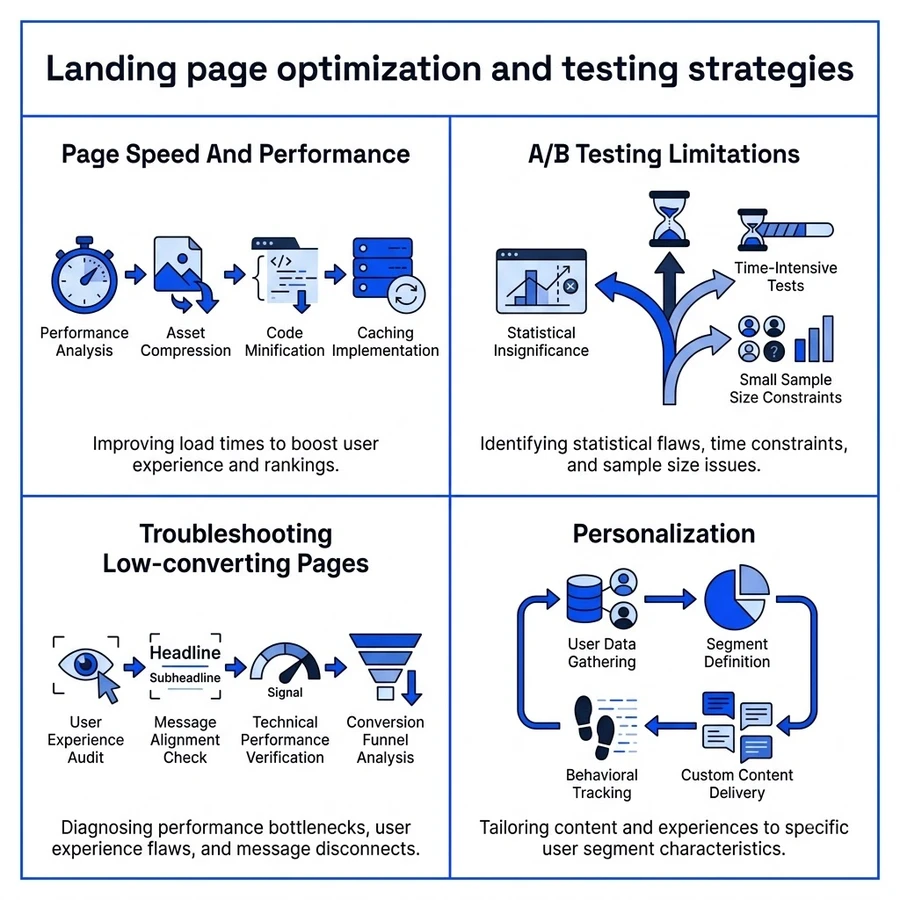
Continuously A/B test elements like headlines, CTAs, and form fields to improve conversion rates. According to an optimization analysis report, only 13% of digital marketing A/B tests achieve statistical significance, so focus on high-variance elements. Iterative testing is key to maximizing performance.
Once optimized, publish your landing page and drive traffic through your chosen channels. Ensure message match between your ads and the landing page content.
Design a clear thank-you page or confirmation state. Outline the next steps for the user, such as email automation handoff sequences or access instructions, to complete the user journey.
To ensure your landing page performs, you need to drive relevant visitors to it. A strategic approach to traffic acquisition is crucial for success. Consider a mix of channels that best reach your target audience and align with your campaign objectives.
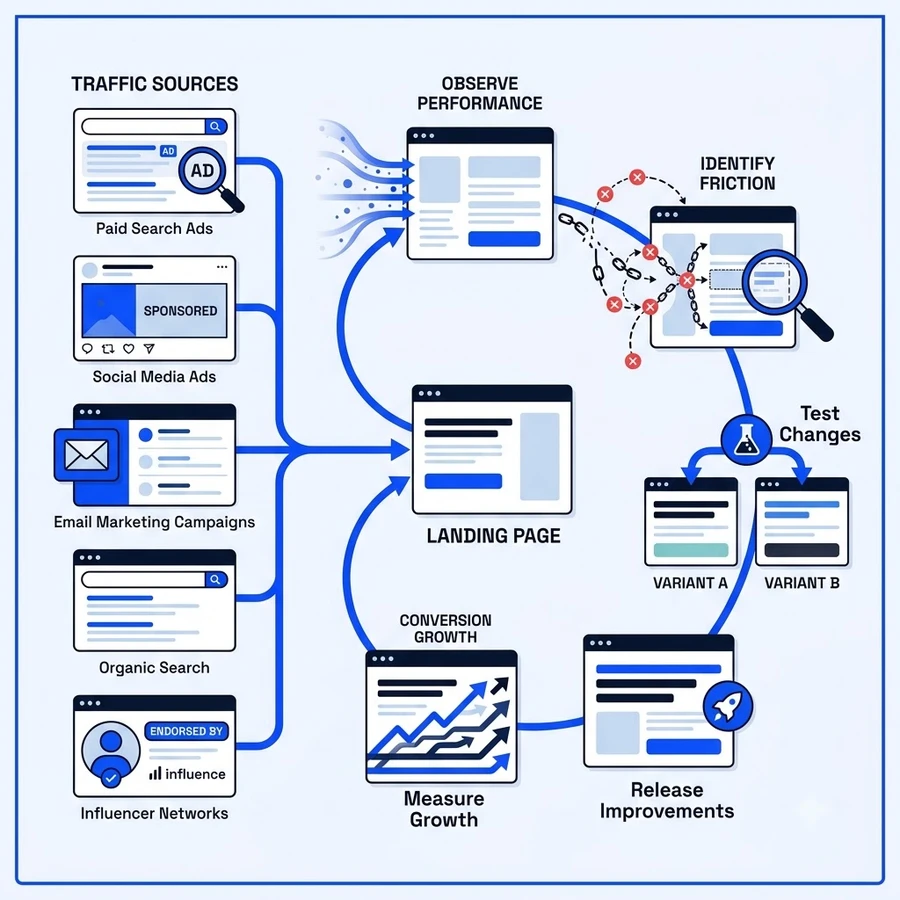
Paid search ads effectively capture high-intent users actively searching for solutions. Platforms like Google Ads allow you to target specific keywords, ensuring your landing page appears when potential customers are most receptive. Conversely, paid social media ads enable precise targeting of specific demographics and interests on platforms such as Facebook, Instagram, or LinkedIn. This allows for broader reach and brand awareness campaigns, even if the immediate search intent isn’t present.
Email marketing remains a powerful channel for driving traffic. Engaging your existing subscriber list with targeted offers can yield excellent results. In fact, email marketing campaigns achieve the highest average conversion rate at 19.3%. Publisher analysis highlights this performance, underscoring the value of nurturing your audience. This channel is particularly effective for promoting new offers, content, or re-engaging past leads.
Building long-term visibility through organic search traffic is a sustainable strategy for digital growth. Optimizing your landing page for relevant keywords can attract visitors over time without ongoing ad spend. Influencer networks offer another avenue for broader reach. By partnering with relevant influencers, you can leverage their established audiences to introduce your landing page to new potential customers. It is important to evaluate channel-specific conversion performance to ensure these efforts translate into tangible results.
Let our team help you turn more visitors into loyal customers
Contact us nowOptimizing your landing page is an ongoing process to maximize conversion rates. This involves a strategic approach to testing and refinement.
No, a full website is not a prerequisite for creating a landing page. Many dedicated landing page builders allow you to design and host pages independently, often using a subdomain. This flexibility means you can launch a focused campaign without needing an entire website infrastructure.
Selecting the right platform depends on your budget, technical comfort level, and campaign objectives. For software feature evaluation, you must compare platforms based on ease of use, customization options, and integration capabilities. Beginners often start with CMS plugins or simple drag and drop builders. More advanced teams leverage specialized landing page builders or custom code solutions for complex funnels.
Message match ensures strict consistency between the advertisement or traffic source a visitor clicks and the landing page content they encounter. Maintaining exact message match helps visitors immediately recognize the value proposition. It confirms the page directly addresses their initial intent, which lowers bounce rates and builds immediate trust.
Landing page success is measured against your specific conversion goals using analytics tracking tools. Key performance indicators include the conversion rate, which tracks the percentage of visitors completing the desired action. Other important metrics are the bounce rate, indicating visitors who leave without interacting, and lead quality.
Costs vary based on whether you choose traditional development, subscription platforms, or newer methods. According to the App Builder guide, traditional development costs range between $5,000 and $50,000 plus, while alternative methods can start significantly lower. Free or low-cost options are also available through basic subscription tools.
Successfully creating a high-converting landing page requires a disciplined blend of strategic planning, focused architecture, and rigorous optimization. Unlike multi-action websites that feature broad header navigation, a dedicated landing page eliminates distractions to guide visitors toward a single, measurable objective.
Whether your campaign focuses on lead generation for software free trials, ebook downloads, webinar registrations, or direct sales, maintaining strict focus is essential. Implementing proven best practices for compelling copy, engaging visuals, and effective calls to action turns visitors into valuable leads. Continuous refinement through analytics tracking and conversion rate optimization ensures your digital marketing campaign achieves sustainable growth.
Let our expert team design and develop a high-converting landing page tailored to your business goals.
Build With Us


Error: Contact form not found.
