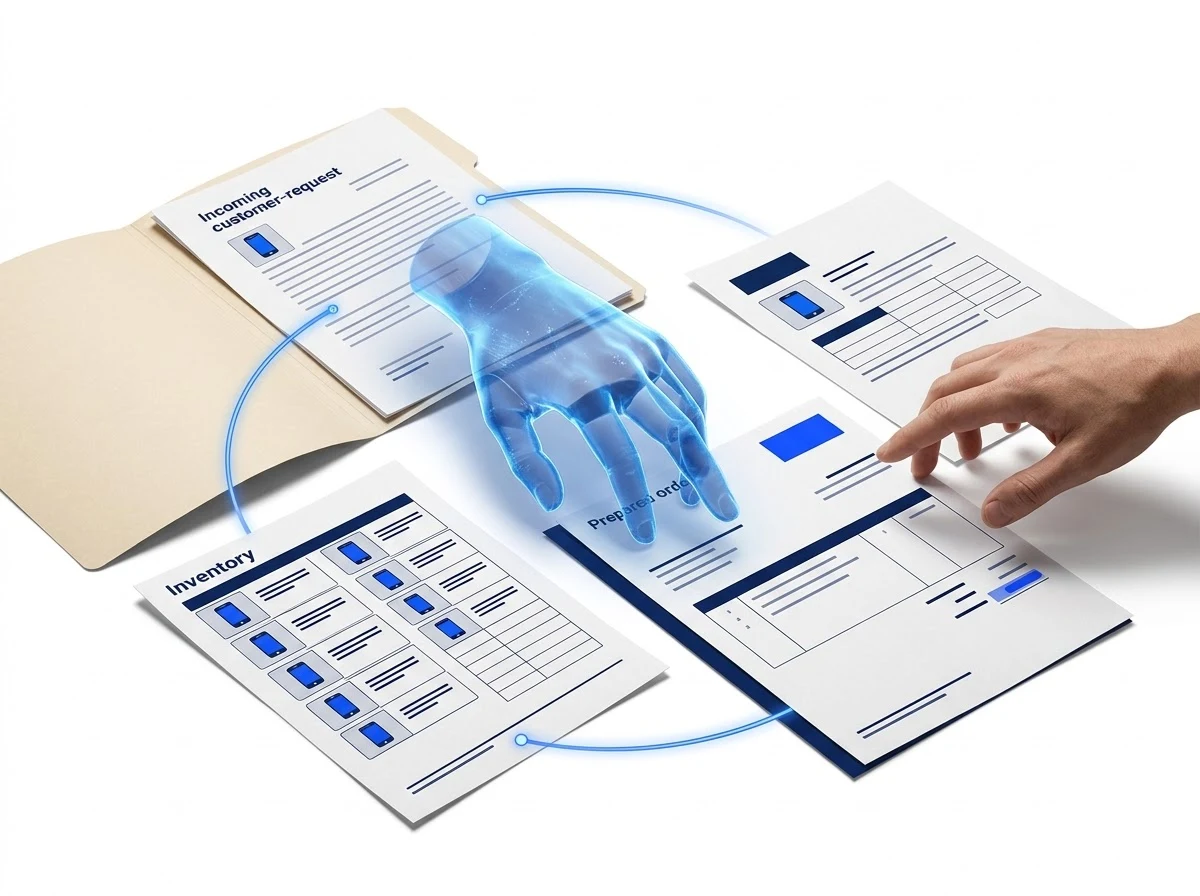
In 2026, mastering the software development process is the primary differentiator for companies scaling in a competitive digital landscape. As Founder and CEO of Enosta, I have witnessed firsthand how moving from rigid, monolithic cycles to high-velocity, continuous delivery models determines project success. Whether you are a startup founder or an engineering manager, optimizing your workflow is essential for achieving sustainable growth. This guide covers the modern SDLC framework, AI-assisted coding, and DORA metrics to help you build secure, scalable, and efficient software systems. By refining your engineering execution, you can align technical output with long-term business objectives.What is the software development process?The software development process is a structured framework used by engineering teams to design, develop, test, and deploy high-quality software systems. In 2026, it is no longer just about writing code; it is a holistic approach to managing the entire product lifecycle.
This process integrates technical best practices, security, and automation to ensure that every feature delivered adds measurable value to the end user. By leveraging professional software development services, organizations can bridge the gap between initial concepts and market-ready products.
Defining the modern SDLC: Beyond just coding
The traditional Software Development Life Cycle (SDLC) has evolved into a dynamic, cyclical model. Modern teams treat software development as an iterative journey rather than a linear path from requirements to release.
- Requirements Gathering: Defining the scope and technical constraints using clear documentation.
- System Architecture: Designing cloud-native structures that ensure scalability and modularity.
- Implementation: Writing maintainable code using AI-assisted tools like GitHub Copilot to boost productivity.
- Quality Assurance: Implementing automated testing frameworks to catch bugs before they reach production.
- Deployment: Using CI/CD pipelines to ensure frequent, low-risk releases.
- Maintenance: Continuous monitoring and optimization based on real-world performance data.
Why a structured workflow is critical for engineering velocity
Without a standardized process, teams often struggle with technical debt, scope creep, and fragmented communication. A well-defined workflow acts as a roadmap, allowing developers to focus on building features rather than resolving process bottlenecks.
According to research on Canada software buying trends, nearly 32% of companies face budget overruns due to poor planning. A structured SDLC mitigates these risks by providing clear milestones and accountability. By implementing standardized workflows, teams can improve their DORA metrics, specifically increasing deployment frequency and reducing the time required to restore service after incidents.
The shift from monolithic cycles to continuous delivery
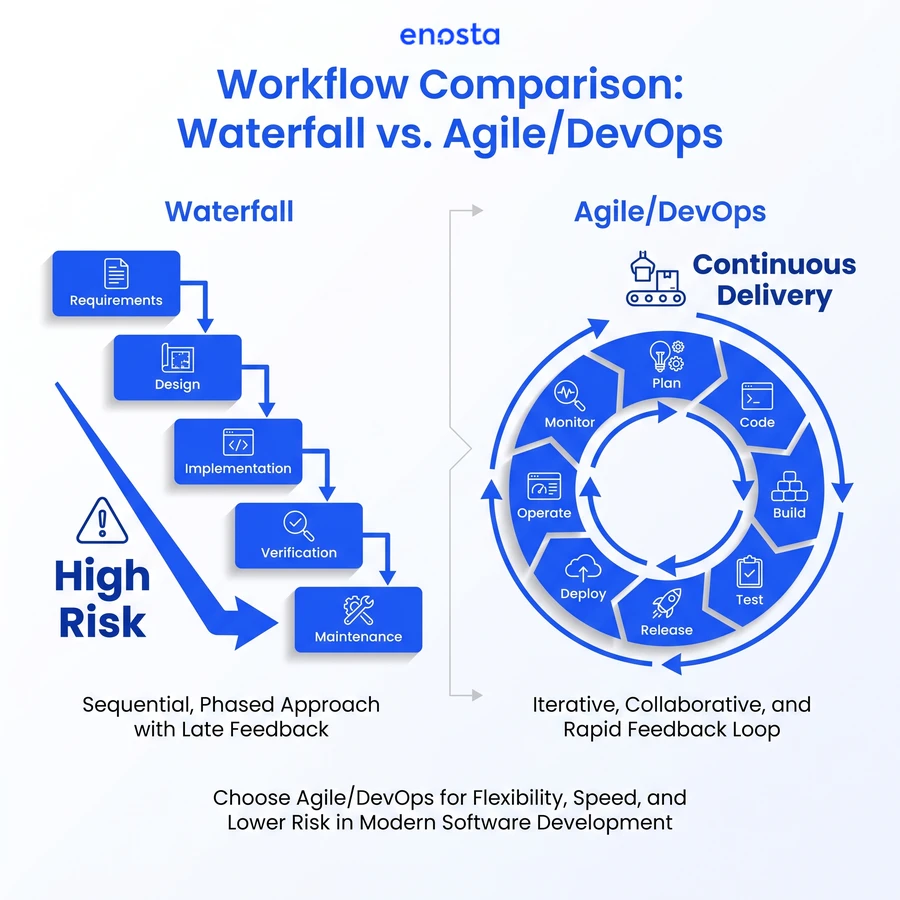
The industry has moved away from the “waterfall” approach toward Agile and DevOps models. This shift allows teams to deliver updates in days rather than months, ensuring they remain responsive to market changes.
| Feature | Monolithic/Waterfall | Agile/DevOps |
|---|---|---|
| Release Frequency | Monthly or Quarterly | Daily or Weekly |
| Feedback Loop | Late in the cycle | Continuous and immediate |
| Risk Management | High (Big bang release) | Low (Incremental updates) |
| Automation | Minimal | High (CI/CD integration) |
Adopting a continuous delivery model allows your team to integrate security early in the process, known as “shift left” security. By embedding automated security checks into the pipeline, you reduce the risk of vulnerabilities reaching production. This modern approach is essential for companies operating in regulated industries where compliance is non-negotiable.
Measuring success in the development process
To truly master the development process, you must measure it. Relying on gut feelings is insufficient in an era of data-driven engineering. I recommend focusing on three core areas to identify bottlenecks:
- 01Deployment Frequency: How often your team successfully pushes code to production.
- 02Lead Time for Changes: The time it takes for a commit to reach production.
- 03Change Failure Rate: The percentage of deployments that result in system degradation or require hotfixes.
By tracking these KPIs, you can ensure that your team is not just busy, but productive. If your team is struggling to maintain velocity, it may be time to audit your CI/CD pipelines or consider external partnerships to handle specific technical challenges. When you align your engineering culture with these metrics, you create a sustainable environment for innovation and growth.
7 Stages of the modern software development lifecycle
Mastering a high-velocity engineering project requires a rigorous approach to the software development lifecycle (SDLC). By standardizing these seven stages, teams can improve predictability, reduce technical debt, and accelerate time-to-market.
Stage 1: Requirements analysis and feasibility study
The foundation of any successful project lies in clear requirements. This stage involves defining the “what” and “why” before a single line of code is written.
- Stakeholder alignment: Facilitate workshops to capture both functional needs and non-functional performance requirements.
- Feasibility check: Conduct a thorough assessment of technical, financial, and operational viability before committing resources.
- Documentation: Create a comprehensive Software Requirement Specification (SRS) document to serve as the project roadmap.
According to Capterra’s software buying trends, 33% of organizations face critical issues during data migration, while 32% struggle with budget overruns, often due to poorly defined initial requirements. Investing time here prevents costly pivots later. A clear SRS acts as a contract between stakeholders and engineering, minimizing scope creep.
Teams should validate these requirements against market realities. For instance, in the Australian market, where the number of software programmers has surged to 216,000 by 2026, competition is fierce. Projects must offer distinct value propositions to survive. Use techniques like SWOT or CO-STAR analysis to filter out non-viable ideas early.
Rigorous feasibility studies also identify resource gaps. If a project requires specialized cloud-native expertise, the team must secure talent or training early. Ignoring these constraints during the initial phase often leads to project stalling during the implementation phase. A well-vetted plan is the strongest defense against unforeseen technical hurdles.
Stage 2: Strategic system design and architecture
This phase transforms abstract requirements into a technical blueprint. Architects define the stack, data flow, and infrastructure strategy.
- System architecture: Choose between monolithic, microservices, or serverless architectures based on specific scalability and maintenance needs.
- Database design: Normalize data structures to ensure long-term efficiency, data integrity, and reliability under high load.
- API strategy: Define clear communication protocols between services to ensure interoperability and future-proof the system.
A robust architecture is the backbone of software development services. Teams should document the rationale behind their architectural decisions to maintain clarity as the project scales. Decisions made here regarding cloud-native design or containerization impact the total cost of ownership significantly.
Consider the trade-offs between speed and flexibility. While a microservices approach offers immense scalability, it introduces complexity in service orchestration. Documenting these trade-offs ensures that future developers understand the “why” behind existing constraints. This prevents the “knowledge silo” effect common in long-term enterprise software projects.
Effective architecture also anticipates future compliance needs. In regions like Europe, where the market for custom software is growing at a CAGR of 21.6%, adhering to data sovereignty is non-negotiable. Designers must incorporate modular components that allow for localized data processing without re-engineering the entire core system.
Stage 3: AI-assisted implementation and coding standards
Modern development leverages AI to boost engineering velocity without compromising code quality. Developers use AI-assisted coding tools to automate boilerplate tasks.
- AI Integration: Tools like GitHub Copilot assist in rapid prototyping, boilerplate generation, and unit test creation.
- Coding Standards: Enforce strict linting and style guides to ensure codebase consistency across diverse teams.
- Peer Review: Use automated Pull Request (PR) checks to maintain high code quality standards before merging.
AI-assisted coding does not replace human oversight; it shifts developer focus toward high-level logic and architecture. By automating repetitive tasks, teams reclaim hours previously lost to manual syntax errors. Ensure that AI-generated code undergoes the same security and performance review as human-written code to prevent vulnerabilities.
Consistency is key when using AI tools. Teams should establish a shared repository of prompts and configuration files. This ensures that the code generated by AI aligns with the project’s established design patterns. Without these guardrails, AI can introduce inconsistent logic that complicates future maintenance and debugging efforts.
Stage 4: Automated testing and quality assurance
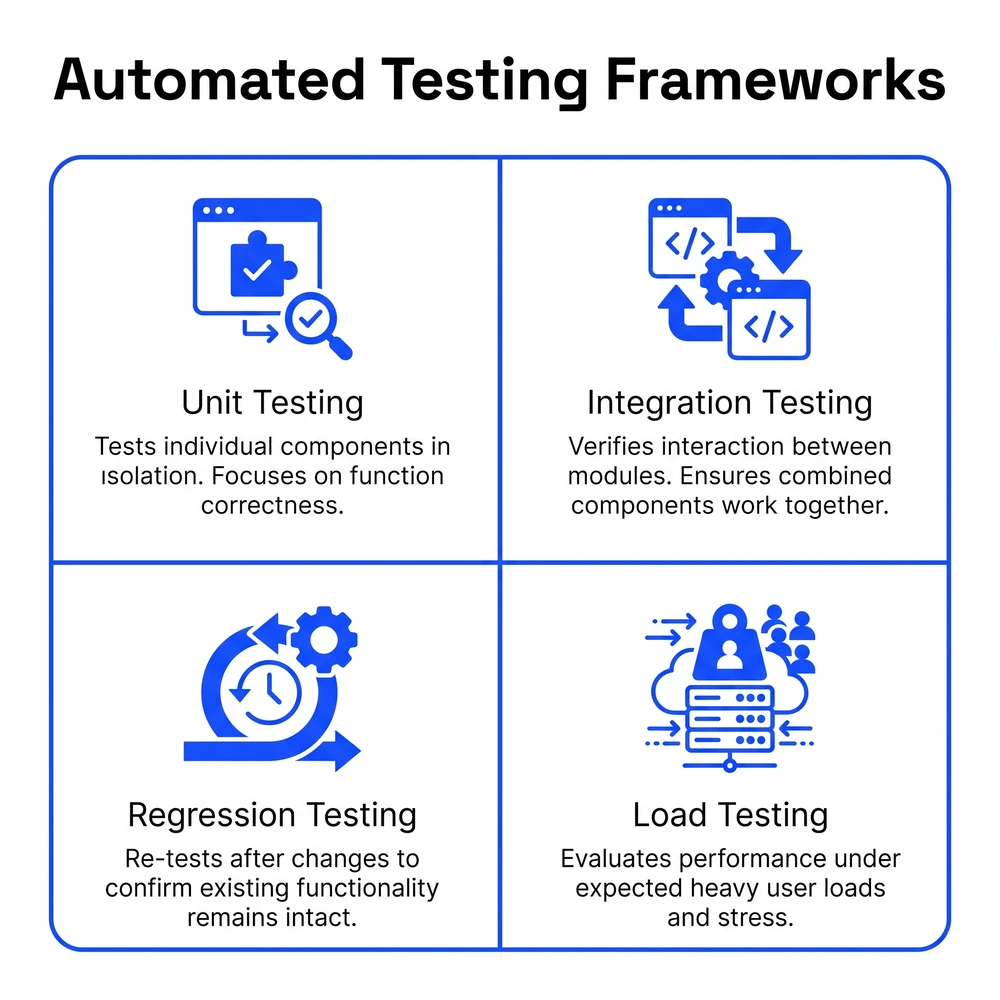
Quality assurance is no longer a final hurdle; it is a continuous process. Automated testing ensures that new changes do not break existing functionality.
| Test Type | Objective | Frequency |
|---|---|---|
| Unit Testing | Validate individual functions | Every build |
| Integration Testing | Ensure component interaction | Post-build |
| Regression Testing | Prevent feature regressions | Daily |
| Load Testing | Check system performance | Pre-release |
By implementing a “Shift Left” testing strategy, teams identify defects early. This significantly reduces the cost of remediation compared to finding bugs in production. Automated suites provide immediate feedback, allowing developers to address issues while the context is fresh in their minds.
Testing must evolve with the application. As projects grow, the test suite often becomes a bottleneck. Optimize your pipeline by running parallel tests and caching dependencies. This allows for faster feedback loops, which is essential for maintaining high velocity in modern, AI-integrated development workflows.
Stage 5: Deployment and release management
Deployment should be a non-event through automation. Implementing CI/CD pipelines allows for frequent, reliable, and low-risk releases.
- CI/CD Pipeline: Automate the build, test, and deployment process using tools like Jenkins, GitLab CI, or GitHub Actions.
- Infrastructure as Code (IaC): Use Terraform or Pulumi to manage environments consistently and avoid configuration drift.
- Blue/Green Deployment: Minimize downtime by running two identical production environments to facilitate instant rollbacks.
Automating these steps ensures that the production environment remains stable. This reduces the “Time to Restore Service” metric, a core component of DORA metrics for high-performing engineering teams. Frequent, smaller releases are inherently safer than large, infrequent deployments. This approach limits the blast radius of any potential bugs.
Modern deployment also requires observability. Before a release is finalized, ensure that logging and monitoring are active in the target environment. This provides immediate visibility into system health post-deployment. If errors occur, the team can respond instantly, ensuring minimal impact on the end-user experience.
Stage 6: Maintenance and continuous improvement
Software development does not end at deployment. Continuous improvement ensures the system remains secure and performant as user needs evolve.
- Monitoring: Use tools like Prometheus, Datadog, or New Relic to track system health and latency in real-time.
- Feedback Loops: Conduct regular sprint retrospectives to identify process bottlenecks and improve overall team velocity.
- Refactoring: Allocate time in every sprint to address technical debt and optimize legacy codebases before they become liabilities.
Maintenance is an iterative cycle. By treating the production environment as a source of truth, teams can proactively address issues before they impact the end-user experience. Data-driven maintenance requires logging and telemetry to identify patterns in system failures. Use these insights to prioritize the product backlog for the next development cycle.
Documentation is equally vital during the maintenance phase. Every fix or optimization should be accompanied by updated documentation. This practice prevents the accumulation of “hidden” logic that confuses future developers. Treat maintenance as an opportunity to refine the architecture, not just a way to keep the lights on.
Stage 7: Security integration (DevSecOps)
Security is the final, critical pillar of the modern SDLC. Integrating security protocols at every stage, or “Shift Left,” protects the application from common vulnerabilities.
- Static Analysis (SAST): Scan source code for security flaws during the build phase to catch issues before deployment.
- Dependency Scanning: Use OWASP-compliant tools to identify and update vulnerabilities in open-source libraries or third-party packages.
- Compliance Automation: Automate checks to ensure adherence to GDPR and other regional data residency requirements.
Integrating security into the workflow minimizes the risk of data breaches. It transforms security from a reactive bottleneck into a proactive feature of the development culture. Security should be treated as a shared responsibility rather than a siloed function. This cultural shift, often called DevSecOps, is essential for building trust in modern digital ecosystems.
Teams must also prioritize training to keep developers updated on evolving threat landscapes. Regular penetration testing and vulnerability assessments supplement automated tools. This layered approach ensures that security is baked into the product from day one. By prioritizing security, you protect your brand reputation and ensure long-term sustainability for your digital products.
Navigating project bottlenecks and feature creep
Even with a perfect process, teams often encounter roadblocks that threaten delivery timelines. Identifying these hurdles early is essential for maintaining engineering velocity.
- Feature Creep: Establish a strict change management process where every new requirement must be evaluated against the current sprint capacity.
- Technical Debt: Prioritize refactoring tasks alongside new feature development to prevent the accumulation of “code rot” that slows down future iterations.
- Resource Constraints: Utilize professional consulting services to optimize your infrastructure and CI/CD pipelines, allowing teams to do more with less.
Handling bottlenecks requires transparency. Use tools like Jira to visualize the workflow and identify where tasks are piling up. If a specific phase consistently lags, investigate whether it stems from skill gaps, inadequate tooling, or unclear communication between departments.
Open communication is the best remedy for bottlenecks. When developers feel comfortable raising concerns early, the team can adjust the roadmap before the project falls behind. Foster a culture where process improvements are celebrated as much as new feature launches. This balance keeps the team motivated and the delivery pipeline smooth.
Measuring success with DORA metrics
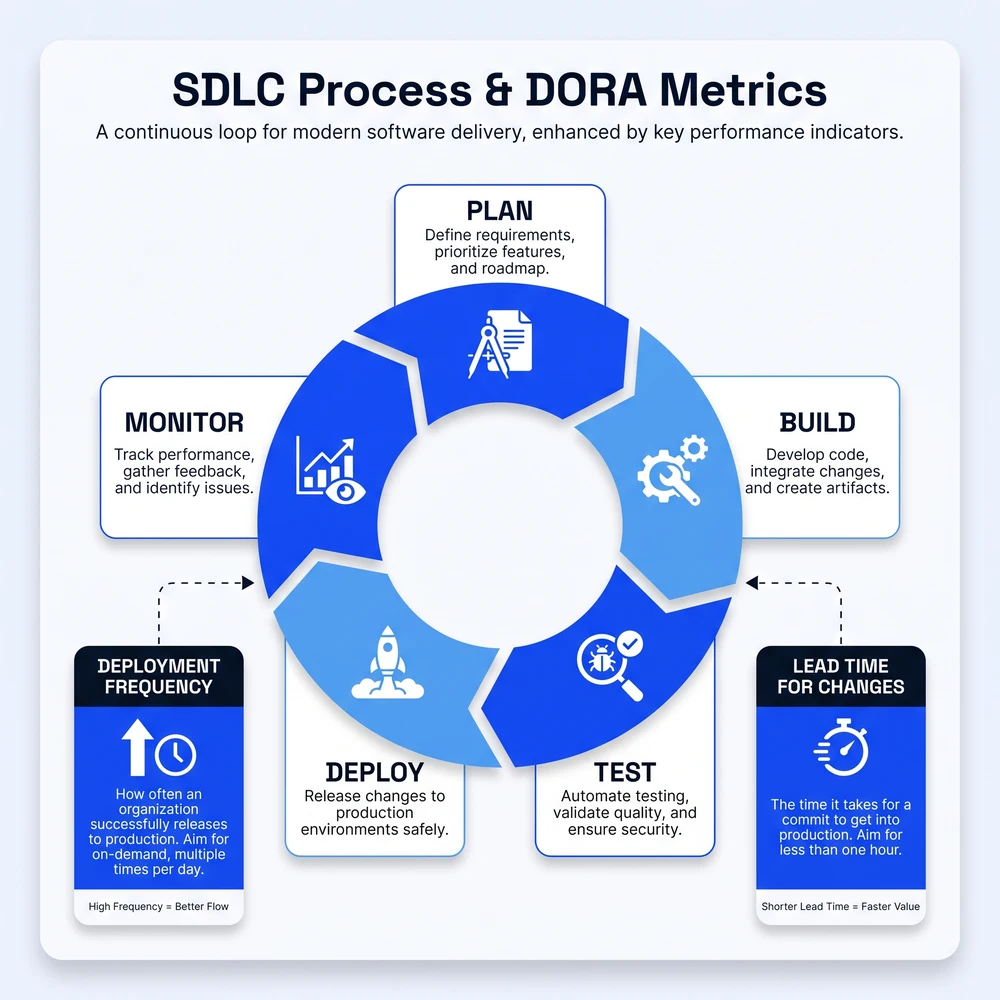
Data-backed decision-making distinguishes high-performing engineering teams from those that struggle with unpredictable delivery. Monitor these four key metrics to gauge your process health:
| Metric | Goal |
|---|---|
| Deployment Frequency | Increase to enable faster feedback |
| Lead Time for Changes | Reduce to improve time-to-market |
| Change Failure Rate | Minimize to ensure system stability |
| Time to Restore Service | Decrease to maintain high availability |
These indicators provide a clear picture of your development efficiency. High deployment frequency combined with a low change failure rate suggests a mature, automated pipeline. Conversely, high lead times often signal bottlenecks in the review or testing stages that require immediate process optimization.
Consistently tracking these metrics allows for objective performance reviews. Instead of relying on gut feeling, leadership can use DORA data to justify investment in new tools or team training. This data-driven approach builds a culture of continuous improvement, where every team member understands their role in the overall success of the project.
Comparing software development methodologies
Choosing the right framework dictates your engineering velocity and project success. In 2026, teams must select models that align with their business goals, team size, and technical complexity.
Waterfall vs. Agile: When to choose which model
Waterfall follows a linear, sequential path where each phase must complete before the next begins. It suits projects with fixed requirements, strict regulatory compliance, or stable infrastructure needs.
Agile prioritizes iterative development, allowing teams to deliver functional software in short cycles. It thrives in high-uncertainty environments where user feedback shapes the feature roadmap.
- Choose Waterfall if: You have clear, unchanging documentation and a fixed budget. It is ideal for legacy system maintenance or hardware-integrated software where changes are costly.
- Choose Agile if: You need rapid market entry. It is perfect for startups or SaaS platforms that require constant updates based on real-time user metrics.
According to Market Research Future, the shift toward automated DevOps workflows is driving a 14.65% CAGR in adoption. This move away from rigid Waterfall structures reflects the industry demand for continuous integration and deployment.
Scrum vs. Kanban: Comparing frameworks for engineering teams
Scrum and Kanban are both Agile methodologies but serve different operational needs. Scrum relies on time-boxed sprints, typically lasting 2-4 weeks, to deliver specific increments of software.
Kanban focuses on continuous flow, utilizing a visual board to limit Work-in-Progress (WIP). It is highly effective for maintenance teams or projects with unpredictable incoming requests.
- Scrum: Best for teams needing high structure and predictable release cadences. It requires specific roles like the Scrum Master and Product Owner to manage the backlog.
- Kanban: Best for teams managing a steady stream of incoming tasks. It allows for immediate prioritization changes without waiting for a sprint to end.
In my experience leading software development services, the choice often depends on the product lifecycle stage. Early-stage products benefit from the rigid feedback loops of Scrum. Mature products often transition to Kanban to handle ongoing support tickets and minor feature updates efficiently.
Hybrid models: Balancing structure and flexibility in 2026
Hybrid models, often called “Scrumban,” combine the structured planning of Scrum with the visual flexibility of Kanban. Teams use sprints for major feature releases while maintaining a Kanban board for daily bug fixes.
This approach mitigates the risk of “feature creep” by forcing teams to commit to specific sprint goals. Simultaneously, it maintains the agility to respond to urgent production issues without disrupting the entire development team.
Methodology comparison matrix
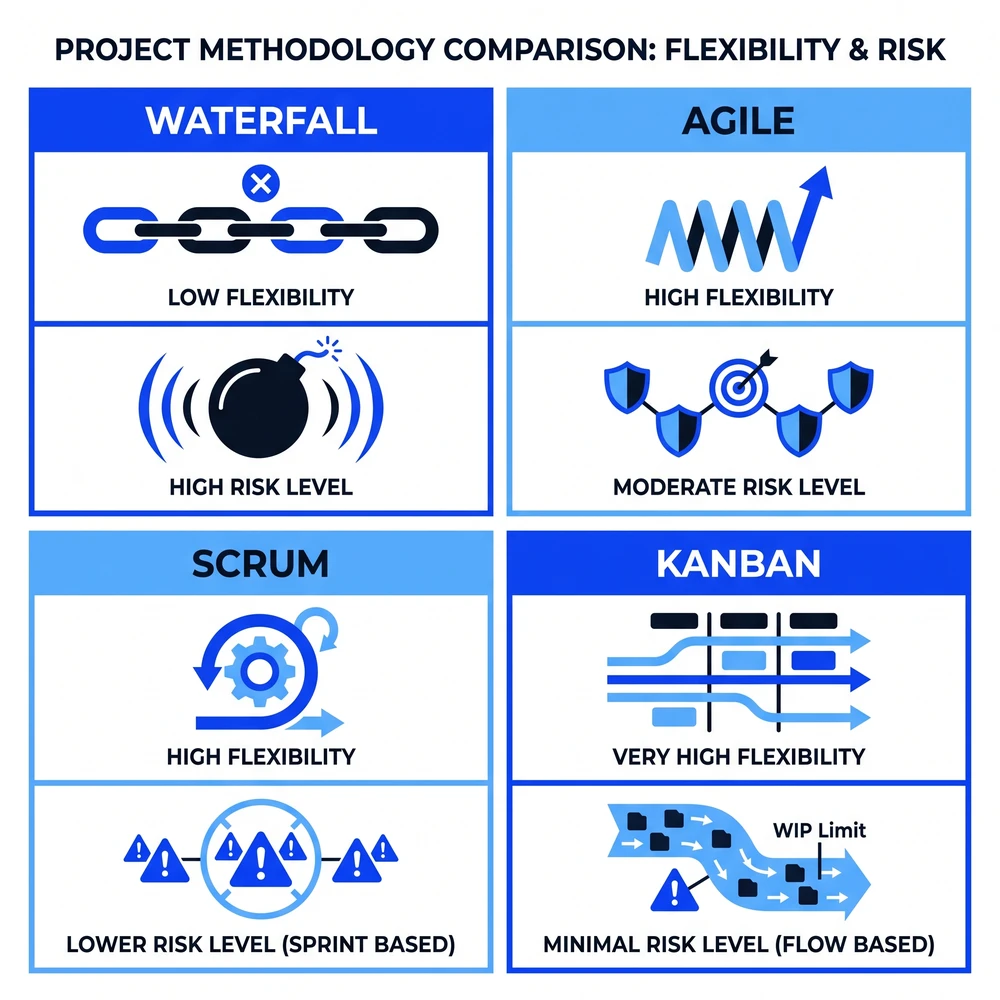
The following table summarizes how these frameworks perform across key engineering benchmarks.
| Methodology | Best For | Flexibility | Risk Level | Documentation |
|---|---|---|---|---|
| Waterfall | Fixed-scope projects | Low | High | Extensive |
| Agile | Market-driven apps | High | Low | Minimal |
| Scrum | Complex feature sets | Medium | Medium | Moderate |
| Kanban | Continuous maintenance | High | Low | Minimal |
| Hybrid | Large enterprise scale | Medium | Low | Moderate |
Measuring success in your chosen framework
Regardless of the methodology, you must track performance using DORA metrics. These include Deployment Frequency, Lead Time for Changes, Change Failure Rate, and Time to Restore Service.
- Deployment Frequency: Measures how often your team pushes code to production. High-performing teams automate this via CI/CD pipelines.
- Lead Time for Changes: Tracks the time from code commit to production deployment. This identifies bottlenecks in your custom software engineering process.
- Change Failure Rate: Monitors how often deployments cause service degradation. Lowering this rate is a primary goal of implementing “Shift Left” security practices.
By integrating AI-assisted coding tools like GitHub Copilot, teams can further accelerate these cycles. Data shows that 57% of North American organizations now utilize multi-step AI agent workflows to automate testing and code generation, significantly reducing manual overhead.
Overcoming methodology-specific pitfalls
Every framework carries inherent risks if mismanaged. Technical debt is a common issue in Agile, where speed is prioritized over code quality.
- Agile/Scrum Pitfall: Ignoring “Refinement” sessions leads to unclear requirements and scope creep. Ensure the product backlog is groomed consistently to maintain team focus.
- Waterfall Pitfall: The “Big Bang” release can hide critical bugs until the final phase. Implement milestone reviews to catch integration issues early.
- Kanban Pitfall: Without strict WIP limits, team members may multitask, causing cognitive load and reduced output quality. Always enforce a cap on active tasks.
Successful engineering teams in 2026 treat their process as a living document. They conduct regular retrospectives to adapt their workflow based on empirical data rather than rigid adherence to theory.
By aligning your enterprise software development roadmap with the right methodology, you create a scalable environment. Start by auditing your current velocity and identifying where manual tasks create friction. Whether you choose Scrum’s rhythm or Kanban’s flow, your goal remains the same: delivering high-quality, secure software that meets user needs.
Operational strategies for 2026
Modern engineering requires more than just picking a framework; it demands a cultural shift. You must foster an environment where developers feel empowered to suggest process improvements during every sprint retrospective.
- Standardize Code Reviews: Use automated linting and pull request templates to ensure consistency across the team. This reduces friction during peer reviews.
- Implement Infrastructure as Code (IaC): Tools like Terraform or CloudFormation ensure your environments remain reproducible and scalable. This prevents the “works on my machine” syndrome.
- Prioritize Security: Shift left by integrating automated security scans directly into your CI/CD pipelines. Early detection of vulnerabilities prevents costly rework later.
Consider the impact of the 216,000 software programmers currently active in Australia. With this massive talent pool, competition for efficient, high-velocity engineering teams is at an all-time high. Adopting modern methodologies is no longer optional; it is a prerequisite for retaining top talent and maintaining market relevance.
Managing technical debt in high-velocity teams
Technical debt is the interest paid on quick, suboptimal coding decisions made under pressure. If left unchecked, it can cripple your development speed and increase maintenance costs significantly.
- Allocate Debt Sprints: Devote 10-20% of every sprint cycle to refactoring and cleaning up legacy code. This prevents debt from accumulating into a project-wide bottleneck.
- Document Decisions: Keep an Architecture Decision Record (ADR) to explain why specific trade-offs were made. This context is invaluable for future team members.
- Automate Everything: Manual testing and deployment are primary sources of debt. Invest in robust automated testing frameworks to ensure long-term stability.
I have observed that teams ignoring these practices often struggle with declining morale and high turnover. By making technical debt visible on your Jira board, you ensure that product owners understand the necessity of non-feature work.
Scaling your development process across regions
As your business grows, you may need to manage distributed teams across different time zones. Successful scaling requires standardized communication protocols and a “single source of truth” for documentation.
- Sync vs. Async: Use synchronous meetings only for complex planning and decision-making. Rely on asynchronous tools like Slack or Notion for daily status updates and project documentation.
- Standardize Onboarding: A well-documented process allows new hires to become productive within the first 14 days. This reduces the burden on senior engineers.
- Centralized Backlog: Use a unified project management platform to ensure all teams are aligned on the broader product vision and current priorities.
Global markets are demanding more custom solutions, with European markets seeing a 21.6% CAGR for custom software development. Scaling your process ensures you can meet this demand without compromising quality or security. Stay agile, remain data-driven, and continuously refine your workflow to stay ahead of the competition.
Essential metrics for development success
Optimizing the software development lifecycle requires more than intuition; it demands rigorous, data-driven performance analysis. By tracking precise engineering benchmarks, teams can identify bottlenecks and improve overall delivery velocity.
Understanding DORA metrics: Deployment frequency and lead time for changes
DORA metrics provide the industry standard for evaluating high-performing engineering teams. These four key indicators, popularized by the DevOps Research and Assessment group, offer a clear view of your operational health.
- Deployment Frequency: Measures how often code is successfully deployed to production. High-performing teams typically ship changes multiple times per day rather than in large, risky batches.
- Lead Time for Changes: Tracks the duration from a code commit to that code running in production. A shorter lead time indicates an efficient software development services pipeline.
- Change Failure Rate: Calculates the percentage of deployments causing a failure in production. This metric balances speed with stability.
- Time to Restore Service: Monitors how quickly a team recovers from a production failure. It highlights the effectiveness of your incident response and monitoring tools.
Effective teams leverage these metrics to transform their development culture. For example, by tracking the time to restore service, an engineering manager can identify if their automated testing suites are actually catching regressions before they reach the production environment. A high change failure rate often signals that your team needs to prioritize “Shift Left” security practices or refine their code review standards.
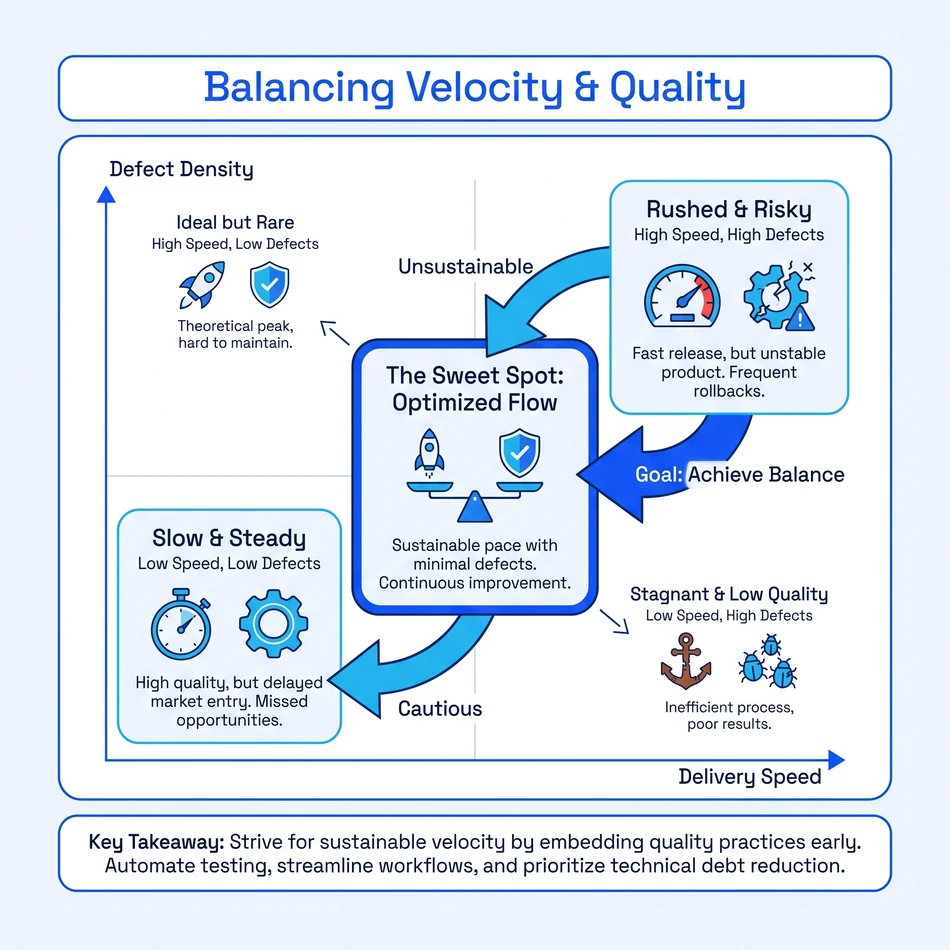
Measuring engineering velocity without sacrificing code quality
Velocity is often misunderstood as simply “writing more code.” True engineering velocity focuses on the speed of delivering value while maintaining strict code review standards and minimizing technical debt.
To measure this effectively, focus on the following balance:
| Metric | Goal | Why it matters |
|---|---|---|
| Cycle Time | Decrease | Measures the speed of moving a ticket from “In Progress” to “Done.” |
| Code Churn | Monitor | High churn often indicates unclear requirements or poor architectural planning. |
| Pull Request Size | Minimize | Smaller PRs are reviewed faster and contain fewer bugs than massive updates. |
| Test Coverage | Increase | Ensures that speed does not degrade the core functionality of your application. |
Over-prioritizing raw output often leads to “feature creep,” where the product grows in size but loses focus. To mitigate this, teams should utilize automated testing frameworks and peer-review mandates to ensure that “fast” code is also “clean” code. When we manage teams, we often find that enforcing a maximum PR size of 200 lines significantly boosts review throughput and quality.
Tracking customer satisfaction and system reliability
Technical metrics are meaningless if the final product fails to satisfy user needs. Reliability and customer sentiment must be integrated into your dashboard to provide a holistic view of success.
System reliability is tracked through Service Level Indicators (SLIs) and Service Level Objectives (SLOs). These targets ensure that your infrastructure meets the performance expectations of your users, such as load times or uptime.
- Error Budget: Defines the threshold of allowed unreliability. If you exceed this, the team stops feature work to focus on stability.
- User Sentiment Analysis: Direct feedback from NPS or user surveys provides the qualitative data needed to balance technical performance.
- Downtime Impact: Tracks lost revenue or user engagement per minute of system unavailability.
Focusing on these metrics allows leaders to make informed decisions about resource allocation. When you integrate AI-assisted coding tools like GitHub Copilot into your workflow, these metrics will help you measure the actual productivity gains. For instance, you might observe a decrease in lead time for changes after implementing AI-driven test case generation across your CI/CD pipelines.
Consistency is the ultimate goal of any engineering manager. By reviewing these benchmarks during every sprint retrospective, you can identify recurring bottlenecks and implement corrective actions before they impact your release schedule.
Tracking these numbers is not about punishing the team for slow performance. Instead, it is about creating a transparent environment where developers can see the impact of their work on the broader business goals. When data is accessible, teams feel empowered to optimize their own workflows, leading to higher engagement and better software outcomes.
How AI is transforming the development workflow
Artificial intelligence is fundamentally reshaping the software development lifecycle by automating repetitive tasks and augmenting human engineering capacity. In 2026, AI is no longer an experimental luxury but a core component of high-velocity engineering teams.
Leveraging AI-assisted coding tools
AI-assisted coding tools like GitHub Copilot act as intelligent pair programmers that suggest code completions in real-time. These tools allow developers to maintain focus on complex architectural problems rather than syntax or boilerplate code.
By analyzing vast repositories of open-source projects, these assistants provide context-aware suggestions that align with established coding standards. This accelerates the initial implementation phase of our software development services significantly.
Automated bug detection and test generation
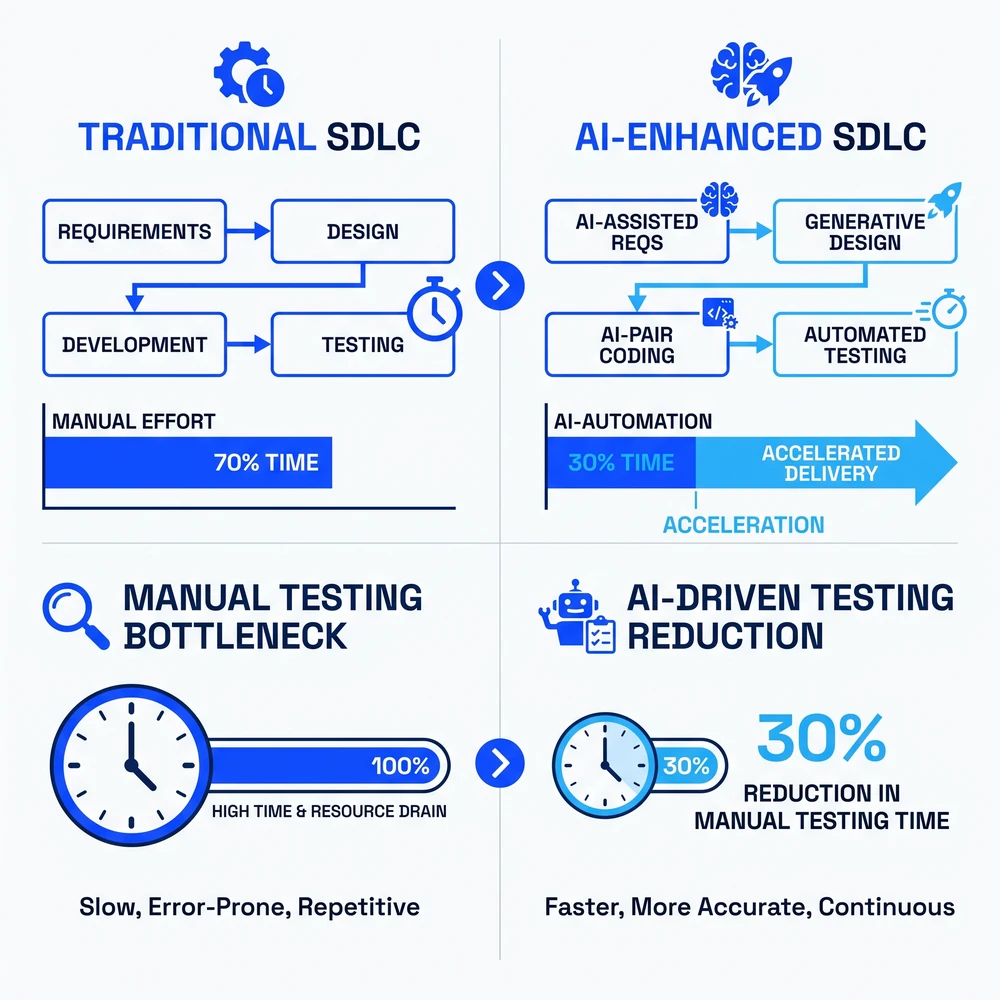
Modern development teams are shifting away from manual quality assurance by utilizing AI-driven testing frameworks. These systems automatically generate comprehensive test cases based on project requirements, ensuring higher coverage and fewer regressions.
- Self-healing tests: AI agents detect UI changes and automatically update test scripts to prevent brittle failures.
- Predictive bug detection: Algorithms scan codebases to identify potential memory leaks or security vulnerabilities before deployment.
- Automated documentation: AI tools generate technical documentation by parsing code comments and project architecture, keeping manuals in sync with the latest commits.
According to research from Modall, these automated workflows allow large enterprises to save over 500,000 engineering hours annually. By reducing the time spent on manual debugging, teams can dedicate more resources to feature innovation and performance optimization.
Predictive risk assessment in project management
Predictive analytics now provide project managers with real-time visibility into potential bottlenecks before they impact delivery timelines. By analyzing historical project data and current velocity, AI models forecast risks such as scope creep or resource shortages.
These tools integrate seamlessly with platforms like Jira or Slack to provide proactive alerts. When a project deviates from its enterprise software development roadmap, the system suggests corrective actions based on successful past resolutions.
| Risk Factor | AI Intervention Strategy | Expected Outcome |
|---|---|---|
| Scope Creep | Automated requirement impact analysis | Reduced feature bloating by 15% |
| Resource Gap | Predictive velocity forecasting | Optimized sprint planning cycles |
| Bottlenecks | Real-time dependency mapping | Improved delivery predictability |
Experience note: Practical AI integration at Enosta
At Enosta, we have observed that AI integration is most effective when it augments human oversight rather than replacing it. By implementing custom AI agents within our internal workflows, our team has successfully reduced manual overhead by 30%.
We use AI to perform initial code reviews, which allows our senior engineers to focus on architectural integrity and security compliance. This hybrid approach ensures that we maintain high code review standards while accelerating our overall development velocity.
Strengthening security through AI
The “shift left” security approach is significantly enhanced by AI tools that scan for vulnerabilities during the coding process. Instead of waiting for a final security audit, developers receive immediate feedback on potential threats.
- OWASP compliance: AI agents flag non-compliant code patterns in real-time.
- Dependency scanning: Tools automatically identify and suggest patches for outdated or insecure libraries.
- Infrastructure as Code (IaC) analysis: AI validates Terraform or Kubernetes configurations to ensure secure deployment environments.
Integrating DevSecOps into your SDLC is now more manageable with these automated tools. By catching security flaws early, companies avoid costly post-release patches and maintain user trust while scaling their custom software engineering process.
Operationalizing AI for long-term success
Adopting AI requires a cultural shift toward continuous learning and tool evaluation. Teams must balance innovation with the risk of “black box” algorithms that may introduce subtle logic errors.
- 01Standardize Tooling: Choose AI platforms that integrate directly with your CI/CD pipelines to ensure consistent application across the team.
- 02Continuous Training: Regularly update AI models with your internal codebase patterns to improve the relevance of suggestions.
- 03Human-in-the-loop: Always mandate human verification for critical code merges, especially in production-critical environments.
As these technologies mature, the divide between average and high-performing engineering teams will continue to widen. Organizations that embrace AI-driven workflows will benefit from faster deployment cycles and more robust, scalable software systems.
Common pitfalls in software engineering
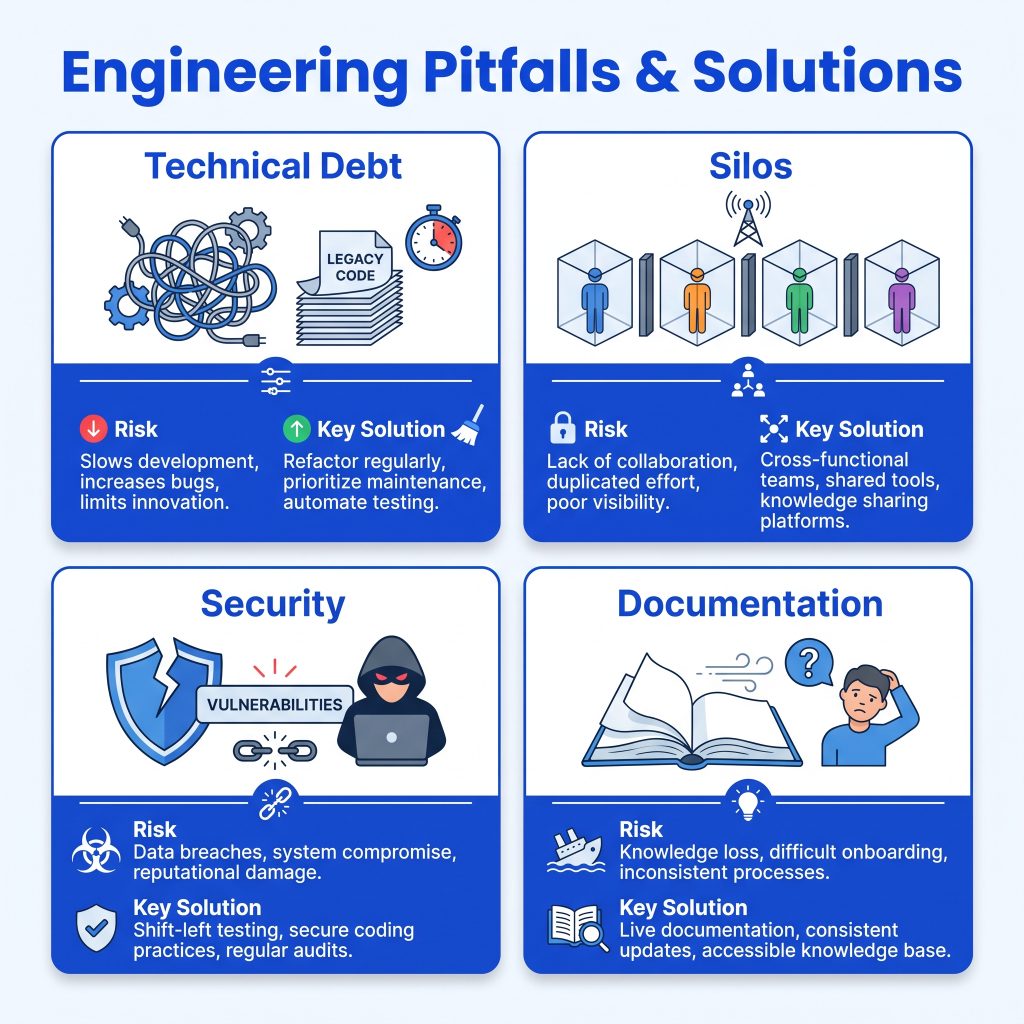
Even the most robust software development lifecycle services can falter if teams ignore structural risks. Technical debt, communication silos, and security oversights often derail high-velocity engineering projects, leading to budget overruns and missed deadlines.
Managing technical debt and feature creep
Technical debt accumulates when teams prioritize speed over code quality, leaving behind shortcuts that require future rework. Left unmanaged, this debt restricts your ability to scale effectively. Feature creep compounds this issue by introducing non-essential requirements that bloat the scope and distract from core product value.
- Prioritize refactoring cycles: Dedicate 20% of every sprint to addressing technical debt to prevent long-term degradation.
- Implement strict change control: Any new feature request must undergo a rigorous impact analysis against existing project timelines.
- Maintain a debt backlog: Track all known shortcuts in Jira or similar tools to ensure they are visible and scheduled.
- Define “Definition of Done”: Clearly outline that code is only complete when it meets both functional and quality standards.
According to Capterra’s software trends research, 32% of businesses suffer from budget overruns, often due to scope creep during implementation. Proactive management of these variables is essential for maintaining engineering velocity.
The dangers of silos: Communication gaps between product and engineering
Silos occur when product managers and engineers operate in isolation, leading to a disconnect between business goals and technical execution. This gap often results in products that are technically sound but fail to solve actual user pain points.
- Foster cross-functional squads: Embed engineers in product discovery sessions to ensure technical feasibility is considered early.
- Standardize communication channels: Use tools like Slack for real-time updates and Confluence for documentation to minimize information loss.
- Conduct regular syncs: Weekly sprint retrospectives provide a space to address alignment issues before they become project-wide bottlenecks.
- Shared KPIs: Align the incentives of both product and engineering teams around the same business outcomes, such as user retention or system uptime.
When teams share a common language, they resolve bottlenecks faster. This collaborative approach is a hallmark of high-performing teams that successfully leverage agile software development outsourcing to scale their capacity.
Overlooking Shift Left security requirements
Many teams treat security as a final checklist item before release, creating a massive bottleneck at the end of the SDLC. “Shift Left” security integrates testing and compliance earlier in the process, reducing the cost of fixing vulnerabilities.
- Automate static analysis: Integrate security scanning tools directly into your CI/CD pipelines to catch code-level risks immediately.
- Threat modeling: Conduct sessions during the design phase to identify potential attack vectors before a single line of code is written.
- Standardize compliance: Ensure your development process adheres to industry frameworks like OWASP to maintain high security-by-design standards.
- Continuous monitoring: Utilize automated infrastructure as code (IaC) checks to ensure production environments remain compliant.
Integrating security early is no longer optional in 2026. As organizations scale, the complexity of data residency and regulatory compliance necessitates a proactive security posture to avoid costly remediation efforts.
Inadequate documentation for remote-first teams
Remote-first environments struggle when knowledge resides only in the minds of individual developers. Without accessible, up-to-date documentation, onboarding becomes a major drag on productivity, and critical system insights are lost when staff turnover occurs.
- Create a “Single Source of Truth”: Centralize all API documentation, architecture diagrams, and coding standards in a shared repository.
- Automate documentation generation: Use tools that generate API specs from code comments to ensure docs stay synchronized with the latest builds.
- Maintain a wiki for processes: Keep a living document outlining the team’s specific software development workflow optimization strategies.
- Video walkthroughs: Supplement text with screen recordings to explain complex architectural decisions for new team members.
Effective documentation serves as the backbone of an enterprise software development roadmap. It allows teams to onboard talent quickly and ensures that the project remains maintainable even as it grows in complexity.
Conclusion and next steps
Mastering the software development process in 2026 requires a blend of disciplined engineering, AI-driven automation, and strategic alignment. Success relies on balancing high-velocity deployment with rigorous security and quality standards. By integrating DevOps practices and DORA metrics, teams can transform their workflow from a reactive state into a proactive engine for growth.
Refining your software development lifecycle services is not a one-time project but a continuous cycle of improvement. Whether you are scaling an existing platform or launching a new product, technical excellence remains the foundation of long-term market competitiveness. The integration of AI-assisted tools and cloud-native architecture ensures your team remains agile in an increasingly complex digital landscape.
Choosing a partner that understands both the technical and business dimensions of software engineering is vital. A strategic partner does more than write code; they provide the infrastructure, security oversight, and architectural guidance necessary to navigate common pitfalls like feature creep or data migration failures. At Enosta, we specialize in helping businesses bridge the gap between initial ideation and robust, scalable production environments.
The path to a scalable development process
Building a scalable process demands a commitment to transparency and measurable outcomes. You must treat your development workflow as a product that requires constant maintenance and optimization. Consider the following pillars to ensure your engineering team maintains velocity without sacrificing quality:
- Standardize CI/CD pipelines: Automate your testing and deployment phases to reduce human error and accelerate time-to-market.
- Embrace Shift Left Security: Integrate security checks early in the design phase, following established OWASP guidelines to minimize vulnerabilities.
- Monitor DORA metrics: Track deployment frequency, lead time for changes, change failure rate, and time to restore service to gain objective insights into team performance.
- Prioritize technical debt management: Dedicate 20% of every sprint to refactoring and cleaning up legacy code to ensure long-term system stability.
- Leverage AI for efficiency: Utilize AI-assisted coding tools to automate repetitive tasks like writing boilerplate code or generating initial test cases.
To achieve true scalability, you must align these technical pillars with your organizational culture. A high-performing team treats documentation as a first-class citizen, ensuring that system architecture remains understandable as the codebase expands. According to DORA (DevOps Research and Assessment) benchmarks, elite performers are twice as likely to meet or exceed their organizational performance goals compared to low performers.
Why partner selection impacts success
Technical capability is only half the equation in modern software development. The most successful organizations often outsource complex engineering tasks to software development services providers to gain access to specialized talent and battle-tested frameworks. A qualified partner brings deep expertise in cloud-native design, regulatory compliance, and infrastructure management that may take years to cultivate in-house.
When evaluating a partner, focus on their ability to act as a strategic extension of your team rather than a simple service provider. Look for evidence of successful project delivery, familiarity with your specific industry regulations, and a culture of continuous learning. A strong partner will proactively identify bottlenecks, suggest architectural improvements, and ensure your roadmap remains aligned with your overarching business goals.
Consider the following comparison when deciding between internal hiring and specialized outsourcing:
| Factor | Internal Development Team | Outsourced Strategic Partner |
|---|---|---|
| Time to Onboard | High (3-6 months) | Low (2-4 weeks) |
| Technical Depth | Limited to current staff | Access to multi-domain experts |
| Scalability | Rigid and costly to adjust | Highly elastic and flexible |
| Cost Predictability | Variable (overhead + salary) | Fixed or project-based models |
Partnering with an external team often provides the “architectural edge” necessary to avoid common pitfalls. For instance, many teams fail during the migration phase because they lack experience with complex legacy-to-cloud transitions. An experienced partner brings pre-built frameworks and proven methodologies that mitigate these risks, allowing your internal team to focus on core product innovation.
Taking your next steps
The transition to a mature software development lifecycle is an investment in your business’s future. By auditing your current workflows and addressing the gaps in your delivery pipeline, you set the stage for sustainable growth and innovation. Whether you are struggling with scaling your infrastructure or looking to optimize your deployment cycles, expert guidance can help you avoid costly mistakes.
The complexity of modern software means that your process is never truly “finished.” You must continuously refine your deployment strategies and security protocols to stay competitive. If you find your team spending more time fixing bugs than building features, it is a clear signal that your current workflow requires an immediate, data-driven audit.
As you move forward, remember that the most effective teams are those that remain adaptable. Technology will continue to evolve, but the core principles of clear communication, iterative development, and rigorous testing will always remain the bedrock of successful software engineering. Start by implementing small, incremental changes to your workflow today, and refine your processes based on real-world data and team feedback. Success is not about finding the perfect process; it is about building a system that allows your team to learn, improve, and deliver value consistently.
Frequently asked questions
Navigating the complexities of modern engineering requires absolute clarity on technical standards and strategic partnerships. These common questions address the integration of security, methodology, and operational efficiency within your software development workflow.
How do you integrate DevSecOps into an existing SDLC?
Integrating DevSecOps requires a “shift-left” mindset where security testing occurs early in the development cycle. You must automate security checks within your CI/CD pipeline to identify vulnerabilities before deployment. This approach minimizes the cost of remediation and significantly reduces the risk of production breaches.
- Static Analysis (SAST): Run automated scans on source code during every commit to catch syntax errors or insecure patterns.
- Dependency Scanning: Monitor third-party libraries for known vulnerabilities using tools like Snyk or OWASP Dependency-Check.
- Infrastructure as Code (IaC) Scanning: Validate configuration files against security best practices before provisioning cloud environments with tools like Terraform.
- Automated Policy Gates: Implement automated gates that block deployment if high-severity vulnerabilities are detected in the build.
What is the difference between SDLC and PDLC?
The Software Development Life Cycle (SDLC) is a specialized subset of the broader Product Development Life Cycle (PDLC). SDLC focuses strictly on the technical engineering phases from requirements to maintenance. In contrast, PDLC encompasses the entire commercial journey of a product.
| Feature | SDLC (Technical) | PDLC (Commercial) |
|---|---|---|
| Primary Goal | Efficient, bug-free code | Market-fit, value delivery |
| Key Activities | Architecture, Coding, Testing | Ideation, Branding, Launch |
| Metrics | DORA metrics, Code coverage | ROI, Customer Acquisition Cost |
| Timeframe | Iterative (Sprint-based) | Long-term (Lifecycle-based) |
How can startups choose the right software development outsourcing partner?
Choosing the right team is critical, as 27% of businesses report lacking necessary support from partners during implementation phases according to Capterra Canada research. A strategic partner should act as an extension of your internal team rather than a mere service provider.
- Technical Alignment: Verify their experience with your specific stack, such as JavaScript or cloud-native architectures.
- Communication Velocity: Assess their sprint cadence and transparency in reporting progress via tools like Jira or Slack.
- Proven Track Record: Look for partners who offer comprehensive software development services rather than just coding, ensuring they understand your business context.
- Cultural Fit: Evaluate their willingness to challenge requirements and provide architectural feedback early in the project.
What tools are essential for a modern CI/CD pipeline in 2026?
A robust pipeline automates the journey from code commit to production, reducing manual intervention and human error. Modern engineering teams prioritize tools that offer seamless integration and high scalability.
- Version Control: GitHub or GitLab remain the industry standards for code management and team collaboration.
- CI/CD Orchestration: Jenkins or GitHub Actions facilitate automated build, test, and deployment triggers.
- Containerization: Docker and Kubernetes ensure environment consistency across development, testing, and production stages.
- Orchestration & Provisioning: Use Terraform to manage infrastructure as code, ensuring reproducible cloud environments across all deployments.