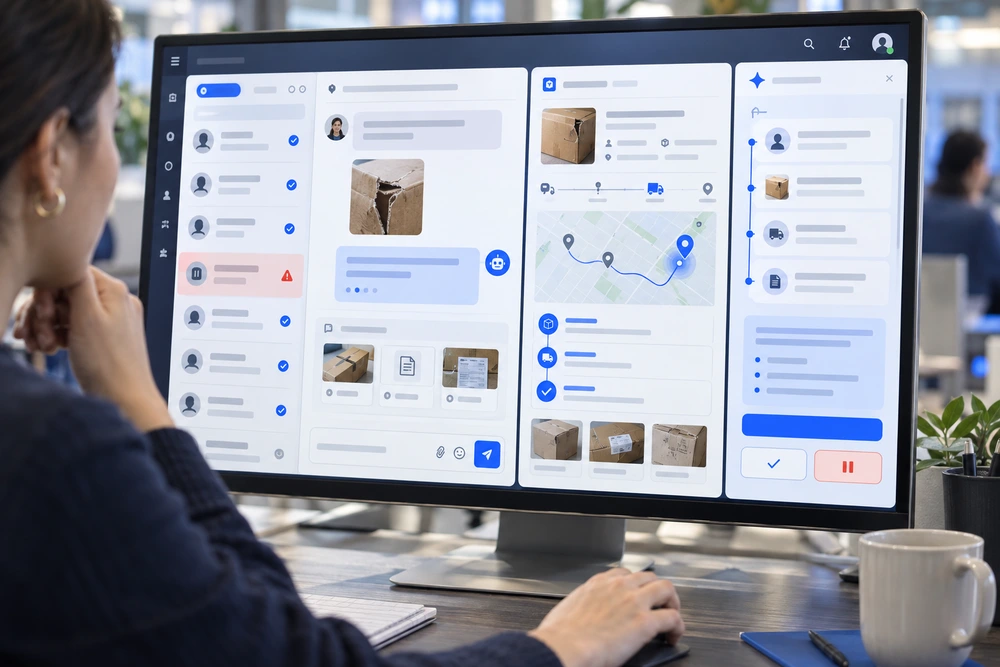
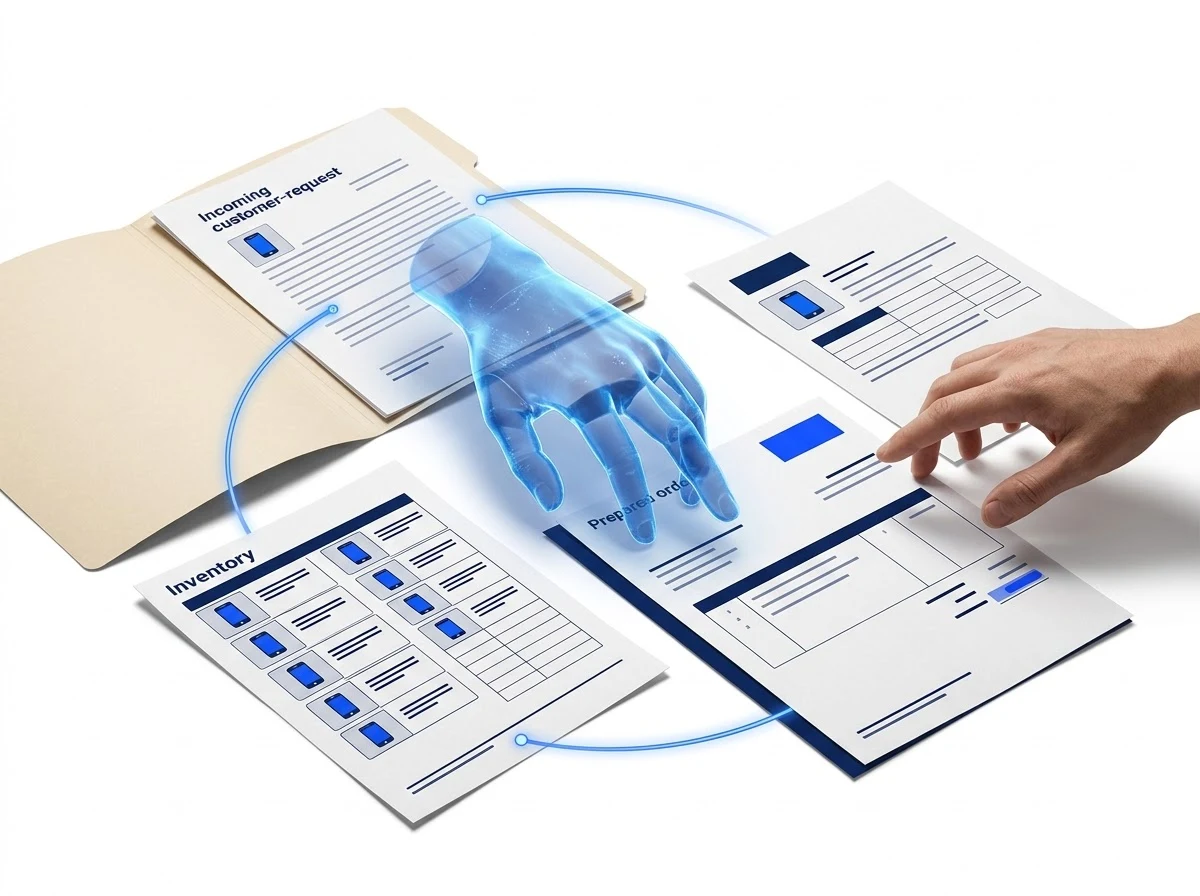
In the rapidly evolving landscape of 2026, modern software design and development demand a unified approach to ensure business agility and technical excellence. As Founder and CEO of Enosta, I have witnessed how bridging the gap between high-fidelity design and production-ready code transforms digital products into scalable assets. This guide explores how integrating software development services with strategic design principles minimizes technical debt and accelerates time-to-market. By aligning cross-functional teams and adopting lean, user-centric methodologies, organizations can navigate the complexities of the current digital economy and build sustainable software that meets both user needs and infrastructure scalability requirements.The modern paradigm of integrated product engineeringThe traditional separation of design and development is an outdated model that frequently leads to project failure in 2026. When design and engineering operate in silos, teams encounter misalignment, leading to costly refactoring and missed market opportunities. A unified strategy, known as end-to-end product engineering, treats design and code as two sides of the same coin. This holistic approach ensures that every UI/UX decision is technically feasible, while every architectural choice supports the intended user experience.
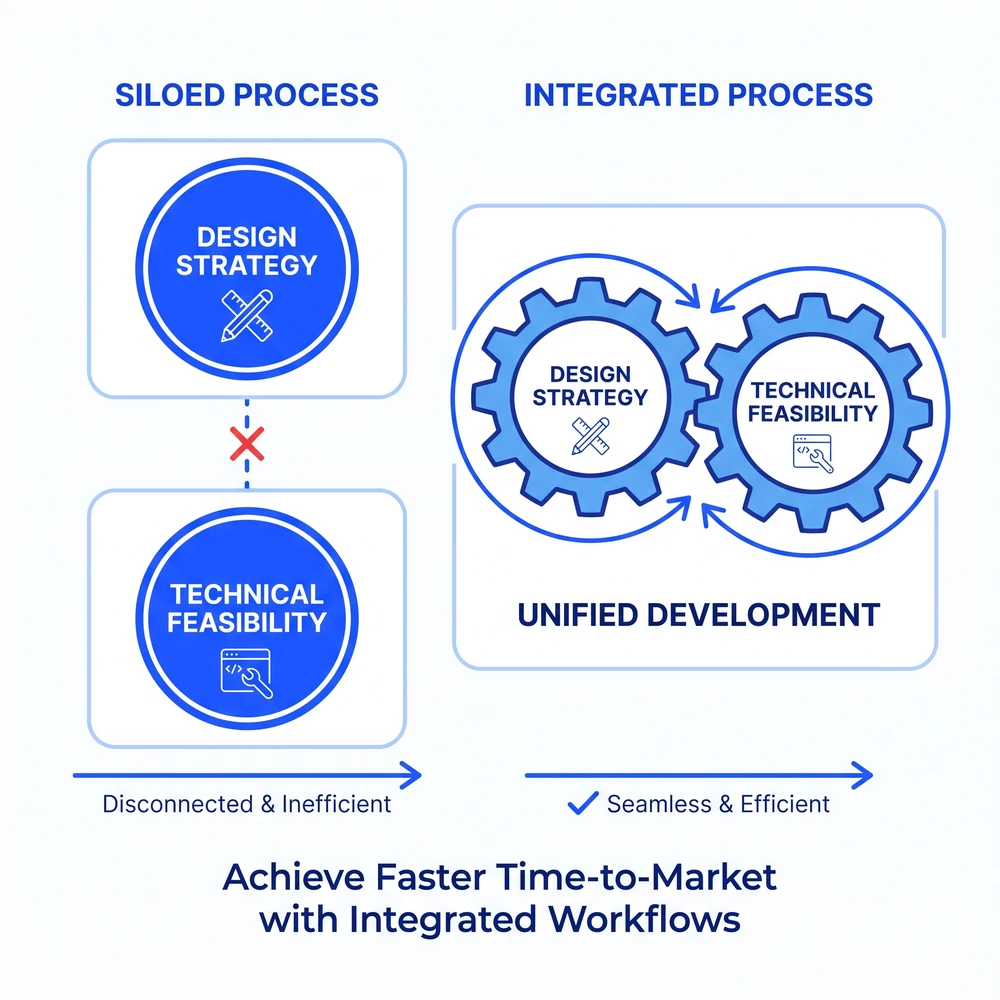
Why the siloed approach fails
In modern software environments, a siloed workflow creates a critical design-to-code gap. Designers often produce high-fidelity mockups without considering the constraints of cloud-native architecture or component-based frameworks. Conversely, developers may build robust backends that lack intuitive interfaces, failing to address user retention. This disconnect inevitably leads to several operational challenges:
- Increased technical debt: Designs that do not map to standard UI libraries require expensive custom code.
- Delayed delivery: Iterative feedback loops between design and engineering become sluggish and inefficient.
- Performance risks: Lack of coordination during the design stage often ignores critical performance optimization constraints.
Defining end-to-end product engineering services
End-to-end product engineering is a strategy where product discovery, design, and development happen concurrently. This process relies on a shared language—often codified in a design system—that acts as a bridge between the creative vision and the technical implementation. By involving engineers in the early design stages, teams perform a technical feasibility analysis before a single line of code is written.
According to recent industry projections, IT spending in Europe is projected to grow by 11.1% in 2026, with a massive 78.2% surge in GenAI investments. Organizations are integrating these AI tools into their core design and development workflows to automate mundane tasks. This shift forces teams to adopt a more integrated mindset, where agility and AI-assisted automation are standard components of the software engineering lifecycle.
The role of cross-functional teams
Cross-functional teams are the backbone of successful digital product design and development. By embedding developers, designers, and business analysts into a single unit, organizations eliminate communication bottlenecks. This structure fosters a culture of shared responsibility, where the team focuses on achieving business KPIs rather than just completing individual tasks.
The following table illustrates how cross-functional collaboration improves project outcomes compared to traditional structures:
| Feature | Siloed Approach | Integrated Engineering |
|---|---|---|
| Communication | Formal, slow handoffs | Real-time, collaborative |
| Technical Debt | High (due to rework) | Low (proactive planning) |
| Feedback Loop/td> | Weeks or months | Hours or days |
| Quality Control | Reactive testing | Continuous integration |
Reducing technical debt through collaboration
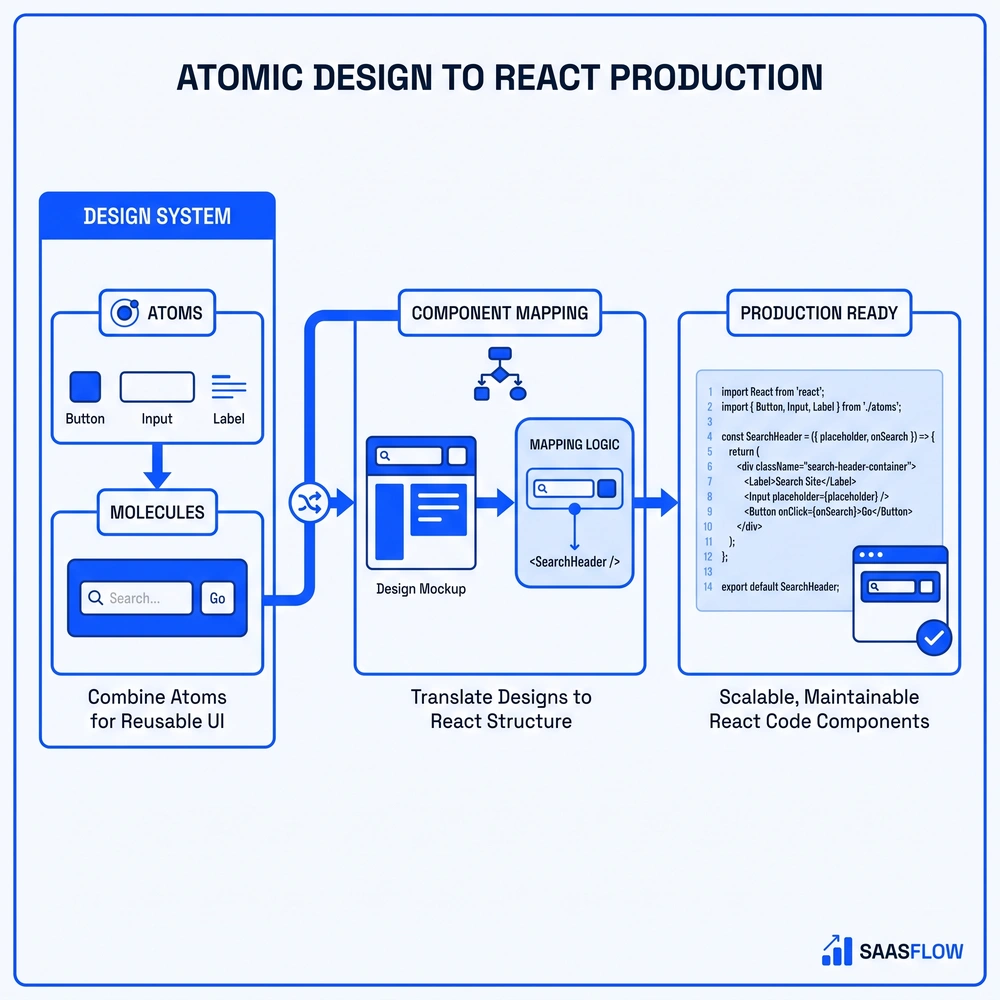
Technical debt is often a result of poor communication during the initial design phases. When designers understand the limitations of React or cloud-native microservices, they create interfaces that are modular and scalable. This alignment prevents the need for massive refactoring later. My experience at Enosta shows that implementing a modular design system, such as Atomic Design, allows developers to map UI components directly to code snippets.
This mapping process significantly reduces development time and ensures that the final product remains consistent as it scales. Furthermore, adopting ISO/IEC 25010 standards for software quality helps teams maintain a high degree of maintainability throughout the development lifecycle. By focusing on these standards from the outset, we ensure that the software is not only functional but also adaptable to future business needs.
Ultimately, the goal is to build a product that is both beautiful and robust. By prioritizing the integration of design and development, businesses can ensure that their software remains a competitive advantage rather than a maintenance burden. This strategic shift is essential for any enterprise looking to thrive in an increasingly digital-first market, where speed and quality determine success.
Bridging the design-to-development gap
The friction between design and engineering often stems from a lack of shared technical language. When designers create high-fidelity prototypes without considering component constraints, they inadvertently build technical debt into the user interface. Bridging this gap requires a unified strategy where design systems and development frameworks speak the same dialect.
The cost of disconnected workflows
When design and development teams operate in silos, the transition from Figma to production often leads to significant rework. Designers might choose complex animations or non-standard interactions that require custom code, increasing development time significantly. This lack of alignment forces developers to either simplify the interface or spend extra hours on custom implementations.
According to industry trends, 85% of developers now leverage AI tools to assist in coding and design translation, yet the structural gap remains a human-centric challenge. Without a shared framework, the “handover” becomes a bottleneck rather than a bridge. Our team at Enosta has found that early collaboration is the only way to ensure design intent survives the transition to functional software.
Integrating design systems with component-based architecture
Adopting a design system based on Atomic Design principles provides a shared vocabulary for both designers and developers. By breaking interfaces into atoms, molecules, and organisms, you create a mapping system that aligns perfectly with modern component-based frameworks like React or Vue.
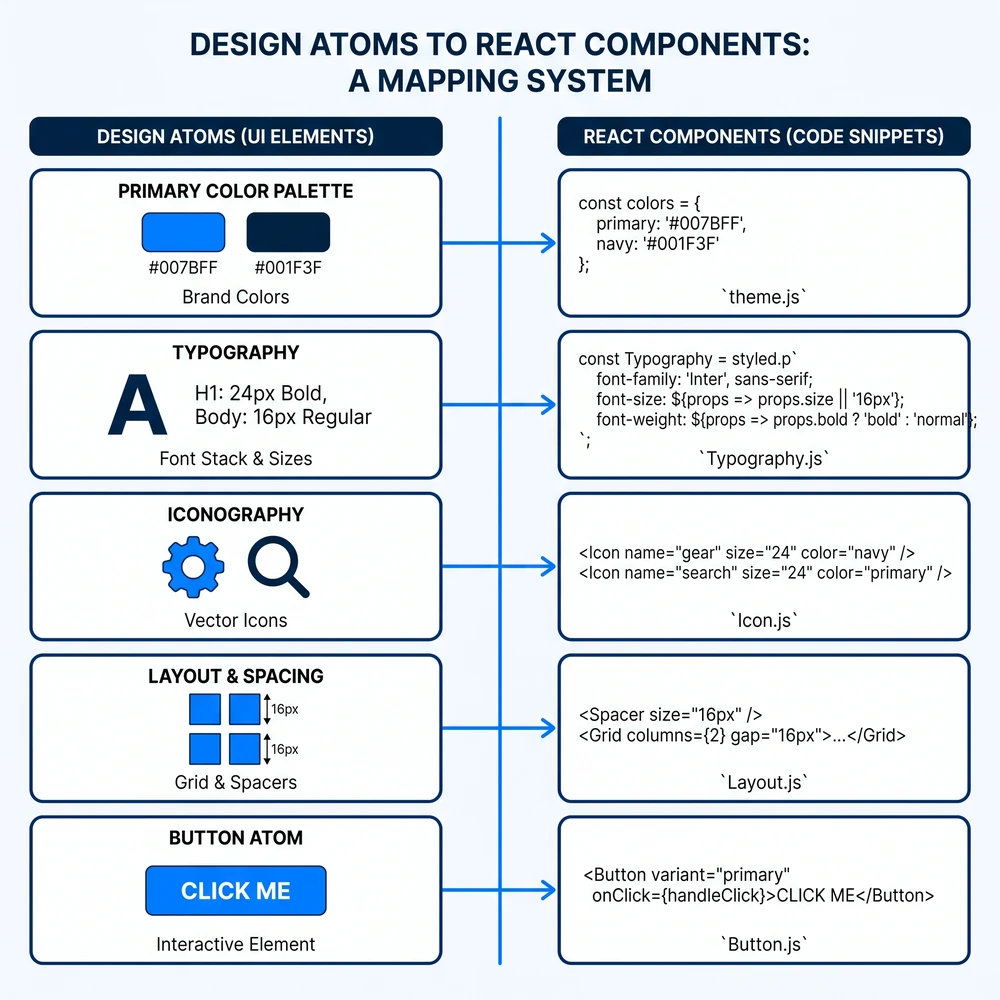
This modular approach ensures that every UI element is not just a visual pixel but a reusable code asset. When a designer updates a button in the design system, the developer can propagate that change across the entire application with minimal effort. This synchronization is critical for scaling enterprise software development partner projects efficiently.
| Element Type | Design Component | Development Counterpart |
|---|---|---|
| Atom | Typography, Color, Icon | Shared CSS Variables / Props |
| Molecule | Search Bar, Form Input | Functional Component |
| Organism | Header, Footer, Sidebar | Layout Component |
| Page | Full Screen Layout | Route/Container Component |
Technical feasibility analysis as a risk mitigator
Early-stage technical feasibility analysis acts as a safeguard against architectural failures. By involving lead developers during the wireframing phase, you identify potential performance bottlenecks before they are baked into the final design. This proactive approach prevents the common pitfall of designing features that are technically impossible or prohibitively expensive to build.
For instance, a design might look sleek but require massive client-side rendering, which hurts performance on low-end devices. A quick review during the prototyping stage allows the team to pivot toward more efficient solutions. This saves weeks of development time and keeps the project within its original scope.
Reducing technical debt through early-stage prototyping
Prototyping is not just for visual validation; it is a tool for architectural planning. By building functional prototypes that reflect real data structures, you can test how the application handles scale before writing production code. This methodology directly reduces technical debt by forcing developers to define data models early.
When we integrate our software development services with client design teams, we emphasize “code-first” thinking. We use prototyping to simulate API interactions, ensuring that the backend architecture is ready to support the frontend requirements. This reduces the risk of “band-aid” fixes later in the lifecycle.
Balancing user experience with cloud-native scalability
Modern software must be both intuitive and performant. Balancing these two goals requires a deep understanding of cloud-native architecture, where the design of the frontend dictates the load on backend services. A design that is too aggressive with API calls can crash a poorly optimized microservices architecture.
We prioritize the following steps to ensure design decisions support scalability:
- Define performance budgets: Set strict limits on asset sizes and API response times during the early design phase.
- Leverage lazy loading: Design user flows that prioritize essential content while deferring heavy data loads.
- Optimize data flow: Map UI states directly to API endpoints to avoid redundant data fetching.
- Adopt server-side rendering where necessary: Improve initial load times by balancing client-side interactivity with server-rendered content.
Overcoming the “Design-to-Code” friction
Many teams struggle with the translation of high-fidelity designs into CSS or Tailwind classes. This friction is often the main source of budget overruns in custom enterprise software solutions. To solve this, we advocate for “Design-to-Code” handoff sessions where developers and designers walk through the component library together.
This process ensures that the design system is not just a static document but a living, breathing codebase. When the design team understands the limitations of the CSS Grid or Flexbox layout, they design interfaces that are inherently more responsive and easier to maintain. This level of collaboration is the hallmark of a mature product engineering culture.
Practical steps for seamless integration
To successfully bridge the design-to-development gap, organizations must move away from linear, waterfall-style handoffs. Instead, adopt an iterative process where feedback loops are continuous. The following table outlines the transition from traditional to integrated workflows.
| Feature | Waterfall Handoff | Integrated Workflow |
|---|---|---|
| Communication | Documents & Specs | Shared Design System |
| Technical Review | Final Stage | Ongoing / Continuous |
| Prototyping | Visual Focus | Functional/Data-driven |
| Feedback Loop | After Build | During Iteration |
By adopting these practices, you transform your development process from a series of disjointed tasks into a streamlined lifecycle. Whether you are building a SaaS platform or a complex internal CRM, the integration of design and engineering is the most effective way to ensure long-term maintainability and user satisfaction.
This approach also aligns with international software quality standards like ISO/IEC 25010, which emphasizes maintainability and functional suitability. By building with these standards in mind, you ensure that your software is not only beautiful but also robust, scalable, and ready for the demands of the modern digital market.
Seven stages of a professional product lifecycle
A structured product lifecycle transforms abstract concepts into scalable digital solutions. By following a rigorous, seven-stage framework, teams reduce technical debt and ensure long-term system maintainability. This lifecycle serves as a blueprint for high-performing cross-functional engineering teams.
Stage 1: Discovery and user-centric requirement mapping
The discovery phase identifies core business value and user pain points before writing code. We prioritize gathering actionable insights through stakeholder interviews and market analysis. This stage prevents the most common failure: building a product that solves the wrong problem.
- Stakeholder alignment: Defining clear business goals and key performance indicators (KPIs) ensures all team members share a unified vision.
- User research: Conducting surveys and deep-dive interviews builds detailed user personas, grounding every feature in real human needs.
- Problem validation: Mapping user journeys identifies friction points that software must resolve, preventing unnecessary feature bloat.
- Requirement prioritization: Using the MoSCoW method categorizes features by their impact, ensuring the most valuable assets receive attention first.
Before we map requirements or write a single line of code, we anchor every project in Design Thinking, a five-stage framework that ensures our solutions are grounded in real human needs rather than assumptions.
- Empathize: We conduct in-depth research with your target users, studying their behaviors, pain points, and unmet needs before forming any solution hypothesis.
- Define: We synthesize that research into a clear problem statement, filtering out noise to isolate the core challenge the product must solve.
- Ideate: With the problem clearly defined, we facilitate structured ideation sessions to generate a range of solution approaches before converging on the most viable direction.
- Prototype: We build low and high-fidelity prototypes to test our assumptions quickly, creating tangible artifacts that surface issues before they become expensive engineering problems.
- Test: We return to real users with the prototype, validate our solution against actual behavior, and refine based on their responses rather than internal opinion.
This process is not a one-time gate before development begins. It is a loop that continues throughout the lifecycle, ensuring that every subsequent sprint remains connected to the original user insight.
Effective discovery relies on data, not intuition. We look for patterns in user behavior that indicate where a product can provide the most leverage. This stage saves hundreds of development hours by pruning non-essential features before they enter the backlog.
Stage 2: Technical architecture design and stack selection
Selecting the right technology stack prevents costly refactoring cycles during growth. We evaluate tools based on scalability, security, and developer ecosystem support. A well-chosen stack supports long-term evolution and reduces the risk of vendor lock-in.
| Criteria | Consideration | Recommended Approach |
|---|---|---|
| Scalability | Handling concurrent users | Microservices architecture |
| Performance | Load time optimization | Cloud-native infrastructure |
| Maintainability | Codebase longevity | Modular component design |
| Security | Data protection standards | Zero-trust authentication models |
Architectural decisions made here determine the speed of future iterations. For instance, selecting a language like Go or Python depends on the specific computational requirements of your platform. We aim for a balance between cutting-edge innovation and proven, stable frameworks.
Stage 3: Rapid application prototyping and validation
Prototyping bridges the gap between design vision and technical reality. By validating clickable prototypes, we avoid building features that do not resonate with actual users. This stage acts as a high-speed feedback loop for product owners.
- Wireframing: Creating low-fidelity structures defines core navigation flows without the distraction of colors or typography.
- High-fidelity interactive prototypes: Simulating real interaction tests usability, revealing how users navigate complex interfaces.
- Usability testing: Observing user behavior identifies navigation hurdles that simple designs often overlook.
- Feasibility check: Ensuring design components align with existing component libraries prevents “design-only” features that developers cannot implement.
According to industry research on AI-driven development, integrating AI tools into prototyping is becoming standard. Teams now use these tools to simulate user interactions at scale, refining the product before the first line of production code is written.
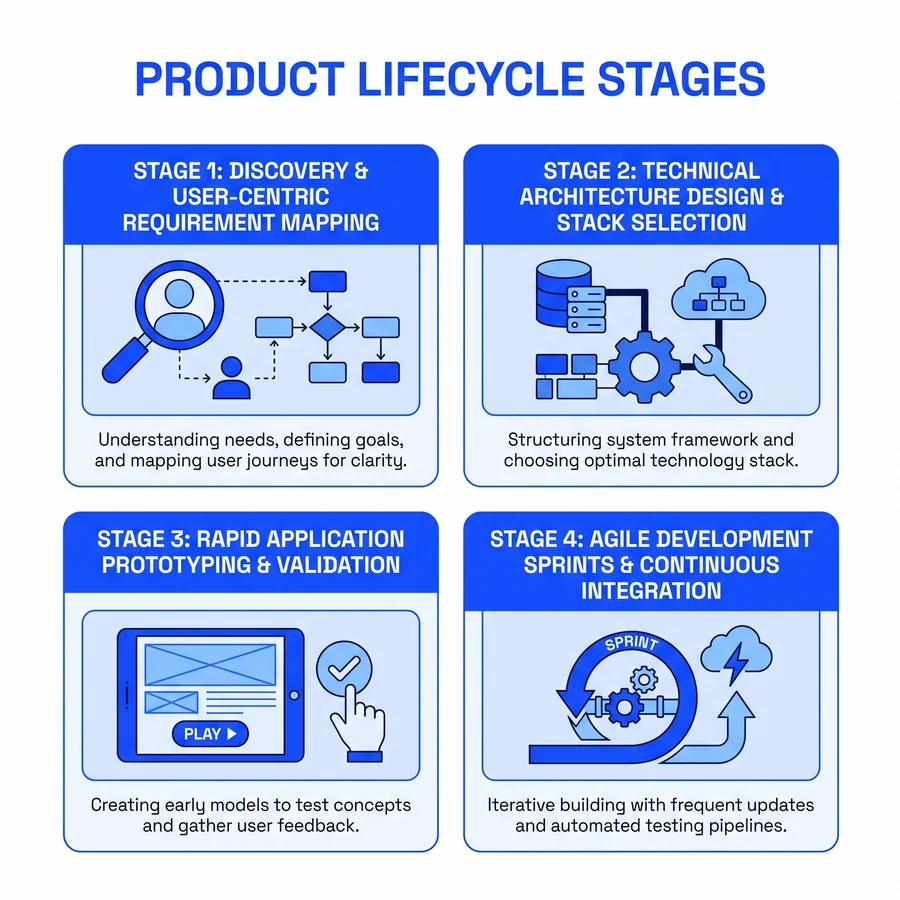
Stage 4: Agile development sprints and continuous integration
Agile methodology ensures iterative progress through two-week sprints. Continuous integration (CI) allows our team to merge code frequently, reducing the risk of integration conflicts and long-term bugs. This disciplined approach keeps the development team focused on the highest-priority tasks.
- Sprint planning: Breaking down large requirements into manageable, actionable tickets allows for consistent, predictable velocity.
- Daily stand-ups: Synchronizing progress and addressing technical blockers immediately keeps the project moving without unnecessary delays.
- Automated testing: Executing unit tests with every code commit ensures stability and prevents regressions in the codebase.
- Sprint reviews: Demonstrating progress to stakeholders gathers real-time feedback, allowing for course correction before the next sprint.
Agile is more than just a process; it is a mindset of continuous improvement. By prioritizing small, functional releases, we deliver value to the market earlier. This approach aligns perfectly with modern expectations for rapid deployment and feature updates.
Stage 5: Quality assurance and ISO/IEC 25010 compliance testing
Quality assurance (QA) is not a final step but an ongoing process throughout the cycle. We measure software quality against the ISO/IEC 25010 standard to ensure functional suitability, reliability, and security. This standard provides a rigorous framework for evaluating system performance.
- Functional testing: Verifying that all features meet specified requirements ensures the product does exactly what it promises.
- Performance testing: Stress-testing the system identifies potential bottlenecks in high-traffic scenarios before they affect real users.
- Security auditing: Scanning for vulnerabilities in the code and third-party dependencies protects sensitive data from evolving threats.
- Compatibility testing: Ensuring the product performs across all required devices and browsers guarantees a consistent experience for every user.
Compliance testing is essential for enterprise-grade solutions. By embedding these checks into the development pipeline, we maintain high standards without slowing down the release cycle. This proactive stance significantly reduces the risk of post-launch failures.
Stage 6: Deployment and cloud-native infrastructure setup
Deployment requires a robust, automated pipeline to minimize downtime. We leverage cloud-native services to ensure the infrastructure scales automatically with user demand. This setup is crucial for managing the volatility of modern digital traffic.
- Infrastructure as Code (IaC): Using tools like Terraform manages server environments through code, ensuring consistency across staging and production.
- Containerization: Wrapping applications in Docker containers ensures the software runs identically regardless of the underlying environment.
- Environment management: Setting up isolated staging and production environments allows for safe testing before any release.
- Load balancing: Distributing traffic maintains high availability and system resilience, even during traffic spikes.
Cloud-native architecture also provides significant cost benefits. By configuring auto-scaling policies, we ensure that resources are only consumed when necessary. This efficiency is a key component of our software development services.
Stage 7: Maintenance, monitoring, and performance optimization
Post-launch maintenance ensures the product evolves with market trends and user feedback. We monitor system health proactively to prevent outages and optimize user experiences. A product is never truly “finished” in the digital age.
- Real-time monitoring: Tracking application logs and error rates using specialized dashboard tools provides instant visibility into system health.
- Performance tuning: Analyzing database queries and API response times identifies opportunities for efficiency improvements.
- Feature updates: Rolling out improvements based on analytics and user requests keeps the product competitive and relevant.
- Security patching: Updating libraries and dependencies mitigates emerging threats and keeps the software secure over time.
Monitoring also provides data for the next cycle of development. By understanding how users interact with the live product, we can make informed decisions for future features. This feedback loop is the engine that drives long-term product success.
What Enosta delivers: UX, UI, and system design end-to-end
The lifecycle framework above describes how we think. This section describes what we actually build, discipline by discipline, across the full design scope.
Most design failures we encounter are not failures of creativity. They are failures of scope. A team builds a beautiful interface with no defined component system, or ships a visual identity with no guidelines for how it scales across touchpoints. What looks complete at handover becomes expensive to maintain six months later.
Our approach covers three integrated layers:
UX design: building from user behavior, not assumptions
UX work at Enosta is not decoration applied after engineering decisions are made. It is the foundation that determines what gets built and why. Our UX output for each engagement includes wireframing and user flow definition, sitemap architecture, interactive prototyping for usability validation, and user and market research to ground every design decision in behavioral data rather than stakeholder preference.
UI design: visual precision that maps directly to code
High-fidelity UI that cannot be built efficiently is not an asset. It is a liability. We design graphic interfaces, animation prototypes, and data visualization components with the component library in mind from the first frame, ensuring that what your users see is what your developers can build without expensive custom workarounds. Every UI engagement includes a UI guidelines and kit that becomes a living reference for the engineering team.
System design: the infrastructure that makes design scalable
A design that exists only in Figma is not a design system. We build the underlying structure that allows design to scale: UI libraries, storefronts, and governing principles that define how the visual language behaves across contexts. This layer is what separates a project that looks consistent at launch from one that remains consistent at ten times the scale.
If you are starting a new product or modernizing an existing one, explore how our product ideation and design services and UI/UX design services fit into your current stage.
4. Architectural styles: A comparative analysis
Choosing the right architectural style determines the long-term success of your digital product. It impacts scalability, maintenance costs, and your ability to pivot in a competitive market. As a founder, I have seen how early architectural decisions dictate whether your system becomes a bottleneck or a catalyst for growth.
Modern engineering teams must evaluate their specific business requirements against the trade-offs of different paradigms. Below, we compare the primary architectural patterns that define today’s high-scale software landscape, ensuring your technology stack remains robust and future-proof.
Monolithic architecture: The foundation
A monolithic architecture builds the entire application as a single, unified codebase. All business logic, data access, and user interface components reside within one deployment unit. This approach offers simplicity during the initial phases of product development.
Teams can move quickly because there are no complex service-to-service communication protocols to manage. Debugging is straightforward since the entire application is contained in one space. However, as the product expands, the monolith can become difficult to scale and maintain.
- Deployment: You must redeploy the entire application for every minor change.
- Scalability: You must scale the entire stack even if only one module requires more resources.
- Technology Lock-in: The entire application is typically restricted to a single technology stack, limiting flexibility.
Microservices architecture: The modular approach
Microservices break an application into a collection of loosely coupled, independently deployable services. Each service handles a specific business function, such as authentication, payment processing, or inventory management. This enables teams to scale specific components based on real-world demand.
According to industry research on software engineering, modularity is a primary driver for enterprise efficiency. By isolating services, you reduce the risk of a single point of failure crashing the entire platform. This is essential for companies aiming for high availability and continuous delivery.
- Agility: Different teams can develop and deploy services independently using various tech stacks.
- Fault Isolation: A bug in the notification service does not necessarily impact the core checkout process.
- Complexity: Managing service discovery, data consistency, and network latency requires significant DevOps maturity.
Serverless architecture: The event-driven model
Serverless architecture allows developers to build and run applications without managing infrastructure. Cloud providers handle the provisioning, scaling, and maintenance of the underlying servers. You only execute code in response to specific events, which optimizes cloud infrastructure costs significantly.
This style is ideal for applications with unpredictable traffic patterns or intermittent workloads. It removes the burden of server management, allowing your team to focus exclusively on product features. However, it introduces risks like “cold starts” and potential vendor lock-in with providers like AWS Lambda or Google Cloud Functions.
Evaluating architectural trade-offs
Selecting an architecture is not about choosing the “best” technology but the most appropriate one for your stage. A startup might benefit from the speed of a monolith, while a mature enterprise often requires the flexibility of microservices. We must balance technical feasibility with long-term business goals.
The following table summarizes the key differences to help you align your software development services with your specific business requirements.
| Feature | Monolithic | Microservices | Serverless |
|---|---|---|---|
| Development Complexity | Low | High | Medium |
| Scalability | Limited | High (Granular) | Automatic |
| Infrastructure Cost | Predictable | High (Management) | Pay-per-use |
| Deployment Speed | Slow | Fast | Instant |
| Fault Tolerance | Low | High | High |
Factors for architectural selection
When deciding on your architecture, consider your team’s expertise and your projected growth trajectory. If you are building an MVP, a monolith or a modular monolith can reduce time-to-market. It allows for rapid iteration without the overhead of managing distributed systems.
Conversely, if you are scaling a platform that serves millions of users, microservices provide the necessary isolation and scalability. You must also consider infrastructure cost efficiency. Serverless can be cost-effective for event-driven tasks but may become expensive for high-volume, constant workloads.
- Maintainability: Assess how easily your team can refactor code without causing ripple effects.
- Cloud-native readiness: Determine if your infrastructure strategy supports containerization and automated CI/CD pipelines.
- Technical debt: Evaluate if the chosen architecture creates long-term complexity that will hinder future feature development.
Bridging the design-to-code gap
Effective architectural design requires a seamless transition from design systems to backend implementation. When your UI components map directly to backend services, you minimize the risk of architectural drift. This alignment is critical for maintaining consistency across your entire digital product ecosystem.
Developers and designers should collaborate early to define the data contracts between services. By using a modular design system, you ensure that the frontend architecture reflects the backend service boundaries. This reduces technical debt and accelerates the delivery of high-quality, scalable features.
Long-term scalability and performance
Scaling a system is not merely about adding more servers to your infrastructure. It requires a deep understanding of bottlenecks and resource utilization patterns within your chosen architecture. Monitoring and observability are essential components of any successful high-scale software strategy.
In my experience, the most successful projects often start with a well-structured monolith that evolves into microservices. This “monolith-first” approach prevents premature optimization. It allows you to refine your domain boundaries before committing to a complex distributed system.
Regardless of the style, focus on maintaining high software maintainability standards. Adhering to the ISO/IEC 25010 quality model ensures that your architecture remains robust as your product evolves. Always prioritize clear interfaces and documentation to bridge the gap between your design and your backend infrastructure.
5. Common pitfalls in software design and development
Building robust digital products requires more than just clean code. Many teams struggle when they separate design from technical execution, leading to costly delays. Identifying these common traps early is the only way to ensure your project remains scalable and efficient.
Ignoring non-functional requirements
Non-functional requirements like security, latency, and data residency are often overlooked during the initial design phase. Teams frequently prioritize visual aesthetics over the invisible infrastructure that keeps an application stable.
- Security vulnerabilities: Failing to integrate security from the start often forces expensive, late-stage refactoring.
- Latency issues: Ignoring load times during design leads to poor user retention once the product scales.
- Data residency: Neglecting local compliance laws can result in severe legal penalties or total service shutdowns.
According to industry standards like ISO/IEC 25010, software quality must encompass performance efficiency and security. Addressing these at the architecture level is non-negotiable for professional software development services.
Over-engineering features without user validation
The “feature creep” trap occurs when teams build complex solutions before validating if the user actually needs them. This creates unnecessary technical debt and distracts from core product value.
- Bloated codebases: Adding excessive features increases the complexity of maintenance and testing cycles.
- Wasted resources: Development hours spent on unused features are hours lost on high-impact updates.
- Decreased usability: An overloaded interface often confuses users, which directly lowers your conversion rates.
At Enosta, we mitigate this by using rapid prototyping to test hypotheses before a single line of production code is written. Validating your core features with real users first ensures that every development sprint adds measurable value.
Inadequate documentation and long-term maintainability
Documentation is the backbone of any scalable project, yet it is frequently the first task sacrificed under pressure. Poor internal documentation leads to knowledge silos and makes onboarding new developers incredibly difficult.
- Knowledge loss: When key developers leave, undocumented logic becomes a “black box” that is dangerous to modify.
- Slow debugging: Without clear architecture maps, teams spend more time identifying bugs than actually fixing them.
- Integration friction: New team members struggle to understand the system, leading to inconsistent code quality and repeated errors.
Maintaining a living design system and clear technical documentation ensures that your software remains adaptable. Think of documentation as an insurance policy for your technical investment.
Misalignment between business goals and technical constraints
Technical teams and business stakeholders often speak different languages. When these groups fail to align on constraints, the resulting product often misses market expectations or fails to meet budget goals.
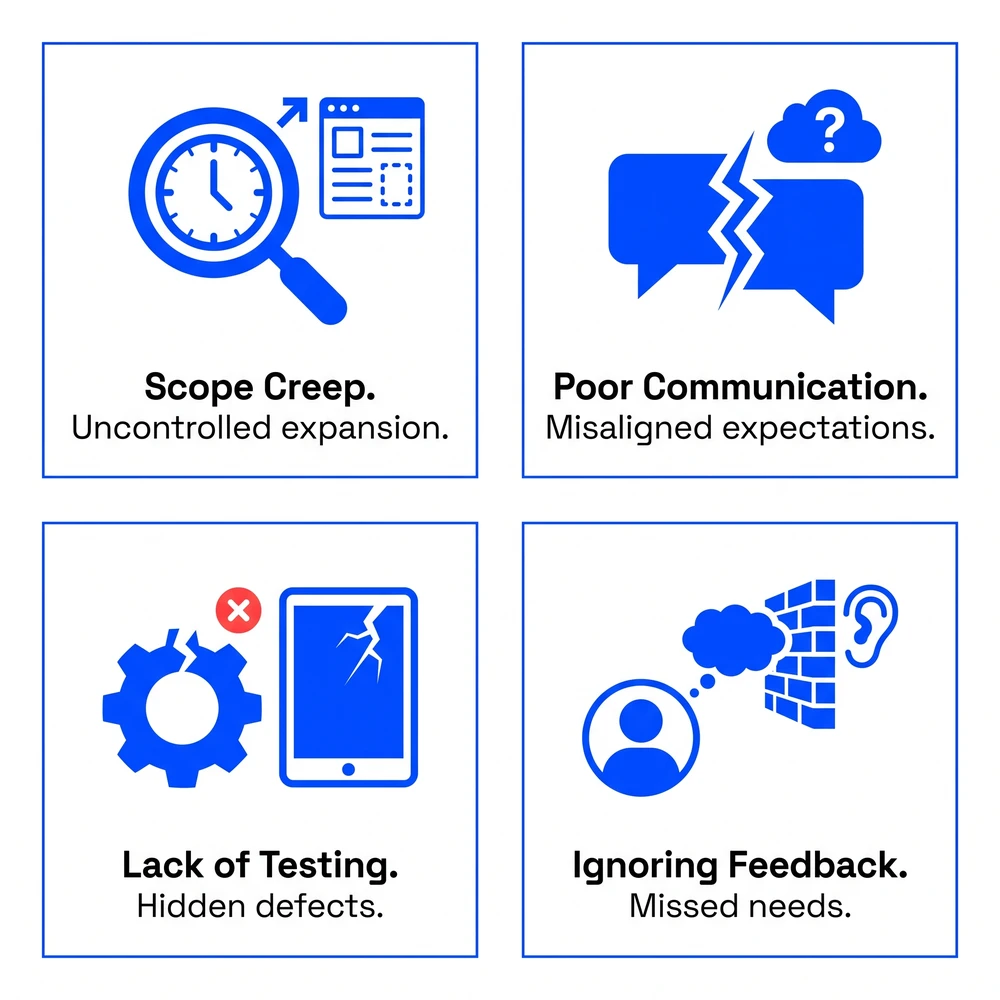
| Pitfall | Business Impact | Technical Impact |
|---|---|---|
| Scope Creep | Budget exhaustion | Increased technical debt |
| Tech Mismatch | Slow time-to-market | Architecture instability |
| Poor Communication | Stakeholder dissatisfaction | Requirement ambiguity |
Alignment requires constant communication between product owners and engineering leads. It is vital to discuss technical feasibility analysis during every stage of the design process to ensure the vision remains grounded in reality.
Operational failures in cross-functional teams
A major hidden trap is the “silo mentality” where design and engineering operate as distinct, disconnected units. This creates a disconnect between the high-fidelity UI designs and the actual technical constraints of the chosen stack.
- Design-to-code friction: Designers create complex animations that the chosen framework cannot support without heavy performance hits.
- Lack of component reuse: Without a unified design system, developers end up rebuilding UI elements, increasing the total codebase size.
- Feedback loops: When developers are only involved at the end of the design phase, they cannot provide input on technical feasibility.
To solve this, implement a “Design-to-Dev” handoff protocol where engineers review wireframes for technical feasibility early. This ensures that the aesthetic vision aligns with the actual capabilities of your cloud-native architecture or front-end framework.
Addressing technical debt through architectural discipline
Technical debt accumulates when teams choose fast, “hacky” solutions over scalable, clean code. While this might speed up the initial launch, it leads to a catastrophic slowdown in the long term.
- Hard-coded logic: Hard-coding business rules instead of using configuration files makes future updates brittle and error-prone.
- Ignoring modularity: Monolithic code structures make it impossible to scale individual services without redeploying the entire application.
- Neglecting testing: Skipping unit and integration tests creates a fragile system where new features regularly break existing functionality.
Prioritizing technical debt is essential for sustainable growth. Schedule dedicated time in every development sprint to refactor code and update documentation. This investment prevents the “spaghetti code” phenomenon that plagues many legacy enterprise systems.
Bridging the gap effectively
These pitfalls are not inevitable. They are simply symptoms of a disconnected lifecycle. By integrating design-to-code workflows, you can align your team’s output with your ultimate business objectives.
- Adopt modular architecture: Use component-based frameworks to keep design systems in sync with code.
- Prioritize technical debt: Schedule regular refactoring sessions to keep the codebase clean and performant.
- Foster cross-functional teams: Ensure designers and developers collaborate from the very first wireframe.
When design and development work in unison, the result is a product that is both beautiful and structurally sound. Avoiding these traps is the hallmark of a high-performing product engineering partner.
6. Real-world impact: Metrics and methodology
Modern software engineering relies on measurable outcomes rather than speculative goals. By integrating modular design systems with agile development, teams move from chaotic iterations to predictable, high-speed delivery cycles. This shift reduces the friction between high-fidelity design and production-ready code, ensuring technical feasibility stays aligned with business objectives.
Bridging the gap with modular systems
We treat design as a structural foundation, not a decorative layer. Implementing Atomic Design principles allows our developers to map UI components directly to code libraries like React or Vue. This synchronization eliminates the friction often found during the design-to-code handover.
When designs are built as reusable modules, the technical team spends less time refactoring styles and more time optimizing backend logic. This modularity ensures that a change in the design system propagates automatically across the entire application interface.
- Standardized components: Each element follows a strict UI library, reducing CSS redundancy across the application.
- Reduced technical debt: Modular codebases are easier to maintain, test, and scale over time.
- Synchronized workflows: Designers and developers share a single source of truth, minimizing feedback loops.
Metrics for success: The 30% efficiency gain
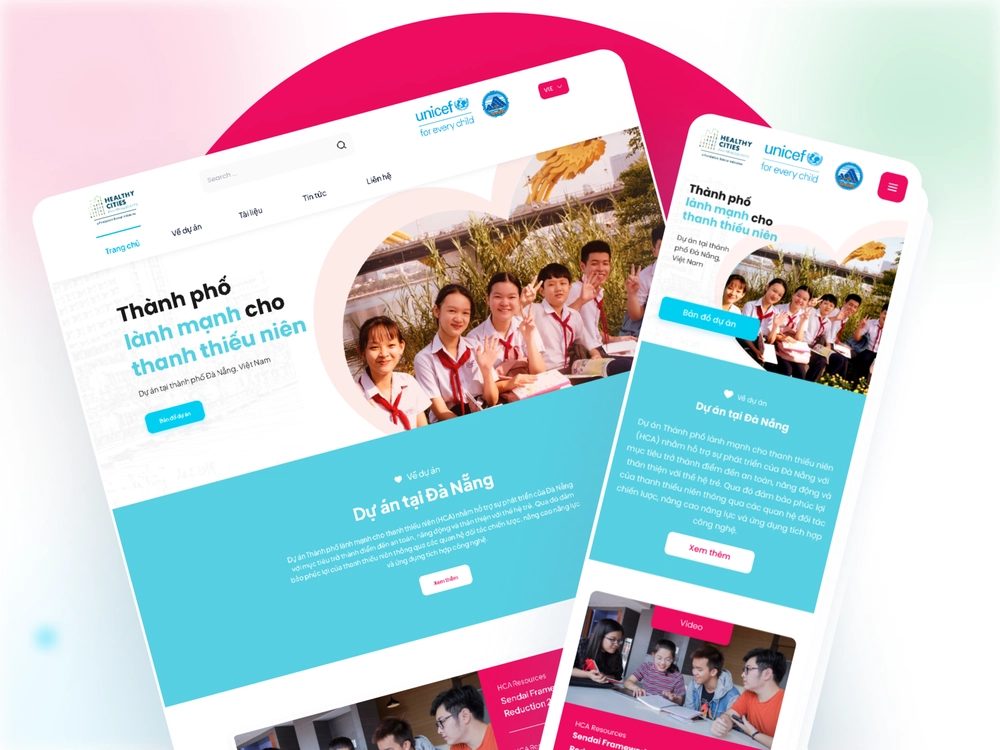
Efficiency in software production is best measured by time-to-market and developer velocity. Through our internal framework, we have successfully reduced development time by 30% for complex portals, such as the UNICEF e-resource project.
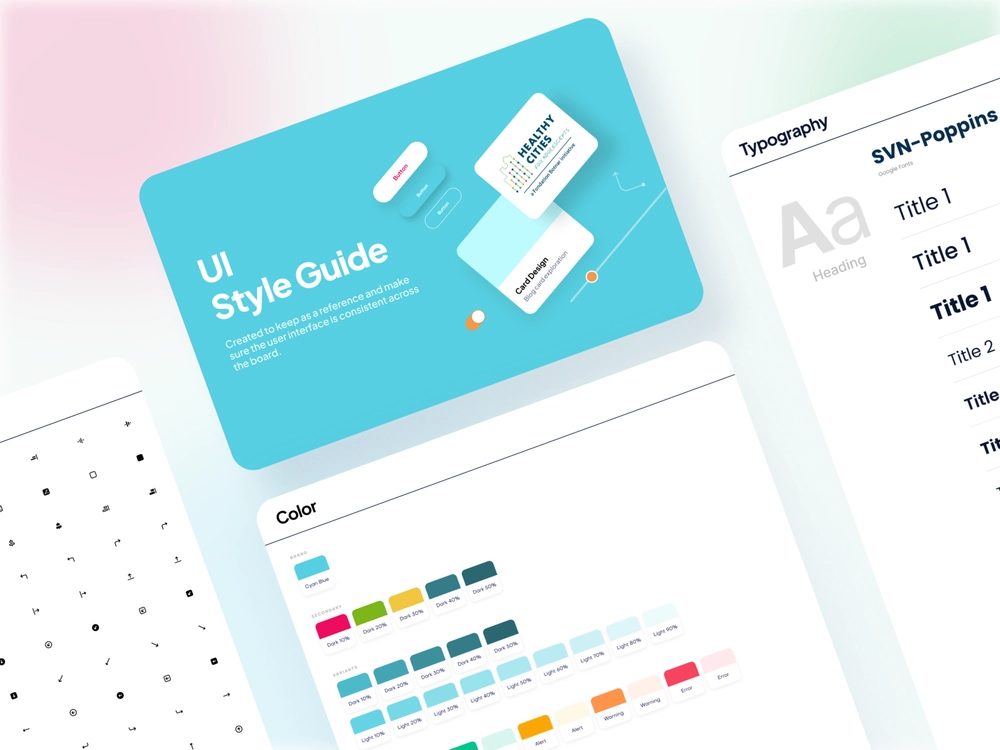
One example of this in practice is the HCA e-resource portal, built in partnership with UNICEF as part of the Healthy Cities for Adolescents global initiative. When the project expanded to Da Nang, Enosta was brought in as the technical partner to design and build a child-friendly, accessible portal that met UNICEF’s international usability and accessibility standards.
The constraints were significant: the interface needed to serve adolescent users with varying levels of digital literacy, comply with UNICEF’s global design requirements, and be maintainable by a local team after handover. By involving engineers during the design phase and using a modular component approach, we delivered a system that met all three requirements without requiring a separate maintenance contract. The full showcase is available on our Behance portfolio.
This reduction stems from shifting the technical feasibility analysis to the earliest design stages. By involving senior engineers during wireframing, we prevent architectural bottlenecks before a single line of code is written.
| Metric | Traditional Approach | Modular Integrated Approach |
|---|---|---|
| Handover Time | 5-7 days | 1-2 days |
| Component Reusability | 15% | 75% |
| Debugging Cycles | High | Low (Automated) |
| Time-to-Market | Baseline | 30% faster |
Iterative loops and user retention
Iterative design-code loops ensure that the final product aligns perfectly with user expectations. We prioritize continuous integration and deployment (CI/CD) to push updates based on real-world usage data.
In our work with Smartos Booking, we implemented a feedback-driven loop that allowed us to test features with actual users every two weeks. Smartos Booking illustrates a different dimension of this methodology. Smartos is a product Enosta has grown from its earliest stage, a B2C workspace booking application that allows users to find, compare, and make inquiries for coworking spaces. Because we were involved before the product had a defined architecture, we could make design and infrastructure decisions simultaneously rather than sequentially.
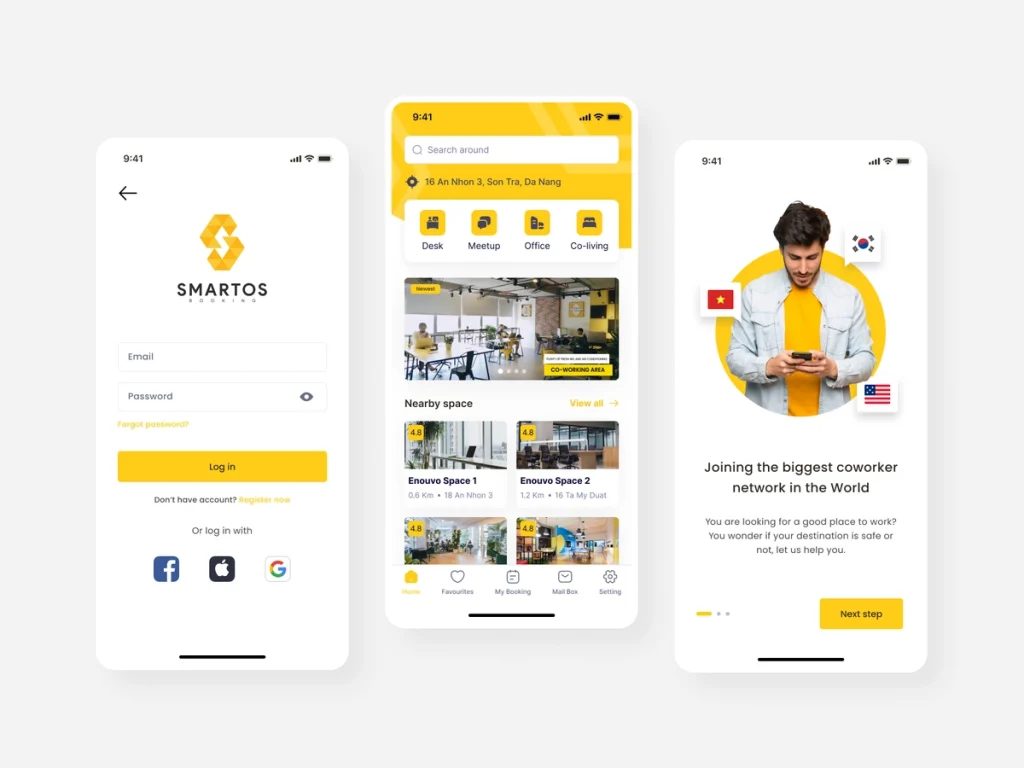
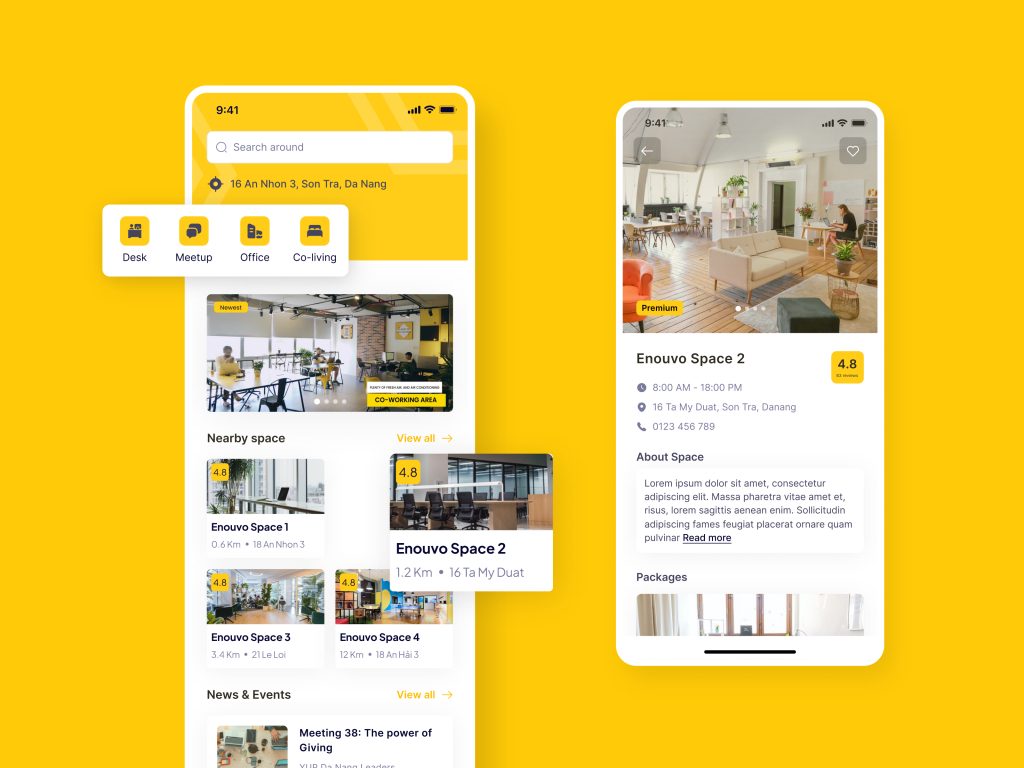
We implemented a feedback-driven development loop that allowed us to test features with actual users every two weeks. This methodology directly contributed to improved user retention rates, as the platform evolved based on clear behavioral metrics rather than assumptions.
When users feel their needs are met instantly, engagement spikes. Our approach focuses on three core pillars of iterative success:
- 01Rapid prototyping: Validate concepts through interactive prototypes before committing to full-scale engineering.
- 02User-centric telemetry: Integrate analytics early to track how users interact with specific UI elements.
- 03Data-backed pivots: Use performance data to decide which features require optimization and which should be deprecated.
Driving performance through professional partnership
Choosing the right partner is vital for organizations seeking to scale their digital infrastructure. Our software development services leverage these proven methodologies to ensure your product remains competitive in a rapidly evolving market.
We understand that technical feasibility must balance with business agility. By combining high-fidelity design with robust, cloud-native architecture, we help enterprises avoid the common pitfalls of fragmented product engineering.
Mitigating technical debt through design
Technical debt often arises when design decisions are made in a vacuum, ignoring the constraints of the underlying infrastructure. By conducting rigorous technical feasibility analysis during the design phase, we ensure that every UI decision supports system maintainability.
We adhere to ISO/IEC 25010 standards to evaluate software quality, focusing on functional suitability and performance efficiency. This proactive stance allows our teams to identify potential performance bottlenecks in cloud-native architectures long before they affect the end-user experience.
- Early architectural review: Engineers validate complex animations or data-heavy UI components for performance impact.
- Scalability planning: Designing interfaces that handle increasing loads without requiring expensive backend rewrites.
- Documentation hygiene: Maintaining clear design principles and component guidelines to prevent knowledge silos within the team.
Cultivating long-term engineering excellence
Beyond immediate project metrics, we prioritize long-term maintainability. Our team documents every architectural decision to ensure that future scaling efforts remain consistent with the initial design vision.
We believe that great software is a living system. By fostering a culture of continuous improvement, we ensure that your product remains resilient against changing market demands. This includes proactive monitoring of cloud infrastructure and regular code audits to keep technical debt at a minimum.
Our commitment to quality means we treat every line of code as an investment in your product’s future. Whether we are building a new application or modernizing an existing system, we apply these rigorous standards to every stage of the lifecycle.
This disciplined approach transforms the software development lifecycle from a series of disjointed tasks into a cohesive, value-driven process. By focusing on these metrics and methodologies, we ensure that your product not only looks exceptional but performs reliably at scale.
7. Strategic partnership: Choosing the right agency
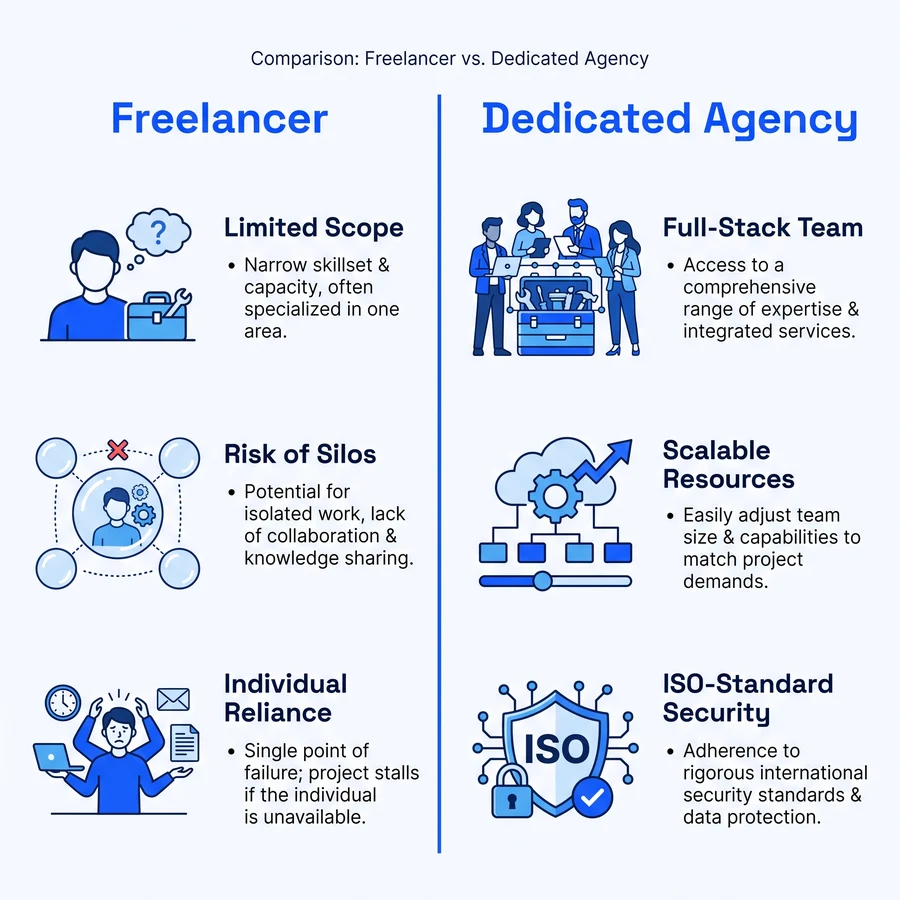
Choosing an enterprise software development partner is a critical decision that influences your product’s long-term viability. Organizations often transition from individual freelancers to professional agencies to gain structural stability, technical depth, and consistent delivery. While freelancers may offer short-term cost advantages, a dedicated agency provides the cross-functional expertise necessary for scaling complex digital products.
Why dedicated teams outperform individual freelancers
Scaling a digital product requires more than just coding skills; it demands a cohesive team of designers, engineers, and project managers. Freelancers often work in isolation, which creates knowledge silos and increases the risk of technical debt. In contrast, professional teams leverage integrated workflows to maintain momentum throughout the product engineering lifecycle.
- Holistic Expertise: Agencies provide a full spectrum of skills, including UI/UX design, cloud-native architecture, and DevOps.
- Knowledge Continuity: Dedicated teams maintain comprehensive documentation, ensuring that project progress continues smoothly even if individual members rotate.
- Agile Maturity: Established firms use standardized methodologies, such as Scrum or Kanban, to ensure transparent communication and frequent delivery of value.
- Resource Scalability: You can easily adjust team size based on project phases without the administrative burden of hiring or onboarding new talent.
Indicators of a reliable software development partner
A reliable partner demonstrates maturity through their processes, transparency, and commitment to quality. You should evaluate potential candidates based on their ability to align technical decisions with your specific business goals. A strong partner will challenge your assumptions to ensure the final product is both feasible and scalable.
| Indicator | Why it matters for your business |
|---|---|
| Proven Track Record | Validates their ability to solve problems similar to your own challenges. |
| Design-to-Code Synergy | Ensures that high-fidelity designs are technically buildable without performance loss. |
| Technical Debt Management | Demonstrates a focus on maintainability and long-term code health. |
| Proactive Communication | Reduces friction during the development process through clear, daily updates. |
Security standards and communication protocols
When evaluating a potential software development services provider, security must be a primary concern. You should inquire about their adherence to international benchmarks like ISO/IEC 25010 for software quality or ISO 27001 for information security. These certifications prove that the agency has rigorous protocols in place to protect your intellectual property and user data.
Ask the following questions to assess their professional standards:
- How do you integrate security testing (DevSecOps) into your CI/CD pipeline?
- What is your internal process for handling data privacy and compliance requirements?
- How do you ensure transparency in project management and reporting?
- What tools do you use to facilitate real-time collaboration between our internal stakeholders and your team?
Mitigating risks through structured partnerships
The design-development gap is a common source of project failure. Professional agencies mitigate this risk by implementing a unified design-to-code workflow. By involving engineers during the initial wireframing and prototyping phases, agencies identify technical constraints early. This proactive approach saves significant time and budget that would otherwise be spent on expensive refactoring later.
According to research from TechReviewer, strategic partnerships are increasingly shifting toward long-term product engineering engagements. This model allows teams to deeply understand your domain, leading to better architectural decisions and faster time-to-market. When you treat your vendor as an extension of your internal team, the focus shifts from transactional task completion to sustained innovation.
Frequently asked questions
Navigating the complexities of modern software projects often raises critical questions for stakeholders. Below, I address common inquiries regarding our methodology, technical standards, and the value of an integrated design-to-development approach to ensure your project succeeds.
How does design thinking influence code maintainability? Design thinking prioritizes modularity and user-centric problem solving to ensure long-term system health. By mapping clear user flows early, we define component requirements that align with clean architecture principles. This process significantly reduces technical debt, as our developers build highly reusable modules rather than rigid, monolithic blocks that are notoriously difficult to update or scale.
What is the difference between custom enterprise software solutions and off-the-shelf products? Custom enterprise software solutions are meticulously tailored to your specific operational workflows, providing competitive advantages that generic, one-size-fits-all tools cannot match. While off-the-shelf products offer immediate deployment, they often force your business to adapt its internal processes to accommodate their rigid limitations. Custom engineering ensures seamless integration with your existing tech stack and long-term scalability.
How do you ensure data security during the development process? We adhere to rigorous security protocols throughout every stage of the software engineering lifecycle. This includes implementing encryption at rest and in transit, conducting frequent vulnerability assessments, and following the comprehensive security standards outlined in ISO/IEC 25010. Our team treats security as a fundamental functional requirement, ensuring that protection is embedded into the architecture rather than treated as an afterthought.
What are the benefits of an AI-native approach to software development? Integrating AI into our workflow significantly accelerates development velocity and improves overall code quality. According to research from JetBrains, 85% of developers now utilize AI tools to assist in coding and design tasks. By leveraging AI for boilerplate generation and automated testing, we focus our engineering talent on solving complex business logic and high-level architectural challenges that define your product’s success.
How does Enosta handle the design-to-code handover process? We utilize a proprietary handover framework that bridges the gap between high-fidelity prototypes and production-ready code. This process ensures that every design component is mapped directly to our component libraries in frameworks like React.
| Stage | Action | Output |
|---|---|---|
| Handover | Design system audit | Atomic Design documentation |
| Mapping | Component tokenization | CSS/SCSS design variables |
| Sync | Code review sessions | Frontend implementation |
| QA | UI/UX visual regression | Pixel-perfect interface |
Why is technical feasibility analysis critical? Before writing a single line of code, we conduct a deep technical feasibility analysis to align design goals with infrastructure constraints. This prevents the common pitfall of designing features that are technically impossible or prohibitively expensive to host on cloud-native architectures. By involving senior engineers during the wireframing stage, we ensure your vision remains grounded in reality while maintaining high performance.
How do we address scalability in early-stage design? Scalability is a byproduct of thoughtful system architecture, not an afterthought. We implement modular system design patterns that allow your product to grow horizontally across microservices as your user base expands. This approach optimizes cloud infrastructure costs and ensures that your application remains responsive under heavy traffic, directly supporting your long-term business growth objectives.
Strategic final thoughts Successful software design and development in 2026 requires more than just technical proficiency; it demands a true strategic partnership. Whether you are scaling an existing platform or launching a new venture, the integration of design systems with cloud-native architecture is vital.
If you need a team that understands how to balance user experience with robust backend performance, we are ready to assist. Our software development services are designed to help you navigate these complexities while maintaining a laser focus on your long-term business goals.