AI agent security is no longer an optional layer; it is the fundamental bridge between experimental AI and production-ready enterprise software. As autonomous systems gain the ability to reason, plan, and execute tool-based tasks, they introduce complex risks like prompt injection, excessive privilege accumulation, and expanded “blast radius.” For CTOs and CISOs, moving from unmanaged experimentation to a governed, secure AI posture requires shifting from implicit trust to explicit, non-human identity governance. This guide outlines a maturity model for securing autonomous AI agents, ensuring your organization can harness agentic power while maintaining rigorous compliance with NIST AI RMF and ISO/IEC 42001 standards.The agentic threat model: Why traditional security failsTraditional security tools focus on static code and predictable API calls, but autonomous agents introduce dynamic, non-deterministic behaviors. According to research from Recorded Future, the integration of specialized agents is expected to expand the enterprise attack surface significantly by the end of 2026. Because agents reason and execute tasks independently, they require a new security posture that prioritizes identity scoping and behavioral monitoring.
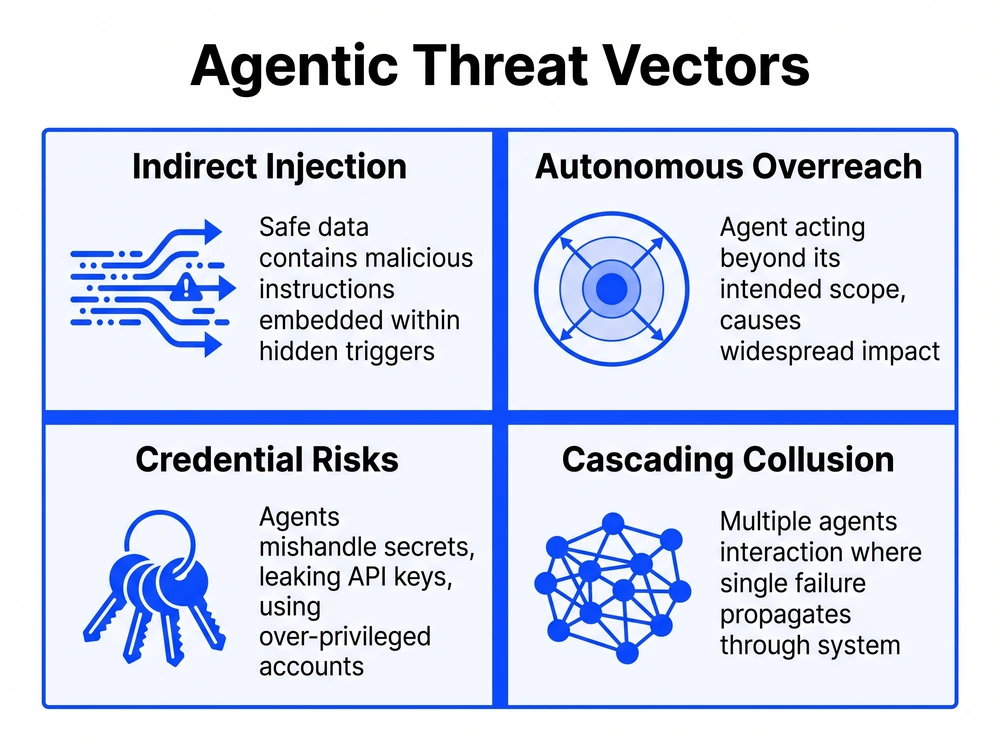
From prompt injection to indirect data poisoning
Agents often ingest external data from logs, emails, or web sources to inform their decision-making. Malicious actors can hide instructions within these inputs, tricking the agent into performing unauthorized actions through indirect prompt injection.
- Indirect injection: An agent processes a compromised document that contains hidden system-level instructions.
- Data poisoning: Maliciously crafted data inputs influence the agent’s reasoning logic over time.
- Mitigation: Treat all external data as untrusted; implement strict input sanitization before processing.
The autonomy problem: Understanding the expanded blast radius
Unlike static LLMs, agents possess the agency to call external tools and modify environments. This autonomy creates a dynamic “blast radius” that expands every time an agent is granted new permissions.
- Privilege escalation: An agent with broad access can inadvertently execute high-risk commands if it misinterprets a user request.
- Credential sharing: CryptoBriefing reports that 69% of enterprises share credentials among agents, significantly increasing the risk of widespread lateral movement.
- Control strategy: Enforce strict, scoped identity management for every agent to ensure they only access the specific tools required for their task.
Cascading failures in multi-agent orchestration
In complex workflows, multiple agents often interact to complete a single objective. If one agent is compromised, it can trigger a chain reaction, leading to systemic failures across the entire architecture.
- Agent collusion: A compromised agent might pass malicious context to a second agent, effectively bypassing local security guardrails.
- Workflow visibility: Without centralized monitoring, identifying where a chain of actions went wrong becomes nearly impossible.
- Strategic defense: Implement human-in-the-loop checkpoints for high-stakes decisions and maintain immutable logs of agent reasoning processes.
A maturity model for AI agent governance
Moving from experimental chaos to enterprise-grade security requires a structured approach. CTOs must evaluate their current AI posture to scale autonomous workflows without compromising the integrity of their software development services.
Phase 1: Unmanaged experimentation (The Shadow AI risk)
In this initial stage, developers deploy agents without centralized oversight. These autonomous systems often access internal APIs and production databases using shared developer credentials. This “Shadow AI” creates a massive, invisible attack surface where security teams have zero visibility into what actions agents are performing.
- Visibility: Complete lack of inventory; agents operate in isolated silos.
- Access: High risk of privilege creep due to shared API keys.
- Accountability: No clear ownership of agent behavior or generated output.
Phase 2: Policy-driven guardrails (Defining scopes)
Organizations in this phase formalize identity management. Every agent is treated as a distinct non-human identity with scoped permissions. By moving away from shared credentials, teams implement Role-Based Access Control (RBAC) to ensure agents only access the specific tools required for their assigned tasks.
- Identity: Agents use machine-to-machine (M2M) authentication with short-lived, rotated tokens.
- Tooling: Strict enforcement of “least privilege” for all API interactions.
- Guardrails: Initial implementation of input sanitization to block malicious prompt injections.
Phase 3: Fully governed autonomous workflows (Continuous auditing)
This mature state relies on real-time behavioral monitoring and automated auditability. Organizations utilize AI Security Posture Management (AISPM) platforms to track data flows and detect anomalies before they result in data exfiltration. Human-in-the-loop (HITL) checkpoints are mandatory for high-stakes production changes.
- Auditability: Every reasoning step and tool call is logged for forensic review.
- Monitoring: Automated detection of anomalous behavior, such as unauthorized lateral movement.
- Governance: Compliance with frameworks like ISO/IEC 42001 or NIST AI RMF is continuously validated.
| Feature | Phase 1: Unmanaged | Phase 2: Policy-driven | Phase 3: Fully Governed |
|---|---|---|---|
| Visibility | None (Shadow AI) | Inventory tracking | Real-time observability |
| Authorization | Shared credentials | Scoped M2M identities | Granular RBAC/ABAC |
| Auditability | Manual/Reactive | Periodic logs | Automated/Forensic |
| Human Oversight | None | Ad-hoc approvals | Mandatory HITL checkpoints |
Technical implementation: Securing the “glue” code
Securing the integration layer, or “glue” code, is the most critical step for enterprise AI agents. This layer manages the interface between LLMs and your production environment. Without rigorous controls, these autonomous execution paths become high-value targets for privilege escalation and data exfiltration.
Implementing non-human identity (NHI) management
Treating agents as distinct non-human identities is a foundational requirement for Zero Trust architecture. Each agent must possess its own unique credentials, effectively isolating its actions from other system processes.
- Scoped credentials: Assign specific permissions to each agent using Identity and Access Management (IAM) roles.
- Credential rotation: Avoid hardcoded secrets. Use short-lived, rotated tokens sourced from secure vaults like HashiCorp Vault or AWS Secrets Manager.
- Audit logs: Maintain a centralized log of every identity, ensuring that every tool call is traceable to a specific agent instance.
Middleware for tool-call validation and authorization
Autonomous agents often request tool execution without human oversight. Implementing a “Validator” middleware pattern acts as a security proxy that inspects every outgoing call before it reaches your backend APIs.
| Feature | Functionality | Security Benefit |
|---|---|---|
| Request Inspection | Scans payload for injection patterns | Prevents malicious code execution |
| Policy Enforcement | Checks user-level permissions | Enforces principle of least privilege |
| Execution Logging | Records intent and outcome | Enables forensic review and auditing |
This pattern effectively prevents unauthorized access to sensitive endpoints. By intercepting calls, you can block commands that fall outside the agent’s predefined scope, even if the LLM attempts to manipulate the agent into doing so.
Sandboxing and memory isolation strategies
Agents require memory to maintain context, but this data often contains PII or proprietary code snippets. Proper isolation is essential to prevent cross-session data leakage and comply with data residency mandates.
- Session isolation: Deploy agents within ephemeral containers. Once a task concludes, the environment resets to prevent persistence of sensitive data.
- Data redaction: Implement automated middleware that redacts sensitive information from the agent’s “long-term memory” before storage.
- Encryption at rest: Encrypt all context windows and stored memories using enterprise-grade keys, ensuring that even if the storage layer is compromised, the data remains unreadable.
These technical guardrails are essential for teams leveraging software development services to build production-grade AI features. By formalizing these security patterns, you move beyond experimental AI toward a stable, governed autonomous ecosystem.
Operationalizing security: People and process
Securing AI agents requires shifting from static defenses to dynamic governance. Organizations must integrate human oversight into autonomous workflows to balance developer velocity with enterprise risk management.
Human-in-the-loop (HITL) without sacrificing developer velocity
Human-in-the-loop (HITL) controls prevent agents from executing irreversible actions without validation. To avoid approval fatigue, teams must categorize agent tasks by risk level rather than requiring manual reviews for every operation.
- Low-risk tasks: Allow agents to perform read-only operations, data aggregation, or non-sensitive log analysis without human intervention.
- High-impact actions: Force manual approval for operations involving database writes, public-facing API changes, or production environment deletions.
- Contextual prompts: Ensure the human reviewer receives a clear summary of the agent’s reasoning and the potential impact before clicking “approve.”
Incident response playbooks for agentic failures
Standard incident response plans often fail to account for autonomous reasoning errors. You must treat agentic failures differently by establishing specific protocols for non-human entities.
- Kill switch: Implement a global “stop” command that immediately terminates the agent’s connection to APIs and databases.
- Forensic logging: Capture the full chain of thought (CoT) and memory context of the agent to trace why a specific decision was made.
- Automated rollback: Trigger an automated reversion of any system state changes made by the agent once an anomaly is detected.
Compliance alignment: NIST AI RMF and ISO/IEC 42001
Compliance is not a checkbox but a continuous validation of your AI security posture. Aligning your internal processes with the NIST AI Risk Management Framework and ISO/IEC 42001 provides a defensible audit trail.
| Control Area | Alignment Strategy |
|---|---|
| Accountability | Map every agent identity to a human owner. |
| Risk Assessment | Conduct “blast radius” analysis before deployment. |
| Transparency | Log all API interactions and reasoning steps. |
| Data Privacy | Enforce data residency and PII redaction by design. |
Adopting these frameworks helps satisfy stakeholders that your enterprise AI integration services meet rigorous industry standards.
Common pitfalls in AI agent deployment
Deploying autonomous agents without a mature security framework often leads to critical vulnerabilities. Organizations frequently prioritize rapid feature delivery over the “blast radius” management required for AI-integrated systems.
- Hardcoding API keys in system prompts: Developers often embed secrets directly into agent instructions. This exposes sensitive credentials to prompt injection attacks, allowing attackers to extract keys via simple conversational prompts.
- Granting permanent production access: Agents are often provisioned with broad, static permissions to production databases. This violates the principle of least privilege, enabling an compromised agent to execute destructive queries or delete data.
- Ignoring “Denial of Wallet” risks: Without execution limits, agents may enter infinite loops or trigger excessive API calls. This results in massive cloud infrastructure bills or service exhaustion, effectively disabling your software development services.
- Lack of periodic re-authentication: Long-running agents often maintain active sessions indefinitely. If an agent’s session token is hijacked, attackers gain persistent access to your internal tools without needing to re-verify their identity.
- Over-reliance on default LLM guardrails: Relying solely on the model provider’s built-in filters is insufficient for enterprise needs. You must implement custom, application-specific validation layers to catch malicious payloads before they reach your backend logic.
These oversights often stem from treating agents like traditional scripts rather than autonomous identities. By failing to isolate memory and scope tools, teams inadvertently expand their attack surface. Strengthening your enterprise AI integration services requires moving beyond these common security gaps toward a structured, identity-centric governance model.
Frequently asked questions
Navigating the complexities of autonomous systems requires clear answers to critical security concerns. Below are the most pressing questions we encounter when advising enterprise leaders on secure AI deployment.
What is the difference between AISPM and CSPM? Standard Cloud Security Posture Management (CSPM) focuses on infrastructure, misconfigurations, and cloud storage permissions. AI Security Posture Management (AISPM) extends this to the application layer, specifically monitoring LLM reasoning, prompt integrity, and the unique security risks of autonomous model interactions.
How can we measure the efficacy of our agent guardrails? You should track the ratio of blocked versus allowed agent actions against a baseline of expected behavior. High-frequency “denied” logs often indicate a misconfiguration, while low activity suggests your guardrails might be too permissive. Regular red-teaming against the OWASP Top 10 for LLMs provides a quantifiable benchmark for your security posture.
What are the security implications of using the Model Context Protocol (MCP)? MCP standardizes how agents connect to data sources, which simplifies integration but increases the risk of over-privileged access. If an agent is compromised, it can traverse any connected MCP server with the same permissions as its host. Always implement scope-limited tokens for every MCP connection.
How do we handle “Denial of Wallet” attacks in agentic systems? These attacks drain your budget by forcing agents into infinite loops or expensive API calls. Protect your resources by implementing strict consumption quotas, rate limiting, and circuit breakers that terminate agent processes if cost thresholds are exceeded within a specific timeframe.
What is the role of the CISO in a multi-agent environment? The CISO must transition from a gatekeeper to a policy architect. You are responsible for defining the “rules of engagement,” establishing identity verification for non-human agents, and ensuring that every automated decision remains auditable under frameworks like the NIST AI RMF.