
What Is AI Transformation? What Changes Beyond AI Tools
September 21, 2026 See more
A comprehensive go-to-market strategy aligns your value proposition, target audience, and distribution channels to ensure a successful product launch. founders and product leaders use this roadmap to validate demand, optimize customer acquisition, and accelerate revenue growth before scaling operations. Our team at Enosta often applies structured product ideation and design frameworks to help startups refine these core positioning pillars. This guide covers actionable planning steps, modern automation tools, and essential differentiation metrics to build a resilient execution plan.
A go-to-market strategy serves as an operational blueprint. It bridges product development and commercial execution. This strategy aligns teams across target buyers, positioning, pricing, and distribution to accelerate time-to-value. A GTM strategy synchronizes product development, marketing, sales, and customer success teams. This ensures everyone shares a common understanding. It is crucial for achieving sustainable market advantage.
Many businesses understand the importance of a GTM strategy. However, they often struggle with its actual execution. According to Harvard Business Review Analytic Services research, 83% of B2B leaders deem a GTM strategy very important. Yet, only 38% find their organization’s execution effective. This disconnect reveals a wide gap between strategic intent and operational reality.
Additional benchmarks highlight ongoing structural hurdles inside modern commercial organizations. According to GTM Research data, only 37% of B2B professionals view GTM as an integrated revenue framework, while roughly 21% operate without a formal strategy or ownership structure. This lack of cross-functional alignment severely hinders market entry success. Extended planning cycles also reduce revenue achievement because teams lose critical momentum.
Launching a product without a GTM strategy introduces high financial and operational risks. A structured plan offers several foundational benefits for growing organizations:
Businesses must recognize the exact operational moments that require a fresh go-to-market plan. Implementing a structured GTM motion is critical during specific growth phases. These triggers signal that a strategic reassessment and potentially a new plan are necessary to ensure success.
A well-defined go-to-market strategy is not a static document. It requires activation at key junctures in a company’s lifecycle. Recognizing these moments allows for proactive planning and resource allocation, significantly increasing the chances of a successful market entry or expansion.
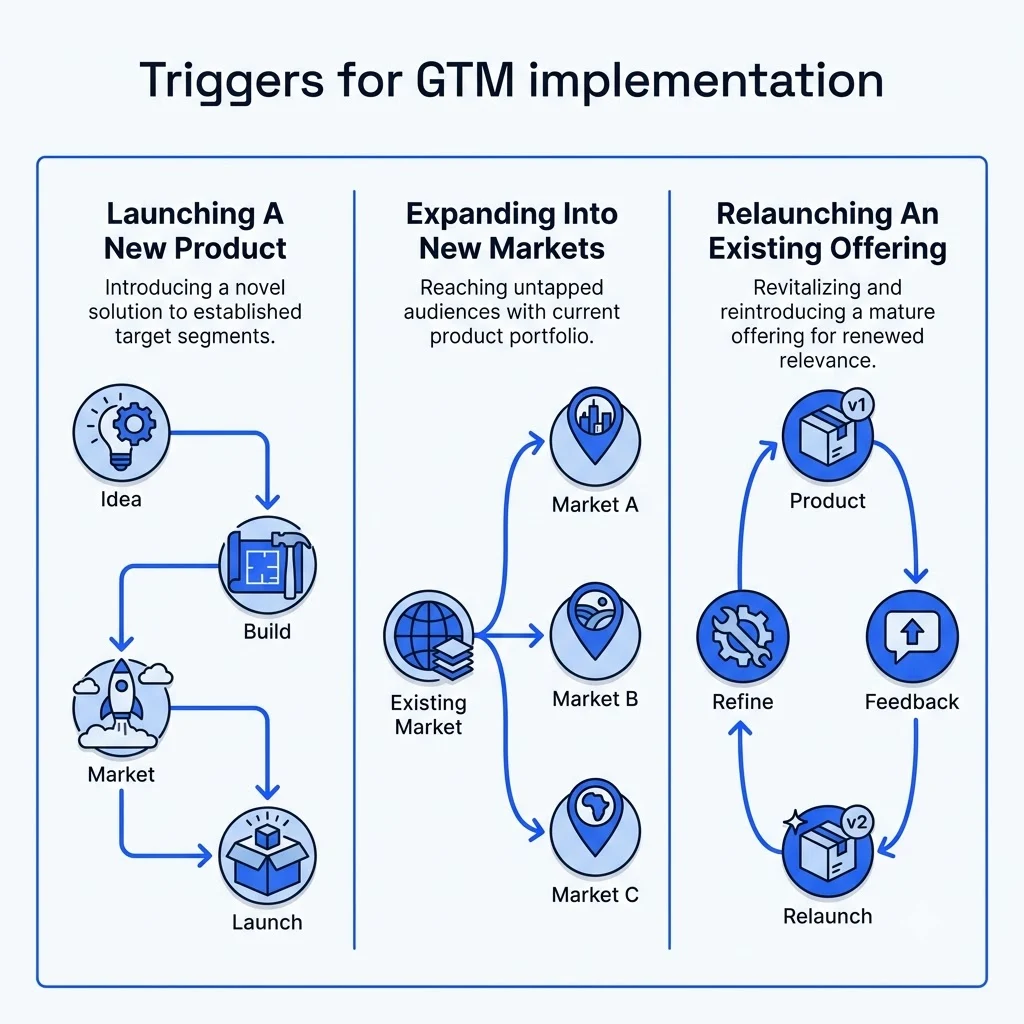
Introducing a brand-new offering to existing or new markets is a primary trigger for a GTM strategy. This involves defining the product’s unique value proposition and ensuring it resonates with the target audience. Clear positioning and a well-thought-out pricing model are essential for initial market traction. Our team often sees that without a focused product ideation and design process feeding into a GTM plan, new products struggle to gain visibility and adoption.
Entering new geographic regions or demographic segments demands a tailored approach. This requires adapted distribution channels, localized messaging, and a deep understanding of the new market’s competitive landscape. For instance, a company expanding into Europe might need to consider the continent’s diverse regulatory environments and consumer preferences. According to Kenresearch report, the Europe Metal Service Centers Market, valued at USD 19,450 million in 2025, illustrates the scale of opportunities, but also the need for region-specific strategies.
Revitalizing a mature product or shifting its business model also necessitates a renewed GTM strategy. This could involve targeting a different customer segment, updating the product’s features, or changing its pricing structure. A thorough analysis of the current market position and customer feedback is crucial. This ensures the relaunch addresses previous shortcomings and capitalizes on new opportunities, rather than simply repeating past efforts.
| Trigger Event | Core Objective | Key Strategic Focus | Primary Requirement |
|---|---|---|---|
| Launching new product | Secure initial market traction | Value proposition and positioning | Product ideation and design alignment |
| Expanding into new markets | Capture regional market share | Localized messaging and channels | Competitive landscape analysis |
| Relaunching existing offering | Revitalize mature product lines | Business model and segment shifts | Customer feedback and market audit |
A successful go-to-market (GTM) strategy is built on several interconnected components. These elements transform broad market insights into actionable plans. They ensure that your product or service effectively reaches and resonates with its intended audience.
The foundation of any GTM strategy lies in thorough market intelligence. This involves understanding market size, emerging trends, and customer needs. It also requires a deep dive into the competitive landscape. This research informs critical decisions throughout the planning process.
A crucial component is defining your Ideal Customer Profile (ICP). This goes beyond basic demographics. It involves mapping out psychographics, pain points, and buying behaviors. Understanding who your customer is allows for tailored messaging and channel selection. For instance, a B2B SaaS company might target IT managers struggling with data integration challenges.
The value proposition must clearly articulate the unique benefits your offering provides. It answers the customer’s question: “Why should I choose you?” This statement should be concise and compelling. It forms the core of all marketing and sales messaging.
Your pricing strategy is equally vital. It must align with the perceived value, production costs, and competitor pricing. A tiered pricing model, for example, can cater to different customer segments with varying needs and budgets.
Selecting the right sales channels ensures your product reaches the target audience efficiently. This could involve direct sales teams, channel partners, e-commerce platforms, or a combination. The choice depends heavily on your ICP and product type.
The marketing plan outlines how you will generate awareness and demand. This includes defining messaging, content strategy, and promotional activities. For example, a new tech product might use a phased launch campaign, starting with early adopters and expanding to a broader market.
Operational readiness is key for a smooth launch. This involves coordinating timelines, resources, and cross-functional teams. Defining clear success metrics and Key Performance Indicators (KPIs) allows for performance tracking. This helps in evaluating the strategy’s effectiveness and making necessary adjustments. The Europe marketing automation software market, for example, was valued at $2.4 billion in 2025 and is projected to reach $8.1 billion by 2034, highlighting the importance of understanding regional market dynamics for GTM planning.
A customer journey map visualizes the entire customer experience. It tracks touchpoints from initial awareness to post-purchase engagement. This helps identify opportunities to improve customer satisfaction and retention. Finally, a comprehensive budget allocation ensures all GTM activities are adequately funded. Only 23% of B2B technology companies achieve their first-year revenue targets following a product go-to-market launch, underscoring the need for meticulous planning and resource allocation.
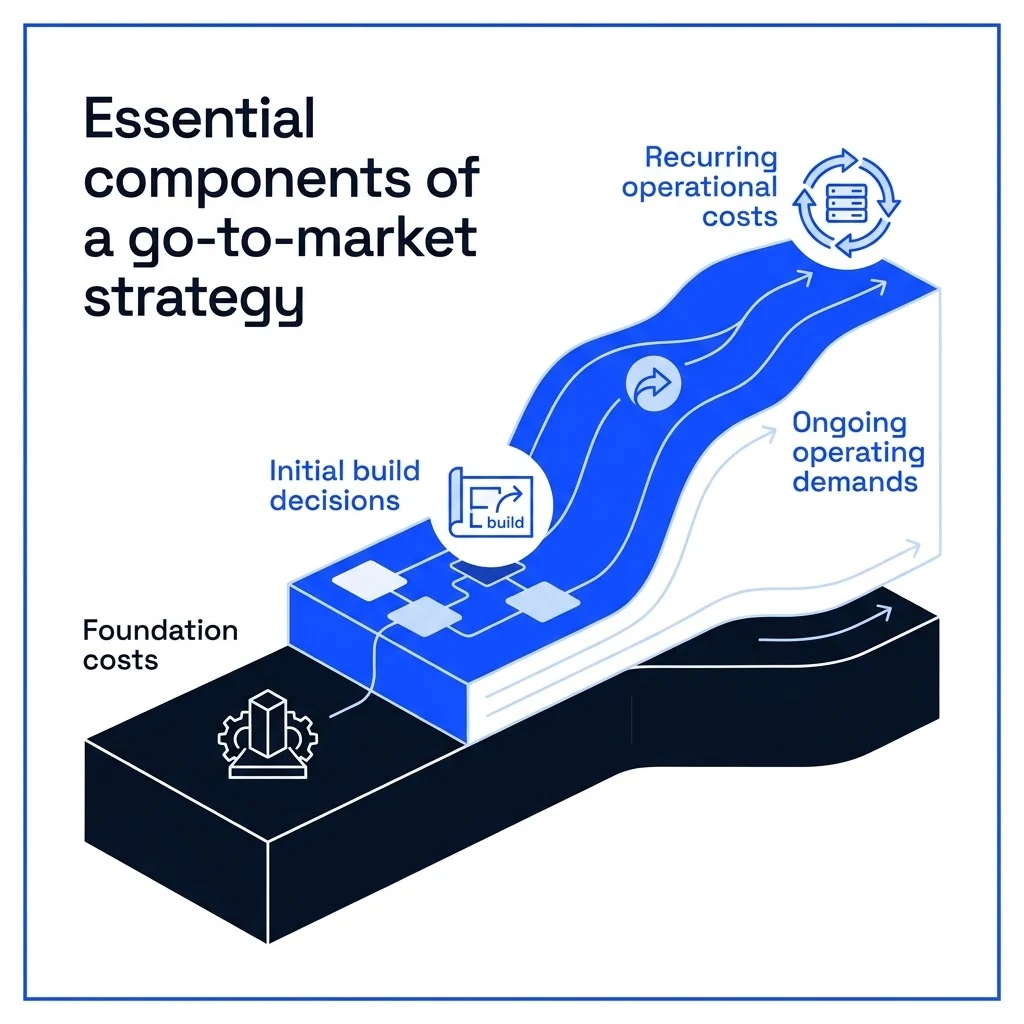
Executing a structured launch plan requires following a sequential workflow. Use this framework to take your product from concept to commercial reality, ensuring all critical aspects are considered before market entry.
Begin by identifying the specific market segments your product will serve. Conduct thorough market research and gather market intelligence to understand industry dynamics and total addressable market size. Develop detailed buyer personas representing your ideal customer profile through careful persona mapping.
Catalog their exact operational pain points, desired outcomes, demographics, and psychographics. Understanding your audience deeply is the foundation of an effective go-to-market strategy.
Clearly articulate what makes your product unique and valuable to your target audience. Map your product features directly to the customer pain points identified during market research.
Develop a compelling value proposition formulation that resonates with your ideal customer profile. This statement should communicate the problem you solve and your unique solution. Strong product positioning ensures your message cuts through market noise.
Determine the optimal pricing model for your product based on production costs and buyer willingness to pay. Explore value-based or tiered pricing options while carefully analyzing competitor thresholds to align with customer expectations.
Ensure your packaging reflects how customers will consume and benefit from your offering. The Australia Digital Marketing Software Market Report values the local market at USD 1.8 billion, supported by high internet penetration. This indicates strong digital infrastructure for diverse pricing models.
Identify the most effective channels to reach and sell to your target customers. Options include direct sales teams, online marketplaces, channel partner networks, or strategic retail partners.
Consider product complexity, sales cycle length, and customer buying behavior. B2B SaaS models might require inside sales, field sales, and partner programs. B2C offerings typically rely on e-commerce, retail, or direct-to-consumer websites.
Develop a comprehensive marketing plan to generate awareness, interest, and demand. Define your core messaging, select promotional channels, and allocate your budget across demand generation and account-based marketing campaigns.
Simultaneously, create a sales enablement plan to equip your team with tools and training. This ensures they communicate your value proposition effectively and close deals whether executing product-led growth or sales-led selling motions.
Set clear, measurable key performance indicators to track your go-to-market performance. Align these metrics directly with your overarching business objectives and revenue targets.
Track customer acquisition cost, conversion rates, sales cycle duration, and lifetime value. According to the SiriusDecisions GTM Benchmark Report, only 23% of B2B technology companies achieve their first-year revenue targets following a product go-to-market launch.
Finalize all operational aspects for launch day across your organization. Coordinate closely with product development, marketing, sales, and customer support teams while establishing risk management protocols.
Prepare support staff to handle inquiries and gather initial customer feedback. Plan post-launch activities to monitor performance and iterate based on market response. Continuous optimization remains key to long-term success.
Handle support inquiries, CRM data organization, and customer onboarding workflows to reduce early churn. Teams must maintain proactive communication channels after launch to ensure high user engagement. Reviewing customer interactions helps refine your software development services and product features over time.
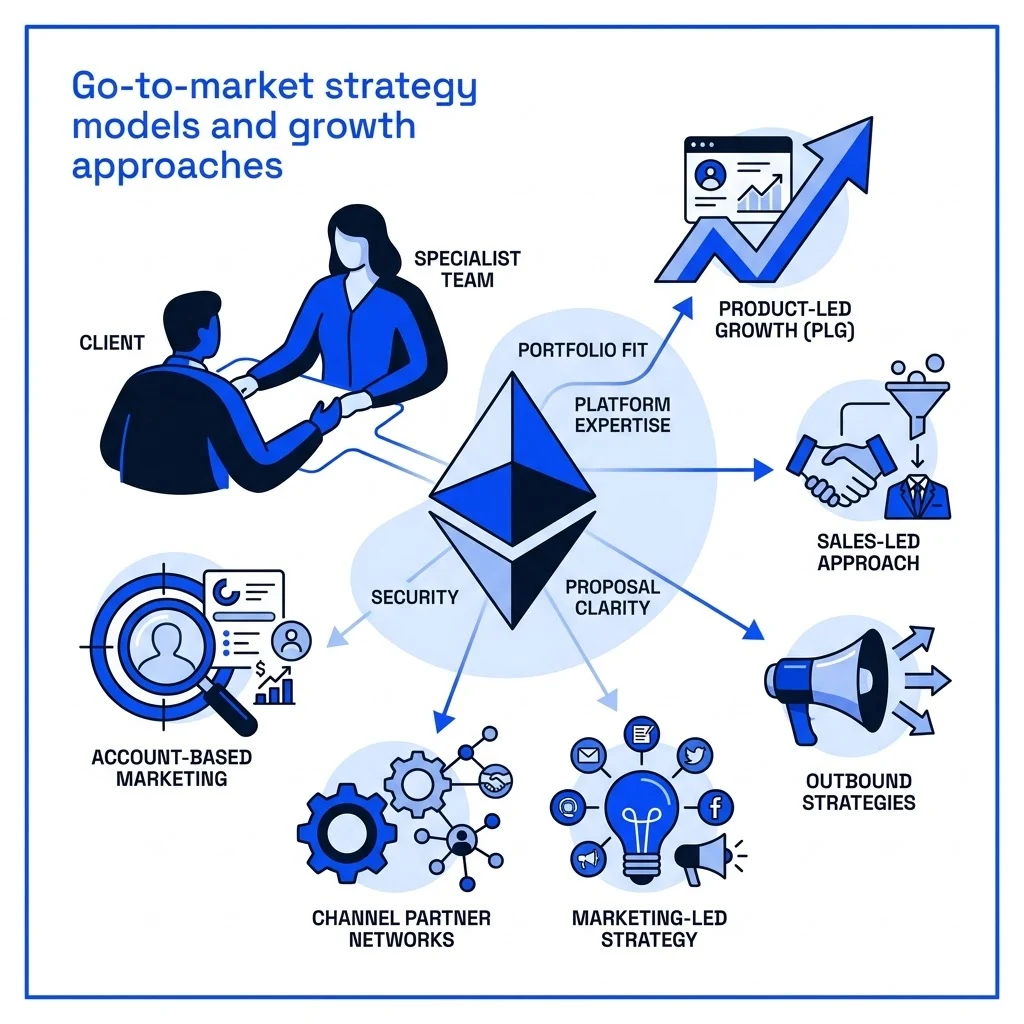
Businesses employ various go-to-market models based on their product, market, and sales complexity. Understanding these models helps tailor the strategy for maximum impact and resource allocation. Each approach has distinct operational requirements and target buyers.
| Model Type | Primary Focus | Best Suited For | Key Operational Tradeoff |
|---|---|---|---|
| Product-led growth (PLG) | Self-serve product experience | B2B SaaS and developer tools | High product engineering cost versus low acquisition cost |
| Sales-led selling | Direct consultative sales teams | Complex enterprise software | High customer acquisition cost versus high contract value |
| Outbound strategies | Proactive cold outreach and prospecting | High-acumen target accounts | High labor intensity versus predictable pipeline generation |
| Channel partner networks | Third-party resellers and affiliates | Scalable global expansion | Lower direct control versus rapid market reach |
Product-led growth centers on using the product itself to acquire, convert, and expand customer relationships. Users often experience core value through self-serve free trials or freemium tiers before upgrading. This model thrives in SaaS environments, prioritizing user experience and product virality. According to the ChartMogul Go-To-Market Report, top-performing B2B software companies reach 1,000 active subscribers in a median of 11 months with PLG, whereas typical organizations take two years.
A sales-led selling strategy relies heavily on direct sales professionals to engage prospects, demonstrate value, and close deals. This approach suits complex, high-ticket products or services needing a multi-stakeholder consultative process. It requires significant ongoing investment in sales enablement, discovery training, and executive sponsorship. Teams must align closely with software development services to ensure enterprise custom requirements are met during trials.
Outbound strategies use proactive cold outreach, targeted email sequences, and direct executive networking to generate pipeline. This motion works best when selling into well-defined enterprise accounts with known decision-makers. It requires specialized sales development representatives and robust data enrichment tools to maintain high outreach relevance.
Marketing-led strategies focus on creating broad market awareness and demand through content creation and paid acquisition. They use inbound content marketing, digital advertising, and automated lead nurturing campaigns. The goal is to attract a large audience and educate them until they are ready for direct sales engagement.
This model leverages third-party partners like system integrators, resellers, or affiliate agencies to reach new markets. It allows companies to scale their geographical reach quickly without building expensive direct sales infrastructure. Brand consistency and partner enablement programs remain critical for long-term channel success.
Account-based marketing targets high-value enterprise accounts with highly personalized campaigns and bespoke messaging. Demand generation builds broad pipeline interest across a wider segment of mid-market buyers. Integrating these motions ensures balanced coverage across enterprise and volume tiers.
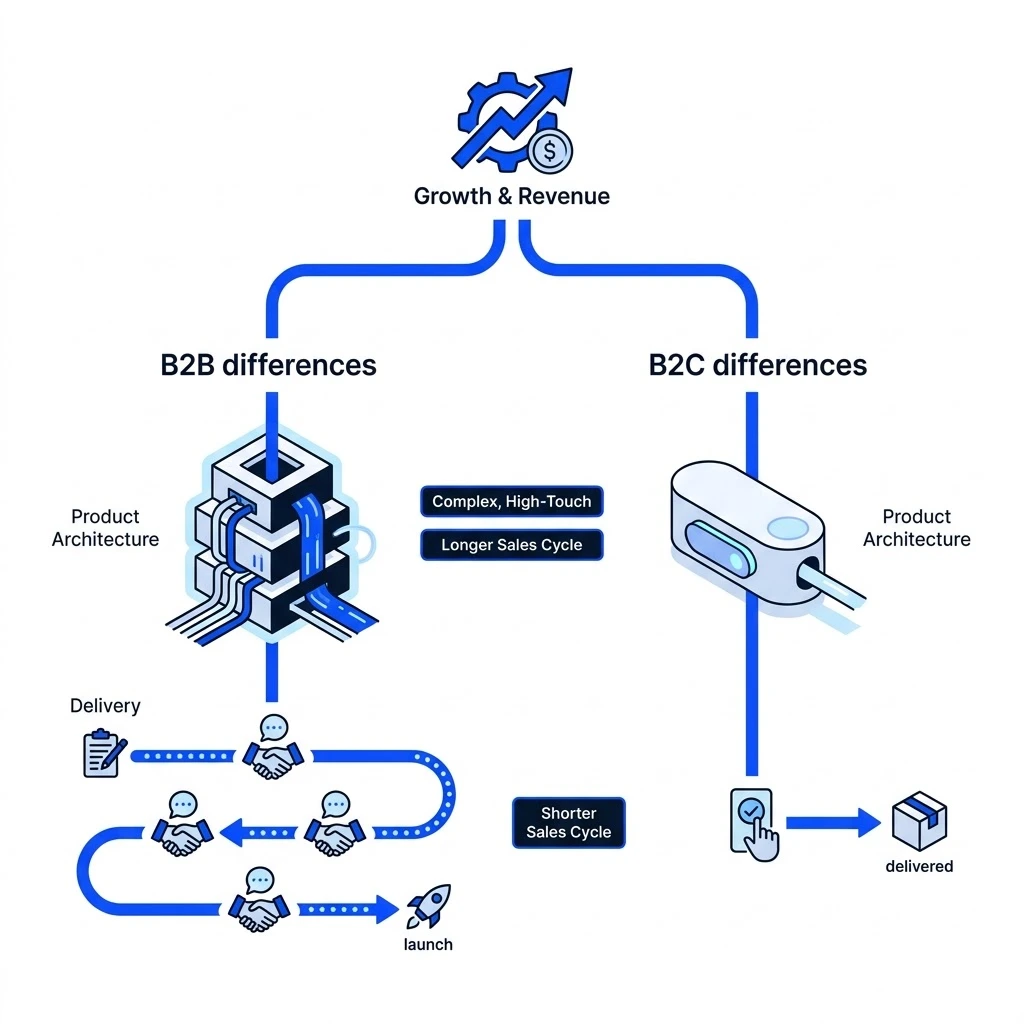
While the core principles of a go-to-market strategy remain similar, significant differences exist between B2B and B2C approaches. These distinctions arise from unique customer behaviors and distinct buying processes. Understanding these differences is crucial for tailoring your go-to-market strategy for maximum impact.
B2B go-to-market strategies typically prioritize demonstrating a clear return on investment and long-term value. They often involve navigating complex procurement cycles with multiple stakeholders and decision-makers, frequently utilizing specialized work-community platforms. In contrast, B2C strategies focus more on emotional connection, lifestyle alignment, and simplicity. These approaches typically involve transactional, single-decision-maker workflows.
| Strategic Dimension | Business-to-Business (B2B) | Business-to-Consumer (B2C) |
|---|---|---|
| Primary Focus | ROI and long-term outcomes | Emotional connection and lifestyle |
| Decision Makers | Multiple stakeholders and committees | Single decision-maker |
| Sales Cycle | Extended and complex procurement | Short and transactional |
| Distribution Channels | Direct sales and partner networks | E-commerce and retail |
Top-performing companies complete product go-to-market launches with an average success rate of 76%, as reported in PDMA Global Best Practices Research. This contrasts sharply with peer firms using ad-hoc frameworks, which achieve success rates of only 51%. A well-defined go-to-market plan ensures your product resonates with the correct audience through the most effective channels. For instance, a b2b saas go to market strategy might leverage content marketing and direct sales outreach. A B2C consumer good, however, often relies on social media campaigns and rapid customer acquisition tactics.
It is essential to distinguish a go-to-market (GTM) strategy from a marketing plan and a business plan. Each document serves a unique role in an organization’s strategic architecture. Understanding these differences ensures clarity and effective execution.
A GTM strategy acts as a detailed operational blueprint. It guides the launch of a specific product or service into a defined market. This strategy integrates crucial elements like product-market fit, pricing, sales enablement, distribution channels, and customer success initiatives. Its primary focus is tactical and execution-driven, aiming for successful market entry and initial growth.
A marketing plan is a focused component within the broader GTM strategy. It concentrates on promotional activities and lead generation efforts. While a business plan outlines long-term vision, purpose, and funding, a GTM strategy unifies product-market fit, pricing, sales enablement, and customer success. The marketing plan details how to communicate value and attract customers.

A business plan provides the overarching strategic foundation for the entire organization. It defines the company’s long-term vision, core purpose, financial projections, and funding requirements. This document guides overall business direction and is critical for securing investment. It sets the context within which both GTM and marketing plans operate.
| Feature | Go-to-Market Strategy | Marketing Plan | Business Plan |
|---|---|---|---|
| Primary Focus | Product launch and market entry | Promotion, lead generation, brand awareness | Overall company vision, funding, long-term goals |
| Scope | Product, price, place, promotion, sales, success | Marketing channels, campaigns, messaging | Entire business operations, financials, strategy |
| Timeline | Specific launch and initial growth period | Ongoing, often quarterly or annual cycles | Long-term (3-5+ years) |
| Objective | Achieve market penetration and initial revenue | Generate leads, build brand, drive sales | Secure funding, guide strategic direction |
| Target Audience | Specific customer segments for a product/service | Broader market or specific customer segments | Investors, lenders, internal stakeholders |
| Relationship | Overarching launch blueprint | Component of GTM strategy | Strategic foundation for all plans |
Artificial intelligence and automation are transforming how businesses approach go-to-market strategies. These technologies offer powerful tools to enhance efficiency, personalize customer interactions, and drive revenue growth. Embracing AI means moving beyond traditional methods to create more agile and data-driven market entry plans.
Marketing and sales functions report the largest revenue impact from generative AI adoption across business operations. Revenue teams capture tangible productivity gains when generative AI is embedded directly into customer acquisition workflows. This shift helps organizations close the gap between strategic intent and actual deployment.
Data from the Salesforce State of Sales report shows that 87% of sales organizations use AI across the customer lifecycle. Furthermore, 54% of sales teams have already worked with AI agents to streamline daily operations. This integration automates routine tasks, surfaces instant account insights, and scales personalized customer engagement. Teams leveraging these automated agents see faster pipeline velocity and higher conversion rates.
Even with a well-crafted plan, GTM strategies can falter. Recognizing common failure modes allows businesses to proactively mitigate risks and improve their chances of success. A successful launch requires careful navigation around potential missteps.
Common pitfalls often stem from incomplete planning or misjudging market dynamics. These issues can derail even the most promising products.
To mitigate these risks, ensure thorough market validation before launch. Clearly define your ideal customer profile and tailor your value proposition to their specific pain points. Select channels that align with customer behavior and purchasing habits. Realistic budgeting and resource allocation are crucial for sustained execution. Actively solicit and incorporate customer feedback to refine your product and strategy. Foster strong collaboration between all departments involved in the launch. Setting achievable sales targets based on market data will also contribute to a more successful outcome.
Real-world examples illustrate how different go-to-market strategies can lead to market success. Analyzing these cases provides practical insights for developing your own plan. Success benchmarks offer quantifiable targets for your GTM efforts.
Consider a SaaS founder automation software case study. An early-stage team scaled past initial hurdles through targeted outbound motions. Another scenario involves an office supply retail bundle. This strategy successfully utilized channel partner networks. SaaS median time to reach active subscriber milestones typically hovers within predictable windows. According to the ChartMogul Go-To-Market Report, top-performing B2B software companies reach 1,000 active subscribers in a median of 11 months. Typical organizations take two years.
Top-performing companies complete product launches with a 76% success rate. This contrasts with 51% for firms using ad-hoc frameworks. These figures highlight the measurable advantage of structured processes. The Europe marketing automation software market exemplifies regional growth. It was valued at $2.4 billion in 2025. Projections show it reaching $8.1 billion by 2034. This growth, at a 14.45% CAGR, underscores market potential for well-executed GTM strategies.
A comprehensive go-to-market strategy typically includes several core elements. These are market research to understand the landscape, defining your target audience, crafting a clear value proposition, establishing a pricing model, selecting sales channels, developing marketing and communication plans, planning launch operations, and setting success metrics.
A go-to-market (GTM) strategy serves as the overarching blueprint for launching a product or entering a new market. It encompasses product, price, sales, and distribution decisions. A marketing plan, conversely, is a subset of the GTM strategy. It focuses specifically on promotional activities, communication tactics, and lead generation efforts to reach the target audience.
The timeline for developing and implementing a GTM strategy can vary significantly. For B2B technology companies, average planning cycles run about 4.2 months. Research indicates that planning cycles extending beyond six months are associated with a 14 percent lower revenue achievement. This highlights the importance of efficient planning.
To gauge the effectiveness of your go-to-market strategy, track key performance indicators (KPIs). These include customer acquisition cost (CAC), conversion rates across the funnel, sales cycle duration, customer lifetime value (CLTV), market share growth, and overall revenue achievement against set targets.
Expanding internationally requires careful adaptation of your GTM strategy. You must account for local market nuances, including cultural differences, specific regulatory requirements, language barriers, distinct competitive landscapes, and preferred sales and distribution channels. Understanding these regional variations is crucial for success.
Get expert guidance on your go-to-market strategy
Plan Launch


Error: Contact form not found.
