
What Is AI Transformation? What Changes Beyond AI Tools
September 21, 2026 See more
SEO is more than just a tool for driving immediate sales; it’s a strategic approach to building lasting relationships, establishing your brand’s authority, and positioning your products as logical solutions. This is where understanding the customer journey and aligning your content strategy becomes crucial.
In this blog, we’ll delve into the concepts of the TOFU-MOFU-BOFU strategy for SEO and explore how to integrate them for optimal results.
A sale funnel is a visual representation of the customer’s journey from the moment they become aware of your product or service until they make a purchase.
It’s called a “funnel” because it illustrates how potential customers gradually narrow down through the stages, with many starting at the top but only a few converting at the bottom.

SEO plays a critical role in supporting each stage of the sales funnel by driving relevant traffic that matches the intent of users based on where they are on their buyer journey.
Now, what’s the significance of TOFU, MOFU, and BOFU in all of this?
The TOFU-MOFU-BOFU model provides a valuable roadmap for crafting compelling content that approaches potential customers at each stage, from initial awareness to final purchase.
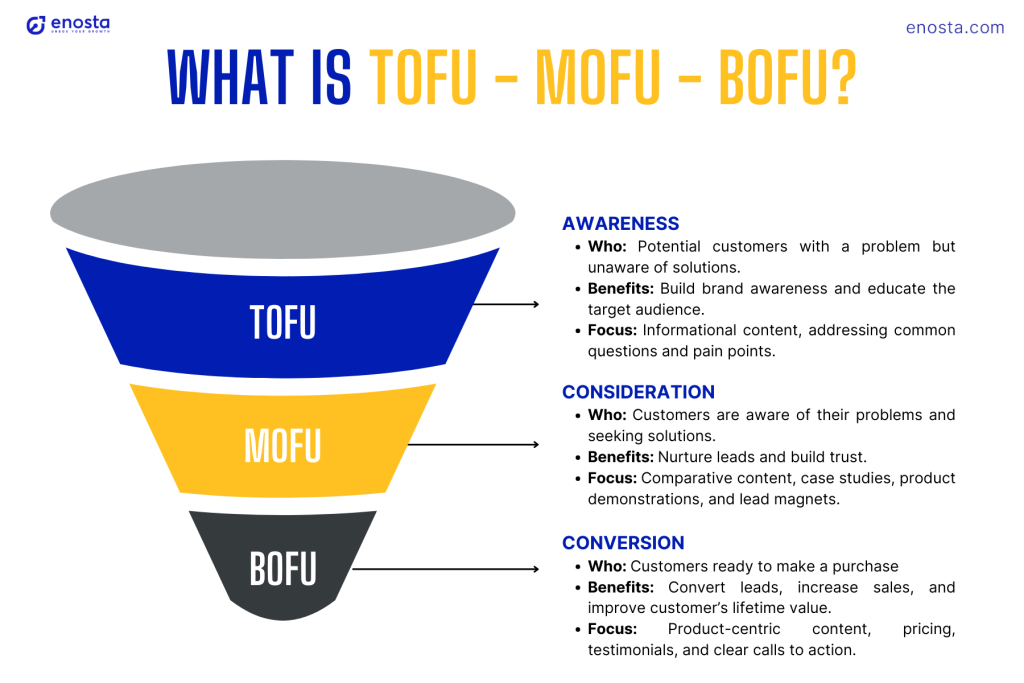
At TOFU, potential customers are just discovering a problem or need. The goal is to attract a broad audience and introduce them to your brand.
At the MOFU stage, customers are aware of the problem and are actively seeking and evaluating solutions. SEO here focuses on more specific, intent-driven keywords:
At the BOFU stage, potential customers are ready to make a purchase decision. SEO should target highly specific, intent-heavy keywords. Ensure that your site is mobile-friendly, loads quickly, and provides a seamless user experience to avoid drop-offs during the decision-making process.
To effectively capture and guide users through each stage of the funnel, it’s important to align your SEO strategy with the different types of keywords based on search intent:
Informational Keywords
These keywords are used by users seeking information or answers to general questions. They are typically at the top of the funnel (TOFU), where the goal is to build awareness.
Navigational Keywords
They reflect a user’s intent to find a specific website, brand, or page. Users might be aware of a brand and are now looking for its particular resources.
Commercial Keywords
Users are researching and comparing options in the middle of the funnel (MOFU). They intend to purchase but are still exploring different products or solutions.
Transactional Keywords
These keywords indicate high purchase intent. Users are at the bottom of the funnel (BOFU), ready to buy, and are searching for specific products, services, or solutions.

To optimize your content for each stage of the funnel, align your keywords and content types accordingly:

By understanding the customer journey and aligning your content strategy with the TOFU, MOFU, and BOFU stages, you can create a powerful SEO foundation.
At Enosta, we don’t just do SEO; we engineer it for maximum impact.
Our tailored strategies are designed to skyrocket your visibility, captivate your audience, and convert leads into loyal customers. Whether you’re a small business or a large enterprise, we have the expertise to unlock your website’s full potential.
Contact us today to start building a winning SEO strategy tailored to your business needs!


Error: Contact form not found.
