
What Is AI Transformation? What Changes Beyond AI Tools
September 21, 2026 See more
Knowledge with topic Seo For Web Developers bridges the gap between clean code and high search visibility by focusing on crawlability, rendering strategies, and Core Web Vitals. This guide helps frontend engineers and full-stack programmers optimize single-page applications, manage server-side rendering, and implement schema markup without sacrificing user experience. You will learn how to audit your web development workflow, fix indexability barriers, and partner effectively with an established seo service company to drive organic traffic. Mastering these technical pillars ensures your web applications load instantly, satisfy search bots, and rank consistently in competitive markets.
SEO is an engineering discipline for developers. It focuses on building fast, accessible, and crawlable architectures. Your role is to remove technical roadblocks for search engine bots, ensuring your site is discoverable and indexable. This contrasts with marketer responsibilities, which focus on content and external authority.
Developers are responsible for server responses, crawler mechanisms, and code structure. Performance metrics and rendering strategies also dictate how efficiently search bots parse web applications. Marketers handle keyword strategy, copywriting, and off-page optimization.
| Responsibility Area | Developer Role | Marketer Role |
|---|---|---|
| Core Architecture | Rendering strategies, asset delivery, server response times | Keyword research, content strategy, user intent alignment |
| Code & Markup | Semantic HTML, schema implementation, clean routing | Copywriting, meta descriptions, on-page content optimization |
| Performance | Core Web Vitals, caching policies, bundle optimization | Conversion rate optimization, campaign tracking, UX copy |
| Crawlability | Robots.txt, XML sitemaps, canonical tags, HTTPS setup | Link building, off-page brand authority, referral traffic |
According to Shno analysis, only 55.7% of all web origins globally pass all three Core Web Vitals performance thresholds. Mobile pass rates lag further behind desktop performance at 49.7%.
This highlights the technical challenge developers face in optimizing site performance and code structure for search engines.
While Google dominates the primary search market, developers should still account for crawler mechanisms across secondary search engines during testing.
For expert guidance on boosting your online presence, consider partnering with an experienced seo service company.
A robust technical foundation is essential for search engines to discover, crawl, and index your website effectively. This involves optimizing site architecture, indexability, and managing crawler interactions. These technical layers ensure your digital assets are accessible and interpretable by automated search bots.
Search engine bots navigate your site by following links across a connected graph. A flat architecture, where any important page is reachable within three clicks from the homepage, is crucial for efficient crawling and link equity distribution. Strong internal linking strategies prevent orphan pages and ensure optimal indexability for developers.
href attributes for navigation. This helps search bots understand the contextual relationship of linked pages.robots.txt file to guide bots away from non-public areas, preventing wasted crawl budget.
Clean, descriptive URLs help users and search engines understand page context. Using lowercase slugs with hyphens makes URLs readable and consistent. Monitoring HTTP status codes is vital for a smooth user experience and efficient crawl budget management. According to Web growth insights, Google commands approximately 92% market share for online search worldwide, making Googlebot compatibility a primary technical target.
| HTTP Status Code | Technical Meaning | SEO Impact & Developer Action |
|---|---|---|
| 200 OK | Successful request | Normal indexing and rendering of the requested resource. |
| 301 Moved Permanently | Permanent redirect | Passes up to 99 percent of link equity to the new target URL. |
| 404 Not Found | Resource missing | Wastes crawl budget if encountered frequently via internal links. |
| 500 Internal Server Error | Server failure | Prevents crawling; repeated errors cause search bots to drop pages from the index. |
Modern JavaScript frameworks offer powerful development capabilities but introduce unique challenges for search engine optimization. Client-side rendering can delay or prevent search bots from indexing content. Server-side rendering and static generation deliver pre-rendered HTML, ensuring immediate accessibility for crawlers. This is crucial for both traditional search engine visibility and modern search architectures.
Client-side rendering relies on the browser to execute scripts and build the page’s content. This process can be resource-intensive for search engine crawlers. While Googlebot has improved its JavaScript rendering capabilities, it is not always immediate or complete. This can lead to indexing delays or empty search results for bots that fail to execute code correctly. For developers, this means critical content might not be available to users searching for it.
Server-side rendering and static generation address client-side limitations by delivering fully formed HTML to the browser and crawlers. With server-side rendering, the server generates the HTML for each incoming request. Static generation pre-renders all pages at build time, creating static files. Both methods ensure search engines receive indexable content instantly. This is a significant advantage as search engines integrate advanced parsing for deeper content understanding.
// Example: Next.js Server-Side Rendering configuration
export async function getServerSideProps(context) {
const res = await fetch(`https://api.example.com/data`);
const data = await res.json();

return {
props: { data }, // Passed to the page component as props
};
}
These techniques are vital for ensuring your application is discoverable. According to Web growth insights, Google commands approximately 92% market share for online search worldwide, making crawler compatibility a primary technical target. While Microsoft’s Bing accounts for a smaller 6% globally, optimizing for major search bots generally benefits all engines.
Different JavaScript frameworks handle rendering strategies in distinct ways. Choosing the right tool depends on your data freshness requirements, infrastructure budget, and indexing goals.
| Framework / Tool | Primary Rendering Modes | Best Use Case | SEO Impact |
|---|---|---|---|
| Next.js (React) | SSR, SSG, ISR, CSR | Dynamic web apps, e-commerce, and enterprise sites | Excellent when configured with SSR or ISR |
| Nuxt (Vue) | SSR, SSG, CSR | Content-heavy applications and marketing sites | High crawler readability out of the box |
| Vanilla React / Vue | CSR (typically) | Single-page apps behind authentication | Requires careful setup or dynamic rendering for full indexing |
| WordPress | SSR (PHP-driven) | Content publishing, blogs, and corporate sites | Native HTML delivery supports strong search indexing |
When should a developer implement server-side rendering versus static generation? Static generation is ideal for content that rarely changes, such as marketing pages or blog posts. It offers maximum speed and performance. Server-side rendering is better suited for dynamic pages requiring real-time data or personalization on each request. For sites built with frameworks like Next.js or Nuxt for Vue, developers can also explore incremental static regeneration for a hybrid approach. This allows static generation with periodic updates without requiring a full site rebuild.
Even with server-side rendering or static generation, developers can encounter hidden technical issues. Hydration errors occur when the client-side JavaScript does not match the server-rendered HTML. This can break page interactivity or cause unexpected layout shifts. Developers must ensure their JavaScript logic correctly aligns with the server-rendered output. Additionally, managing dynamic rendering for specific bots versus user agents adds operational complexity. Careful configuration and testing are essential for a seamless user and crawler experience.
Page performance directly impacts search engine rankings and user retention. Google’s Core Web Vitals (CWV) provide key metrics for evaluating loading speed, interactivity, and visual stability. Addressing these can significantly improve a website’s technical SEO.
Core Web Vitals are essential for a positive user experience and are considered a ranking factor. Developers must optimize for three primary metrics: Largest Contentful Paint (LCP), Interaction to Next Paint (INP), and Cumulative Layout Shift (CLS).
Improving page speed offers tangible business benefits. Optimizing Largest Contentful Paint by 31% resulted in an 8% increase in sales conversions on key commercial pages, highlighting a direct link between performance and revenue. To achieve these gains, developers should focus on several key areas.
Compressing assets using Brotli or Gzip reduces file sizes for faster delivery. Utilizing modern image formats like WebP and AVIF further optimizes image loading times. Implementing lazy-loading for offscreen media ensures that only necessary assets are loaded initially. Setting explicit dimensions for images and other dynamic content elements prevents jarring layout shifts as the page renders. These technical optimizations are vital for both user satisfaction and search engine visibility.

Structured data helps search engines understand your content’s context. Using Schema.org vocabulary in JSON-LD format enables rich results and improves visibility. This is crucial for developers aiming to enhance search engine understanding and user experience.
Implementing Schema.org markup in JSON-LD format provides explicit signals to search engines. You can define entities like articles, products, or FAQs. This approach not only aids traditional search engines but also assists generative AI models in extracting information. For instance, marking up a technical article with the TechArticle type helps search engines understand its specific nature.
<script type="application/ld+json">
{
"@context": "https://schema.org",
"@type": "TechArticle",
"headline": "SEO for Web Developers",
"author": {
"@type": "Person",
"name": "Amit Kothari"
},
"datePublished": "2026-01-01"
}
</script>
This structured approach is vital for developers. It ensures that search engine crawlers, which operate across dominant engines like Google webgrowth.co.uk/blog/, can accurately interpret your site’s content. This accurate interpretation can lead to better indexing and improved search rankings.
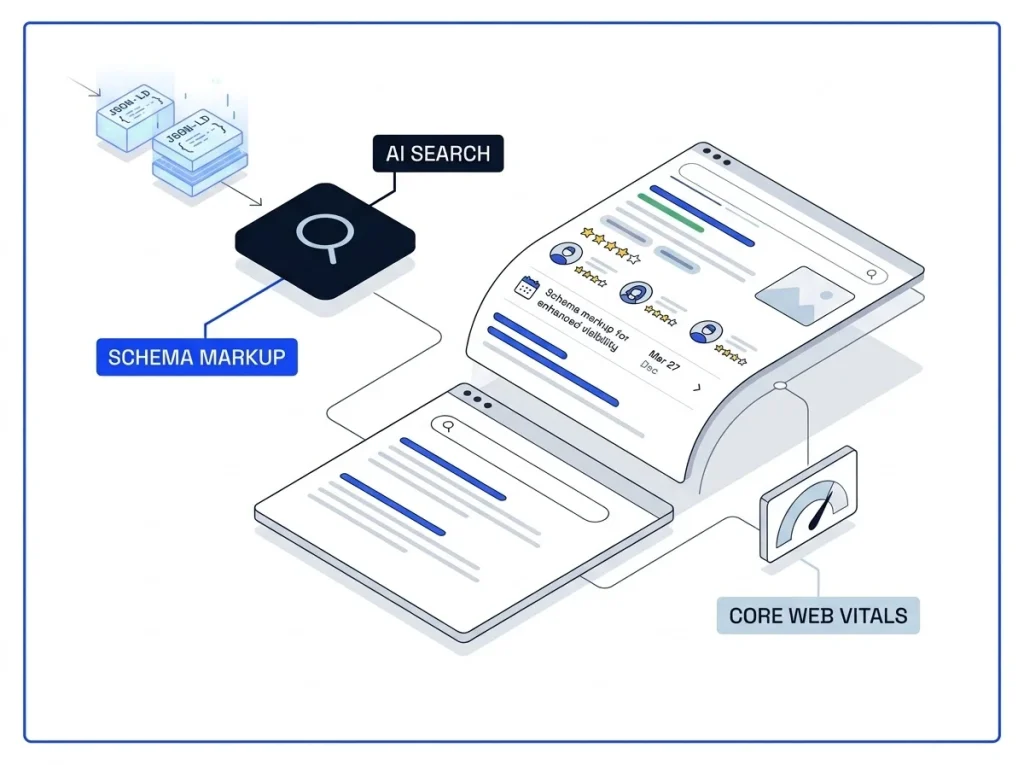
AI search engines heavily rely on structured data to isolate key information. Prioritizing concise, extractable answers above the fold is crucial for AI search citations. Developers should ensure critical information is easily accessible and clearly defined. This makes content more likely to be featured in AI generated answers, driving qualified traffic.
Using breadcrumb schema alongside your main content gives AI models and search bots a clear map of your site hierarchy. This extra context prevents misinterpretation on deep subpages and improves user navigation. Our seo service company profile page helps businesses implement these robust structured content systems effectively.
JSON-LD is a lightweight data-interchange format. It is recommended by search engines for implementing structured data because it is easy for developers to parse, allowing for clean separation of data from HTML.
Schema markup itself does not directly impact performance metrics. However, implementing it efficiently within JSON-LD scripts ensures scripts do not block rendering or negatively affect page load times. Developers must place these scripts correctly in the document head or load them asynchronously if needed.
Yes, schema markup supports international SEO through properties like language tags and regional offers. While standard tags handle regional routing, schema provides additional context about the intended audience and local availability.
Integrating technical SEO checks directly into your development workflow prevents issues before they reach production. This approach transforms SEO from a post-launch task into a continuous development standard. It ensures that search engine optimization is a built-in feature, not an add-on.
Automating SEO tasks within your Continuous Integration/Continuous Deployment (CI/CD) pipeline catches errors early. This process minimizes costly rework and ensures consistent optimization. It allows your team to maintain high SEO standards with every deployment.
alt attributes on images or an improper heading hierarchy.The consequences of neglecting technical SEO can be severe. For instance, 3,117 website accessibility lawsuits were filed in U.S. federal courts in 2025, a significant increase. While not strictly SEO, these legal actions highlight the importance of structured code compliance. Developers must ensure their code adheres to standards that benefit both users and search engines. Furthermore, optimizing Largest Contentful Paint (LCP) by 31% led to an 8% increase in sales conversions on key commercial pages. This demonstrates a direct link between technical performance, which developers control, and business outcomes. Automating these checks in your CI/CD pipeline helps achieve both compliance and performance.
Single-page applications often fail to rank because they rely entirely on client-side JavaScript execution. When crawler script execution limitations prevent bots from running heavy frontend code, they encounter empty page views and unstructured DOM shells. Developers must adopt modern rendering patterns to solve these indexing blockers.
Monitoring server responses is vital for crawl budget protection and link equity preservation. Returning the correct code guides search bots efficiently through your site architecture.
| Status Code | SEO Impact and Developer Action |
|---|---|
| 200 OK | Confirms successful indexing and tells crawlers the resource is ready to read. |
| 301 Moved Permanently | Redirects users and passes valuable link equity to the new destination URL. |
| 302 Found | Signals a temporary routing change, instructing crawlers to keep checking the original URL. |
| 404 Not Found | Tells engines to remove dead links and stop wasting crawl budget on missing content. |
Choosing the right rendering method depends on how frequently your data changes and how much personalization the page requires.
Technical SEO forms the bedrock of effective search engine optimization. By ensuring your website is fast, semantically structured, and accessible, you empower both traditional search engines and modern AI systems to accurately interpret your content. Implementing these core principles from the initial development stages secures lasting visibility across all search channels.
As Amit Kothari, CTO at Enosta, often reminds our engineering teams, developer-driven performance is no longer optional. According to HTTP Archive / CrUX statistics, nearly half of all web origins fail essential performance thresholds, leaving massive conversion upside for teams that master technical execution.
To bridge the division of labor between technical SEO and content SEO, your team should align around several core delivery pillars. The following framework summarizes how backend and frontend decisions influence overall search success.
| Optimization Pillar | Developer Responsibility | Search Impact |
|---|---|---|
| Crawlability & Indexing | Configure robots.txt, XML sitemaps, and server responses | Ensures search bots discover and render pages efficiently. |
| Core Web Vitals | Optimize Largest Contentful Paint, Interaction to Next Paint, and Cumulative Layout Shift | Directly satisfies Google page experience ranking signals. |
| Architecture & Assets | Build flat navigation, clean internal linking, and use WebP/AVIF with Brotli compression | Accelerates load speeds and preserves link equity. |
For context, HTTP Archive / CrUX, 2025 reports 55.7%. Global origins passing all three Core Web Vitals thresholds
Continuous monitoring via Google Search Console ensures your site architecture remains robust long after initial deployment. When development teams treat performance and indexability as core code requirements rather than post-launch fixes, organic traffic scales reliably.
Let our engineering experts audit and optimize your web architecture for peak performance.
Talk to us


Error: Contact form not found.
