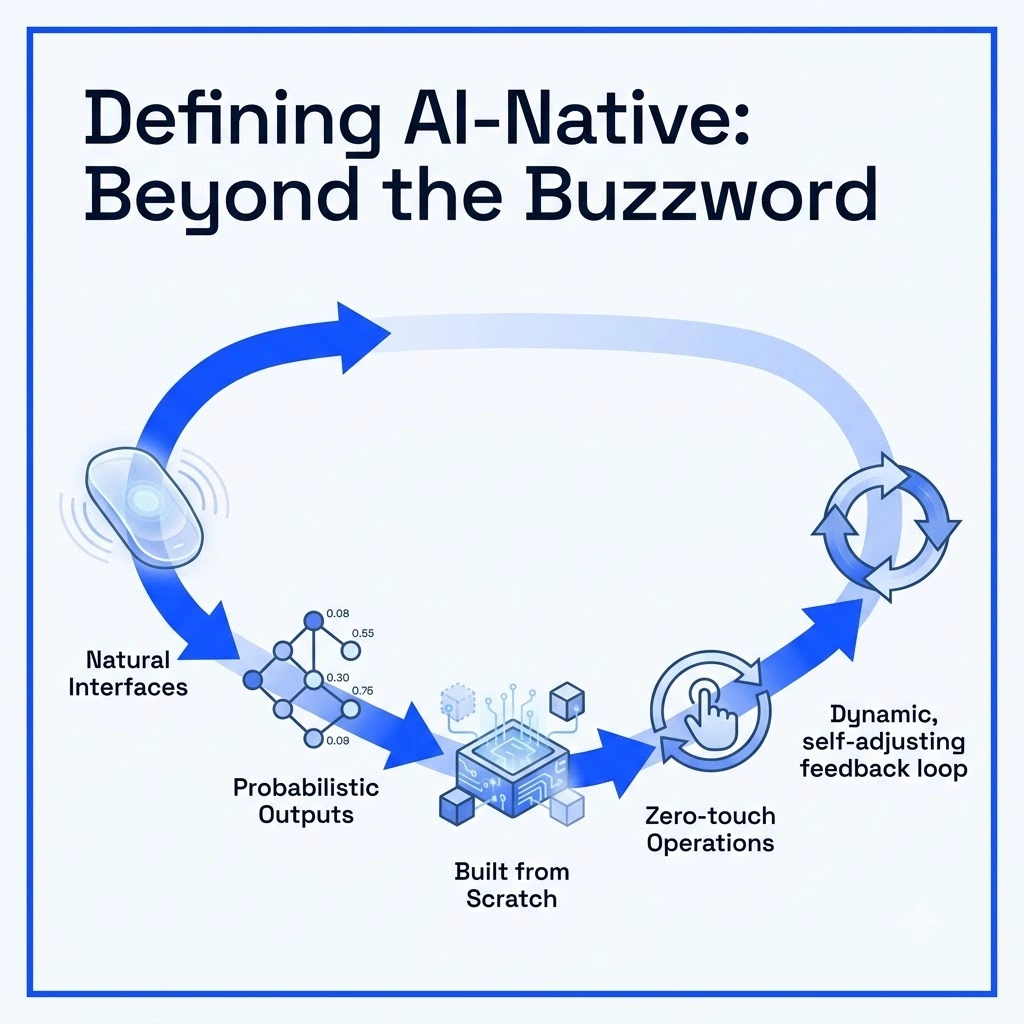
AI-native software is designed around machine learning, autonomous agents, and data-centric engineering from the outset, rather than adding AI to a legacy product later. For business and product leaders, this approach can improve scalability, decision-making, and delivery speed, but it also changes how teams plan architecture, data, security, governance, and operating costs. This guide explains what AI-native means, how it differs from conventional software, which platform and pricing factors matter, and the practical steps needed to evaluate risks and build an AI-native solution for real business operations.Defining AI-Native: Beyond the BuzzwordAI-native describes systems designed from the ground up with artificial intelligence as their foundational architectural core. This means intelligence is not a bolted-on feature, but is embedded across data pipelines, operations, and natural interfaces from inception. According to IBM analysis, AI-native systems use artificial intelligence to shape architecture, decision-making, user experience, and lifecycle management from the outset.
A primary diagnostic for identifying true AI-native solutions is the remove the AI test. According to CRV founder guidance, an AI-native product stops working entirely without its AI, whereas AI-enabled software merely degrades or loses secondary features. This structural distinction separates deterministic legacy logic from probabilistic intelligence layers.
To understand how these platforms operate, consider the underlying technical characteristics that differentiate them from traditional applications:
- Built from scratch: Intelligence is embedded across data pipelines, operations, and interfaces rather than retrofitted.
- Continuous adaptation: Systems use machine learning and agentic workflows to learn from interactions and improve over time.
- Natural interfaces: Users interact via conversational prompts and autonomous agent loops rather than rigid menus and dashboards.
- Probabilistic outputs: Core logic relies on neural orchestration layers and multi-agent workflows instead of static rules.
- Zero-touch operations: Infrastructure relies on proactive monitoring and automated decision-making rather than manual oversight.
The global AI-native SMB financial operating system market exemplifies this architectural shift. Market research indicates the sector reached $4.1 billion in valuation.
AI-Native vs. Other AI Integration Approaches
Understanding the spectrum of AI integration is crucial for business and product leaders. The terms AI-enabled, embedded AI, and AI-native often cause confusion. Differentiating these approaches helps in accurately assessing technology and planning strategic roadmaps.
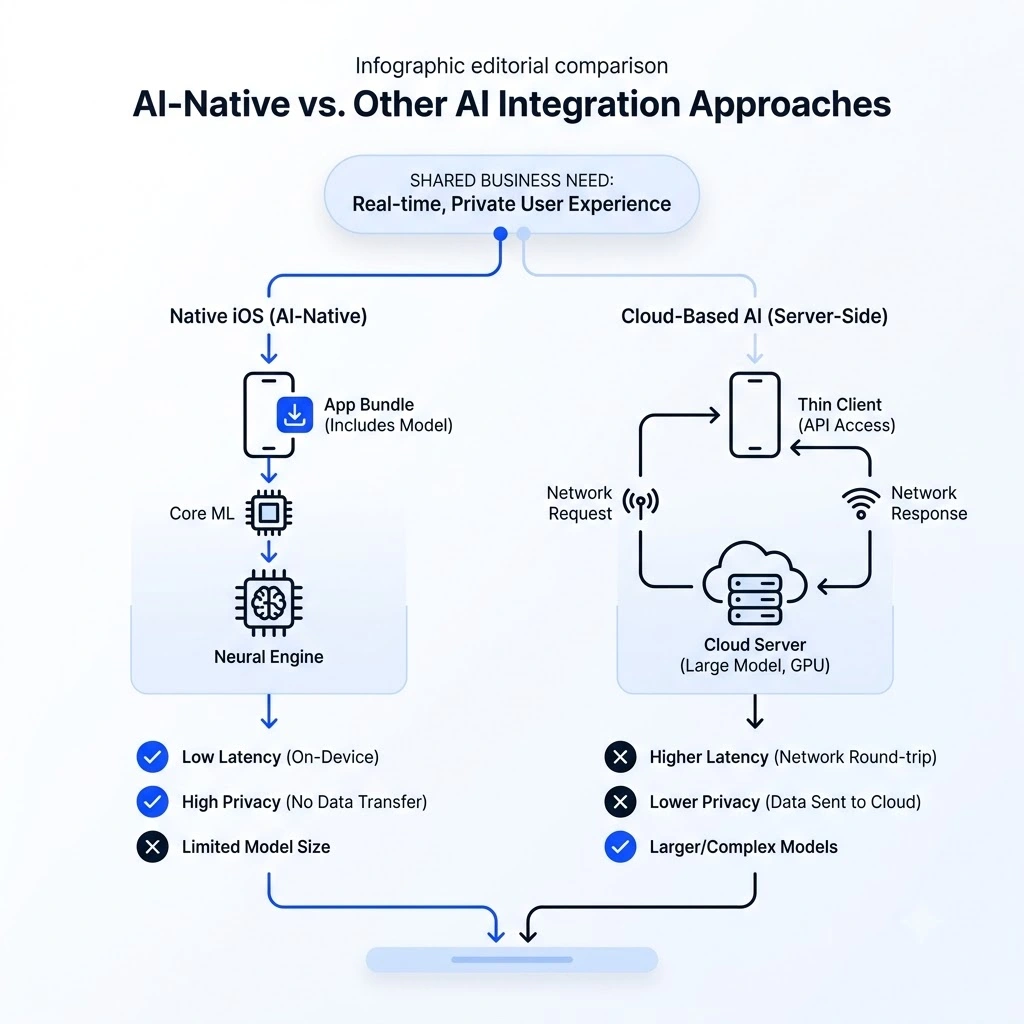
The core difference lies in how AI is fundamental to the system’s design and operation. AI-enabled systems are traditional platforms enhanced with AI tools. Embedded AI integrates AI into specific features. AI-native systems, however, are built from the ground up with AI as their central intelligence.
| Approach | Definition | Integration Level | Operational Impact | Example |
|---|---|---|---|---|
| AI-Enabled | Traditional systems with external AI tools or basic chatbots added on. | Isolated modules or side panels. | Requires users to seek out functionality; offers quick wins without major overhaul. | A legacy banking website with a basic customer service chatbot. |
| Embedded AI | Specific features or modules driven by AI within a standard product. | Embedded into specific features. | Improves targeted user experiences or automates specific workflows. | Product recommendations inside an e-commerce app. |
| AI-Native | Entirely dependent on AI for its core logic, value proposition, and operations. | Embedded across the core workflow. | Continuously assists and automates tasks; enables maximum adaptability and competitive advantage. | Autonomous driving platforms or real-time AI enterprise resource systems. |
This distinction is critical for business leaders. It helps discern genuine platform innovation from marketing hype. Choosing the right approach avoids costly technical debt and ensures a strong return on investment. For instance, customers using AI-native security awareness training see a dramatic drop in phishing susceptibility, from 33.1% to 4.1% within a year. This demonstrates the profound impact of a truly integrated AI system.
In contrast, traditional SaaS companies differentiate themselves with AI features, but AI-native businesses are fundamentally built around intelligence. Companies that are AI-differentiated grow significantly faster, especially in their early stages. In the $1 million to $5 million ARR bracket, these companies grow 70% faster than their traditional SaaS peers. This rapid scaling highlights the inherent advantage of an AI-native architecture.
Core Characteristics of AI-Native Systems
AI-native systems are built fundamentally differently from traditional software. Their core architecture is intelligence-driven. This approach allows for unique capabilities and a distinct operational model.
Built from scratch
AI-native systems embed intelligence at their foundation. This means AI is integral to data pipelines, operational processes, and user interfaces from inception. It is not an afterthought or a feature bolted onto existing infrastructure. This born-AI approach ensures that the entire system is optimized for intelligent operations.
Continuous adaptation
These systems employ machine learning models and autonomous agent workflows. They continuously learn from user interactions and environmental changes. This allows them to adapt dynamically and improve performance over time. This inherent adaptability is a hallmark of AI-native design.
Natural interfaces
Interaction with AI-native systems often moves beyond traditional menus and dashboards. Users typically engage through conversational prompts, semantic search, or autonomous agent loops. This creates a more intuitive and fluid user experience. It allows for more complex tasks to be managed through natural language.
Zero-touch operations
AI-native platforms often feature automated remediation and self-designing infrastructure. Proactive monitoring minimizes the need for manual intervention. This leads to highly efficient and resilient operations. Many AI-native businesses scale rapidly due to this operational efficiency. For instance, SaaS Mag analysis highlights that AI-native businesses scale from zero to $100 million in ARR faster than any other cohort in cloud history.
| Dimension | Traditional Software | AI-Native System |
|---|---|---|
| Core Logic | Deterministic rule engines | Probabilistic machine learning |
| Interface | Static menus and dashboards | Natural language and agent loops |
| Data Usage | Stored in rigid relational schemas | Continuously fed into active pipelines |
| Adaptation | Manual updates and patches | Continuous self-learning workflows |
| Operation | Human-dependent maintenance | Zero-touch automated remediation |
As IBM analysis notes, these platforms use artificial intelligence to shape architecture and user experience from the outset. Companies seeking an ai native solution must evaluate whether their core infrastructure meets these modern demands.
Key Components of AI-Native Architecture
AI-native systems are built on a foundation of specialized architectural components. These elements are critical for enabling intelligence, adaptability, and continuous learning. They go far beyond traditional software structures.
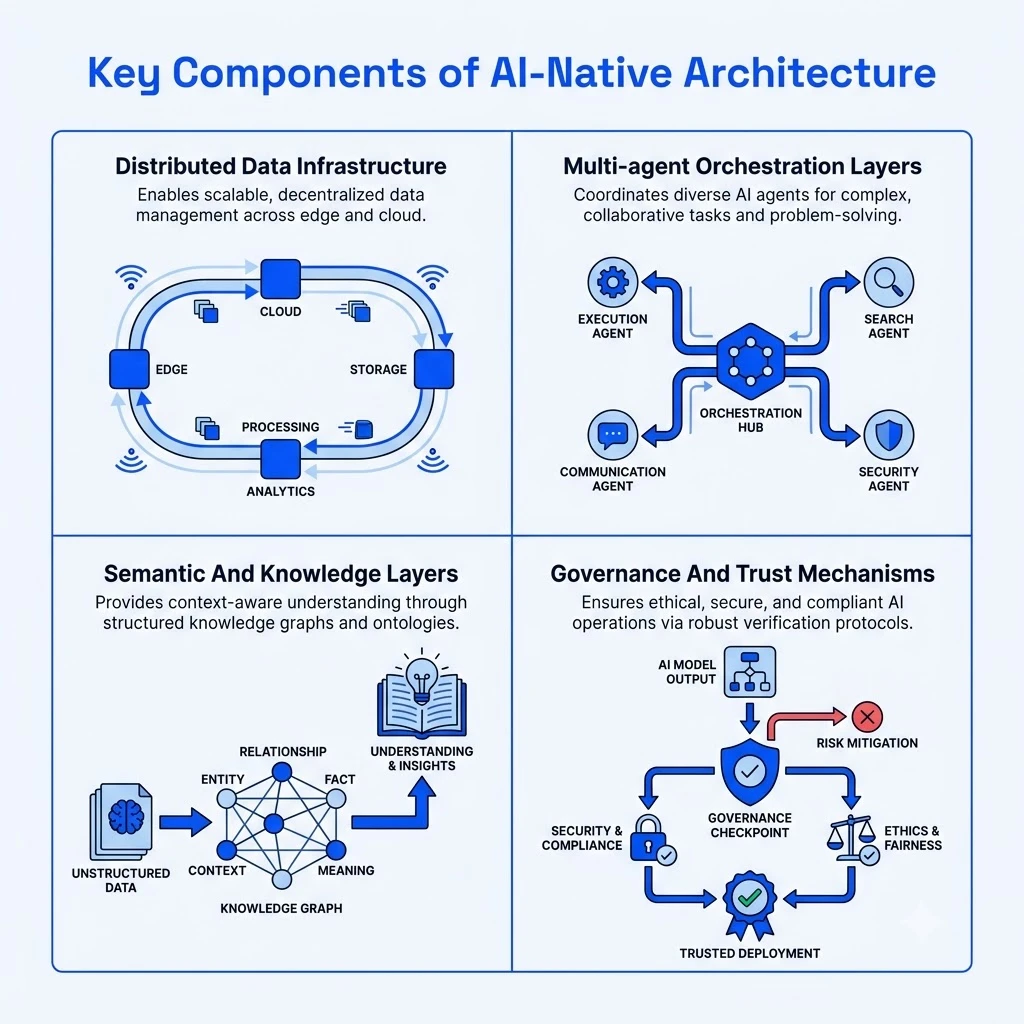
Distributed data infrastructure
A core requirement is a robust, distributed data infrastructure. This often involves real-time data meshes and sophisticated vector databases. These systems are designed to handle massive, continuous streams of information. They are essential for feeding data to AI models. Traditional relational databases often fall short for these demands. Vector databases, for instance, excel at storing and querying unstructured data. They enable semantic indexing, allowing AI to understand the meaning and context of data. This is crucial for advanced AI applications.
Multi-agent orchestration layers
AI-native systems often incorporate multi-agent orchestration layers. These layers allow specialized AI models to collaborate. They can delegate tasks and engage in complex reasoning. This enables the autonomous execution of multi-step business workflows. Instead of a single monolithic AI, these systems use a network of agents. Each agent might specialize in a particular function, like data analysis or natural language processing. They communicate and coordinate to achieve a larger objective. This distributed intelligence is key to handling complex, dynamic problems.
Semantic and knowledge layers
To prevent AI models from generating inaccurate or irrelevant information, semantic and knowledge layers are vital. These layers connect raw data pipelines with large language models to provide contextual grounding. They supply domain-specific facts and enforce enterprise-specific information retrieval. This mechanism is essential for hallucination prevention in production environments. By integrating knowledge graphs or ontologies, AI systems can access structured enterprise data. This structural linkage significantly enhances accuracy and operational reliability.
Governance and trust mechanisms
Implementing strong governance and trust mechanisms is essential for any AI-native deployment. These components are critical for managing data privacy and security. They also address potential vulnerabilities like prompt injection attacks. Ensuring ethical AI deployment is paramount. This includes mechanisms for transparency, fairness, and accountability. For example, according to KnowBe4 data, customers utilizing AI-native security awareness training average a Phish-Prone Percentage drop from 33.1% to 4.1% within 12 months. This demonstrates the practical impact of well-governed AI solutions.
Real-World Examples of AI-Native Platforms
Understanding AI-native concepts becomes clearer when examining real-world applications. These platforms are built from the ground up with artificial intelligence at their core, making them fundamentally different from traditional software. Their architecture, functionality, and user experience are intrinsically tied to machine learning models.
Perplexity AI exemplifies this by offering a search and research experience centered on conversational retrieval. It synthesizes information from multiple sources in real-time, moving beyond simple keyword matching and static indexes. Tesla Autopilot serves as another prime example of this paradigm. It relies entirely on neural networks trained on vast fleet data for critical navigation and safety decisions. Removing the AI layer would render the vehicle control system completely inoperable.
ThoughtSpot Analytics empowers users to query enterprise data warehouses using natural language rather than rigid SQL queries. After implementing this approach, Verivox achieved a 70% adoption rate across teams and successfully decommissioned legacy business intelligence tools. This operational shift demonstrates the tangible impact of AI-native software. As an AI-native delivery partner, Enosta focuses on building ai product development solutions that create real business value at scale. We integrate intelligence deeply into every stage of product lifecycles to ensure sustainable growth.
Business Benefits of an AI-Native Strategy
Adopting an AI-native strategy offers significant advantages that traditional approaches struggle to match. These businesses exhibit superior adaptability, with systems that automatically respond to evolving market dynamics and user behaviors. This inherent flexibility reduces the need for constant manual code updates.
Hyperautomation is another key benefit. Autonomous agents can manage routine and complex processes end-to-end. This frees human teams to focus on strategic innovation and higher-value tasks. Furthermore, AI-native systems deliver scalable intelligence. Their predictive accuracy and operational efficiency naturally improve as user volume and data inputs grow.
AI-native companies also demonstrate remarkable growth potential. They can scale from zero to $100 million in annual recurring revenue faster than any other cohort in cloud history. In the $1 million to $5 million ARR bracket, AI-differentiated companies grow 70% faster than their traditional SaaS peers. This rapid scaling is attracting significant investor attention. In 2025, AI startups accounted for 53% of all new unicorn births globally, underscoring the venture capital focus on this model. The global AI-native SMB financial operating system market exemplifies this growth, valued at $4.1 billion in 2025 and projected to reach $24.6 billion by 2034.

Common Challenges and Risks in AI-Native Development
Building AI-native systems presents significant hurdles. Technical complexity is a primary concern. Managing distributed vector databases, model latency, and the inherent probabilistic nature of AI outputs demands specialized engineering talent. Robust machine learning operations are essential for long-term success.
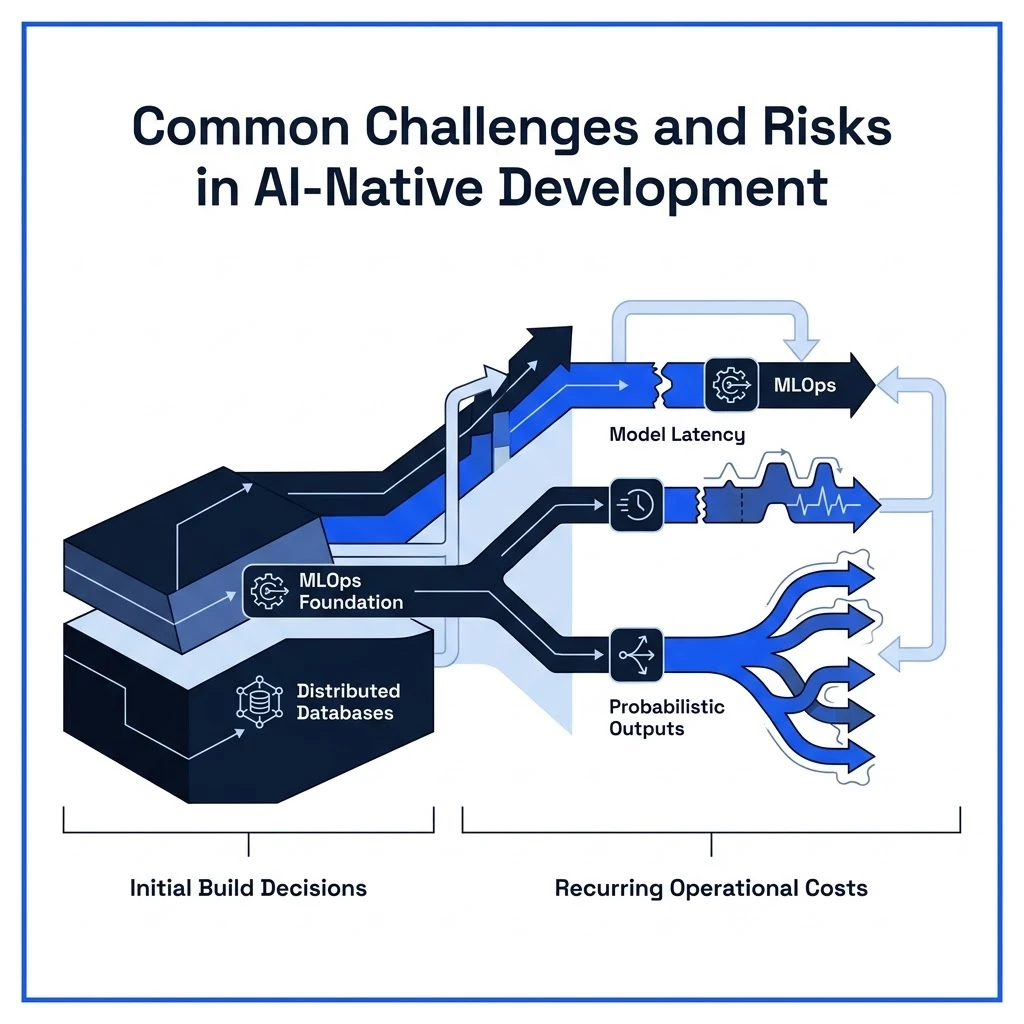
Infrastructure costs can also escalate rapidly without proper controls. The compute power required for continuous model training and real-time generation can strain budgets. According to Gartner projections, 20% of organizations will abandon certain AI deployments and revert to traditional methods by 2028 due to unsustainable cost structures. Careful resource governance is crucial to manage these expenses effectively.
Security and data privacy pose further risks that require proactive mitigation. Protecting against prompt injection attacks, ensuring compliance with data residency regulations, and maintaining secure model isolation demand rigorous governance protocols. These elements must be foundational requirements rather than afterthoughts.
Implementation hurdles and cultural resistance remain common barriers. According to arXiv research, AI projects exhibit failure rates of up to 80%. This failure rate is often driven by unclear strategies, poor integration planning, or internal resistance to an AI-first mindset.
Implementing an AI-Native Strategy: A Step-by-Step Roadmap
Transitioning to an AI-native approach requires a structured plan rather than ad-hoc feature additions. Building an AI-native platform typically spans 18 to 24 months, while initial operational results can emerge within 3 to 6 months. For mid-sized organizations, total investment ranges from $500,000 to $5 million depending on legacy complexity. This transformation requires careful planning across several distinct operational phases.
- 01Assess Current Architecture: Evaluate existing systems, data silos, and technical debt to identify modernization priorities and integration opportunities.
- 02Design Your AI-Native Blueprint: Define required data meshes, multi-agent orchestration frameworks, and model selection criteria for core business logic.
- 03Build Your Data Foundation: Cleanse enterprise data, implement vector storage, and establish semantic layers for accurate model grounding.
- 04Implement Multi-Agent Workflows: Start with narrow agentic loops for internal workflows before scaling to customer-facing autonomous applications.
- 05Enable Continuous Learning Loops: Establish telemetry and monitoring to track performance, capture user feedback, and refine system responses over time.
Organizations can choose between full legacy replacement and hybrid migration strategies. A hybrid approach allows teams to gradually integrate legacy data stores while introducing new orchestration layers. This balances rapid innovation with operational continuity.
According to McKinsey Global Survey findings, while 88% of organizations report regular AI use in at least one function, only about one-third have scaled AI beyond initial pilots into true production deployment. Following a structured roadmap helps bridge this execution gap. Support your development lifecycle with expert guidance through ai product development initiatives.
Frequently Asked Questions About AI-Native Technology
What is the difference between AI-native and AI-powered software?
AI-native software integrates intelligence directly into its foundational architecture, causing the system to cease functioning entirely if the AI layer is removed. AI-powered software merely attaches external AI features, such as basic chatbots, while its core logic runs on traditional codebases.
How long does it take to build an AI-native platform?
Building a production-ready AI-native platform typically requires 18 to 24 months of specialized development, though early proofs of concept often emerge within 3 to 6 months. Gartner projections on intelligent assistants highlight that successful implementations demand iterative testing, robust data pipelines, and continuous adaptation to match user behavior.
Do I need to replace all legacy systems to become AI-native?
Replacing every legacy database and application is rarely practical or cost-effective. Organizations often adopt a hybrid migration strategy, wrapping existing legacy systems with semantic layers while deploying autonomous agent loops for new workflows.
What are the key characteristics of AI-native systems?
- Built from scratch: Intelligence is embedded across data pipelines and operations rather than retrofitted.
- Continuous adaptation: Systems use machine learning models to learn from interactions and improve accuracy over time.
- Natural interfaces: Users interact via conversational prompts and intent-driven commands instead of rigid menus.
- Autonomous agent loops: Workflows execute multi-step tasks independently without constant human intervention.
Conclusion: Embracing the Future with AI-Native Innovation
The transition to AI-native represents a profound shift in how businesses operate and build software. By embedding intelligence at the core of their architecture, organizations move far beyond simple AI-enabled or AI-enhanced tools. This foundational approach unlocks scalable intelligence essential for future growth through a shift from traditional software to autonomous agent workflows and data-centric engineering.
While the journey presents challenges, a clear strategy is crucial for success across diverse use cases. According to the Gartner 2026 CIO Agenda, 87% of surveyed CIOs plan to increase AI budgets, yet many digital initiatives still fall short of business targets. Embracing AI-native principles helps organizations navigate these complexities and secure a lasting competitive edge.